

Factories reopened in June, but weak global demand continues to hurt

Singapore
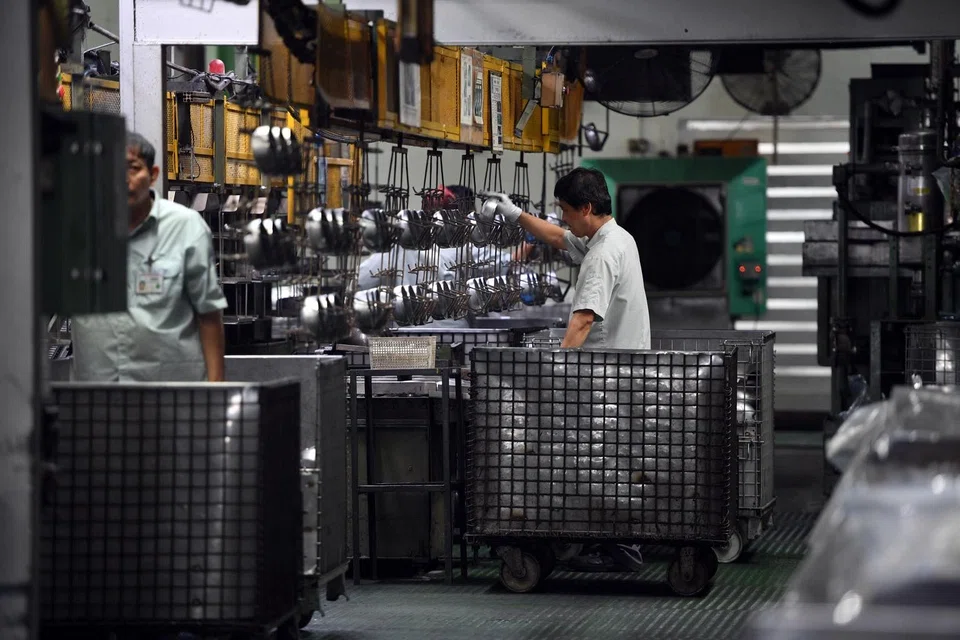
SINGAPORE factories were set to ramp up activity in June as a two-month "circuit breaker" ended, an early sentiment gauge has suggested.
But with end-demand still capped by the novel coronavirus pandemic that has ravaged the globe, the manufacturing sector could still face negative territory in the coming months.
The Purchasing Managers' Index (PMI) reading for June, which was released on Friday, inched up by 1.2 points from the month prior, to 48.0.
Yet the pace of the recovery in manufacturing sentiment still eased from its 2.1-point increase in May, putting the sector on the track to contraction for the fifth straight month.
Meanwhile, the lynchpin electronics segment improved by 1.4 points to 47.6, with its rise also slower than the previous month's 3.4-point jump. The Singapore Institute of Purchasing and Materials Management (SIPMM), which compiles the data, attributed the tepid uptick in readings to the novel coronavirus pandemic.
Singapore enacted a two-month shutdown of non-essential business and social activities - the so-called circuit breaker - in April and May to curb the spread of the deadly virus.
"The June easing of Singapore's circuit breaker measures in two phases has enabled more factory operations, but weak global demand has held back growth in the manufacturing sectors," said Sophia Poh, vice-president of industry engagement and development at the SIPMM, in a statement.
Pointing to both the pandemic and global trade tensions, she added that "local manufacturers are concerned about the declining global demand".
The PMI survey is an early gauge of the month's factory activity. Readings above 50 indicate expansion, while those below 50 suggest contraction.
June's uptick came on the back of slower contractions in new orders, new exports, factory output, employment and supplier deliveries, as well as imports, input prices, and order backlog. Meanwhile, inventory expanded for the straight second month.
Yet, in a concern for economy watchers, the employment index was negative for the fifth straight month, despite edging up from 48.0 to 49.4.
Manufacturing should see a supply-side pick-up this quarter but "medium-term upside potential would likely be capped" by demand, said OCBC Bank chief economist Selena Ling, citing soft job conditions.
Her worry was echoed by Barnabas Gan, an economist at United Overseas Bank, who has pencilled in full-year unemployment of 3.5 per cent.
Separate PMI data from IHS Markit, which covers sectors across the full economy, stood at a four-month high of 43.2 points in June, bouncing back from May's record low of 27.1.
Still, IHS Markit economist Joe Hayes said, "rates of decline have merely eased, and we're yet to see a growth on a broad and sustainable scale". "Until this is the case, a return to the levels of economic activity seen prior to the Covid-19 pandemic will be very gradual," he added.
Barclays analysts earlier said that while Asian PMIs likely improved on factory reopenings, "a V-shaped rebound in growth is far from certain".
They forecast in a report on Wednesday that the regional recovery will be led by mainland China, South Korea and Taiwan but it "may be bumpy and uneven" in the second half all the same.
Manufacturing sentiment in China, where the virus emerged in end-2019, has seen modest optimism. The private-sector Caixin PMI rose from 50.7 in May to 51.2 in June.
But, among South-east Asian markets, IHS Markit found just two countries' manufacturers posting marginal expansion: Vietnam's PMI notched 51.1 points; Malaysia's, 51.0.
All in all, OCBC's Ms Ling believes manufacturing "is likely to register a modest expansion on-year" in 2020.
But Mr Gan warned: "Key manufacturing sectors, save for biomedical manufacturing, could remain in the doldrums in the second half . . .
"Beyond the pandemic, we would also need to account for incremental headwinds stemming from geopolitical and trade tensions."
TRENDING NOW

Once staunchly pro-China, Malaysian Chinese businesses are now distancing themselves from Beijing

Looking beyond looming CEO succession, should UOB potentially pursue a transformative merger?

Could stablecoins be the future of money?

Grab CEO’s wife Chloe Tong on life with Anthony Tan and finding her purpose

