Firms call for help, but now's not the time for fiscal firepower

Singapore
SINGAPORE pulled out all the stops with fiscal support when Covid-19 forced the economy into a two-month hibernation last year.
But the raft of relief measures unleashed during the circuit breaker in 2020 may have raised - and now, dashed - hopes of a similar bazooka during the current Phase 2 (Heightened Alert) period.
"Without the Jobs Support Scheme (JSS) kicking in straightaway, and rental rebates, you end up with a very harsh crash. People will just close shop," said Ang Yuit, vice-president of the Association of Small and Medium Enterprises (ASME).
Analysts told The Business Times (BT) that a selective shutdown - and selective support - is a more strategic move that will protect the economy.
That's even as the government likely retains ample fiscal firepower for a deteriorating epidemic, despite significant past drawdowns on its reserves.
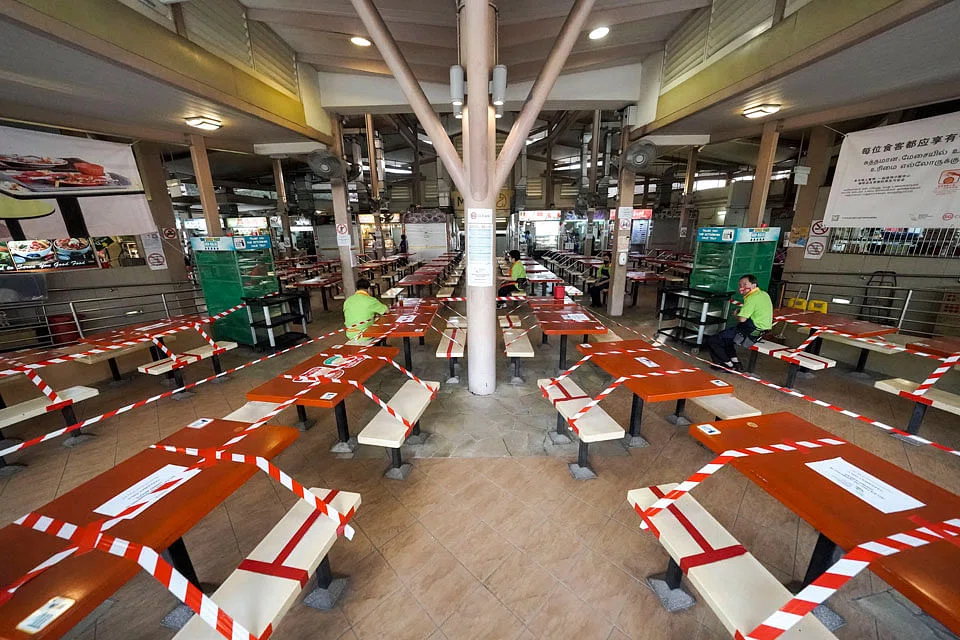
Under the current Phase 2 protocols, services such as dining-in, facials and saunas are barred from May 16 to June 13, while tighter capacity caps apply to retail spaces such as shopping centres and showrooms.
Indoor sports facilities such as gyms also face tougher operating restrictions from May 8 to June 13 - including having to close, unless they offer only low-intensity activities, where participants are masked and do not share common equipment.
These measures have left some business owners crying out for help.
"With reduced sales between 40 per cent and 90 per cent across the board for all F&B concepts over the first few days of HA (heightened alert), owners are also looking closely at lowering large fixed costs," said a Restaurant Association of Singapore (RAS) spokesperson.
With manpower and rental costs the major business bugbears, companies mainly want more JSS wage subsidies and rental rebates.
Yeo Hiang Meng, president of the Federation of Merchants' Associations, Singapore (FMAS), said that circuit-breaker support measures are already warranted now.
FMAS, which represents heartland merchants, also includes members such as spas and beauty parlours - some of which, he said, have "closed completely" at this time.
ASME's Mr Ang also called for more support - such as co-funding salaries by 25 per cent to 50 per cent under the JSS - for retailers now suffering from a massive decline in footfall.
In fact, some business owners wonder whether it would be much easier to shutter for now, rather than bleed money by staying open.
Retail industry lobby group Singapore Tenants United For Fairness last week urged the government to consider a circuit breaker, "instead of facing the current zombie situation for non-F&B businesses".
During the circuit breaker, business support was underpinned by the JSS, which paid 75 per cent on the first S$4,600 of all local salaries in April and May 2020. Funding under the scheme has since tapered off, however, and will end in September 2021.
But economists stressed that circuit-breaker levels of aid are not yet on the cards, as the government actively seeks to avoid a lockdown that would derail the economic rebound.
The circuit breaker cost the economy some S$11.3 billion - or 2.2 per cent of gross domestic product (GDP) - from April 7 to June 1, 2020, government analysts estimated last year.
In contrast, DBS senior economist Irvin Seah and UOB economist Barnabas Gan recently reaffirmed their full-year GDP forecasts in calls with BT.
Contrasting Phase 2 (HA) with the circuit breaker, Mr Gan said: "The situation right now is starkly different... At least the manufacturing and export sector for Singapore is performing well, and the entire services sector is allowed to operate."
Mr Seah also noted that his projection of a 6.3 per cent GDP expansion takes into account a "marginal Q2 sequential decline", although that assumes restrictions ease in the third quarter.
Analysts, however, did not rule out a reopening of the coffers to fund more rescue packages, which they believe the government can afford.
Singapore began a new term of government in 2020 shortly after the general election, limiting access to earlier Budget surpluses.
But OCBC chief economist Selena Ling noted that the government "did not shy away" from a second year of Budget deficit or another drawdown on reserves this year.
"This suggests that, while the fiscal position is weaker than pre-Covid, it doesn't necessarily mean that the policymakers' hands are tied. There is still room to draw on reserves if need be or raise taxes if necessary, although this option may be a hard sell given the state of the economy," she told BT.
Even if past spending and lower revenue have left the government in a weaker position than before, ING senior economist Prakash Sakpal said that "we are sure the authorities will appreciate that this isn't the time to worry about a wider deficit".
He hoped that Phase 2 (HA) "will be a short-lived phase not requiring any further extension of restriction nor the massive relief measures" seen last year.
Granted, some government support has already been unveiled.
The government raised the JSS wage support level to 50 per cent for F&B operators, and is covering part of the commission or delivery costs for food delivery platforms and third-party logistics services.
It has also set aside up to S$18 million for gyms and fitness studios, and added a fresh S$27 million to a relief fund for taxi and private-hire drivers.
But Khoon Goh, head of Asia research at ANZ, said: "There is scope for the government to provide further targeted relief, but it is unlikely to be as generous as last year. It is possible to draw further on the reserves, but that is likely to be a last resort."
For example, hawker tenants got a month's worth of rental waivers from the National Environment Agency and other government agencies. But the FMAS and RAS highlighted how there is no guarantee of the same relief from private landlords.
Indeed, Mr Ang said that the level of government support "is nothing close" to what was given out in the circuit breaker, even though the business impact on sectors such as retail and F&B has been "quite comparable".
Meanwhile, Edward Wong, president of the Spa and Wellness Association of Singapore, told BT that support for the industry has yet to be announced - despite a marked business hit, as "facial is out and other services are affected by lack of customers".
The association has approached the authorities for JSS aid, Mr Wong told BT, adding that most businesses are "open but struggling".
But DBS' Mr Seah argued that "it really is irresponsible of people to just call for a circuit breaker", given the strain on the economy and the path of Singapore's recovery.
"It (a full circuit breaker) will create unnecessary pain on the economy which will then be funded by our fiscal resources," he said, describing the Phase 2 (HA) strategy as "a more focused approach on how we reduce human traffic in a public space".
But, referring to the JSS and the temporary bridging loans for businesses in the worst-hit industries, Ms Ling added: "The path of least resistance is to extend some of the existing support measures... till end-year."