

Firms eager to get staff back into the office
They have put in place plans to progressively ease more employees back to workplaces over the coming weeks
Singapore
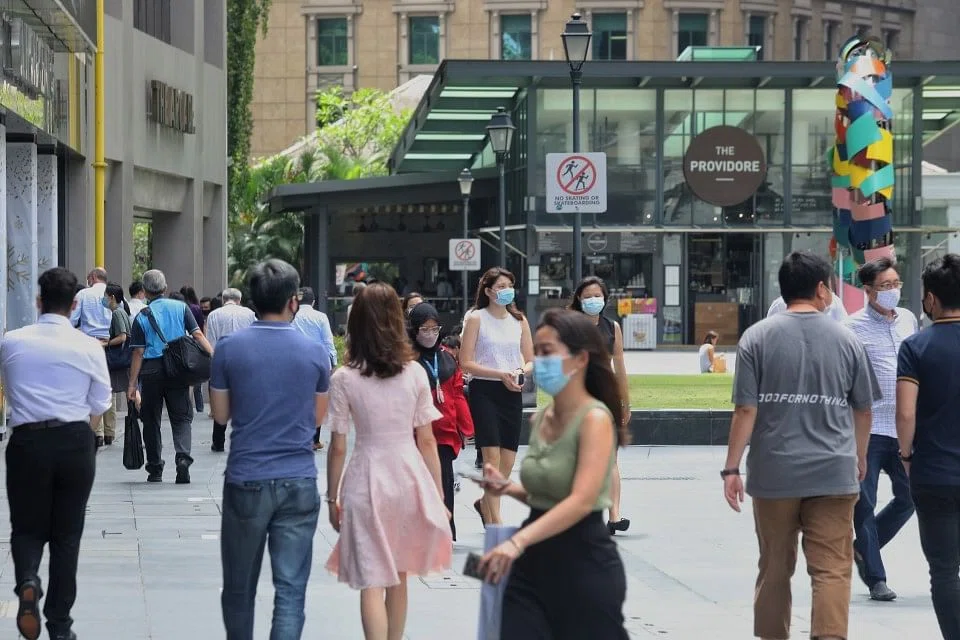
NOW that more staff are allowed in workplaces, firms have been eager to welcome them back, citing benefits such as higher productivity, better social interaction, and smoother collaboration.
Firms told The Business Times that they have put in place plans to progressively ease more staff back to the office over the coming weeks.
In view of higher Covid-19 vaccination rates, the Ministry of Health (MOH) had eased its curbs on workplaces. Work-from-home (WFH) is no longer the default, and since Jan 1, up to 50 per cent of WFH-capable employees may return to the office.
One major benefit that employers cite is better communication.
"For daily job duties, we generally don't see any significant compromise in work quality due to WFH," said Goldbell Group general manager of corporate services Tan Su Ching. "However, interaction, discussion, and brainstorming among staff will be more effective and efficient when they are physically back to office."
Teo Hong Lim, chief executive of property and hospitality group Roxy-Pacific Holdings, finds physical meetings better for the presentation of business plans.
"We have all gotten used to Zoom since Covid started. But we realised that when there are big sets of plans, there can be a lot of details, and it's not convenient to view these on a laptop," said Teo.
"It's good to have the staff come together to view them on a big screen. They are able to pick out the finer details and have better discussions."
Some work processes also require a physical presence. Roxy-Pacific has more than 50 head office staff, and more than 100 staff in its front-line hospitality business.
Said Teo: "We have computerised many of the work processes, but we still need physical presence. We are getting staff to come back on alternate days, with management staff coming in about 2 or 3 days a week."
It is especially crucial to get new hires into the office, given the alienation that may have resulted from the long WFH era, said employers.
Goldbell's Tan noted that with purely remote working, new staff may take a longer time to get used to their jobs and build rapport with their colleagues.
Being physically present not only improves productivity but also aids the learning process of newer staff, said Gerald Tan, founder and managing director of G8 Subsea, a offshore renewable energy company with about 20 staff.
Most of G8's staff are engineers and programmers. Some who were recruited mid-pandemic are finding it difficult to learn the job from home, Tan said.
"It's extremely important that we start getting our work force back to work again while adhering to safe management measures," he said. "Physical camaraderie within a team is still critical to achieve great things - to get important projects and the economy going."
Basil Byrne, co-managing partner and founder of Willowmore, said that WFH has not been effective for his company of 12 staff, and coming back to the office is "really important for productivity".
Byrne said: "No matter how disciplined a person is, if there isn't a routine of waking up, getting dressed, and going to the office at a particular time, it is difficult to focus on work. At home where there isn't anyone to monitor or lack of peer pressure, you can get distracted easily. It's human nature."
A company should not have to provide additional incentives for staff to come back to the office, added Byrne.
Having found it difficult to hire foreigners, Byrne said that hiring locals has forced up wages.
"We are paying high salaries, and coming to the office is a normal part of the job. With the exception of employees that have good reason, we don't see any issues in calling staff back to work," said Byrne.
Staff who realise the importance of their work will naturally want to come back, said G8 Subsea's Tan.
Even firms in sectors like information technology (IT), which may have all of their infrastructure online, have realised the importance of face-to-face interactions.
"It's difficult to tell if a person is facing personal issues like burnout, work fatigue, mental or physical health issues, without seeing them in person," said Leon Yeo, co-founder of fintech company Doxa Holdings.
"We trust our staff to do their work at home and they do deliver, but we also feel that WFH has created a rift. At the end of the day, we are not robots, but humans with feelings and emotions."
Yeo also noted that not all staff can afford an ideal work environment at home, and some will need to come to the office to have a proper workspace.
"The pace of work has rapidly increased today, and especially in the startup world which we operate in, it can be stressful. Having the human connections helps for easier collaboration, and also manage workload and stress," he added.
TRENDING NOW

Unhealthy air quality in Singapore enough to trigger haze pollution law; NEA is monitoring situation

Once staunchly pro-China, Malaysian Chinese businesses are now distancing themselves from Beijing

Could stablecoins be the future of money?
Johor’s investment boom is real, but actual contribution from JS-SEZ unclear

