

Firms that do not change will hit 'dead end': Heng Swee Keat
While it is not an easy process, he stressed that making changes later will be 'much harder'
Singapore
COMPANIES must persist in transforming their business operations through technology, and upgrading workers at the same time, to cope with changes, said Finance Minister Heng Swee Keat on Monday.
He acknowledged that the process is not straightforward or easy, but maintained that it is a necessary step.
"As I said in the Budget, if we do not change, then we will be hitting a dead end," he said, adding that making changes later will be "much harder".
"It is far better for us to take the slightly more difficult road today so that we will reach our destination."
He was speaking to the media at the sidelines of a site visit to ST Engineering's aerospace facility, one week after he delivered the annual Budget statement in Parliament, where he announced that S$4.6 billion will be spent over the next three years to help firms and workers transform.
Mr Heng said that responses to the Budget has been "fairly positive", but noted that there will be some sectors that will face more stress, in particular those which are more manpower-intensive.
"We will need to continue to work closely together with our trade associations, with our unions, so that we can make this major transition," he said.
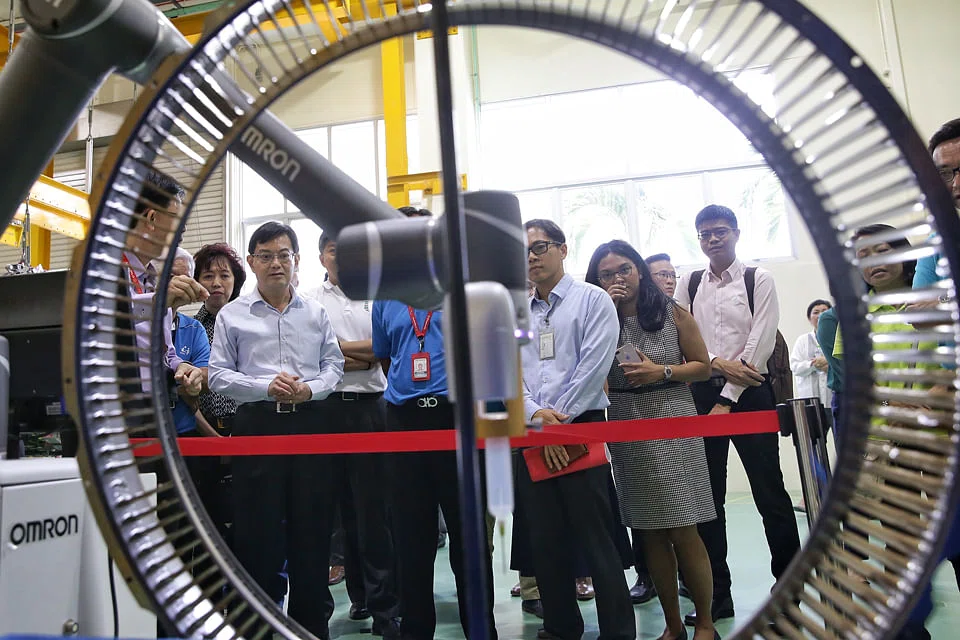
On Monday, he cited ST Engineering Aerospace as an example of a "good role model" for other firms to emulate, due to its efforts to stay ahead.
In particular, ST Engineering Aerospace set up an in-house training council with the Singapore Industrial & Services Employees' Union in September 2018 to equip workers with the skills needed for the future, understood to be one of the first in Singapore.
According to Jeffrey Lam, deputy president of ST Engineering Aerospace, the company decided several years ago that it needed to invest in technologies such as automation to support its workforce, on the back of trends such as an ageing population and the manpower crunch.
The aerospace business employs about 9,000 staff members, with more than half of its workforce above 45. "We realised that to stay competitive globally, we need to continue to invest in the training of our workforce to ensure that they can continue to be relevant," he said.
In the last five years, technology and engineering development investments grew by up to 20 per cent, with "several millions" spent each year, he said.
Since then, the company has seen turnaround time halved for certain work processes, while errors have been reduced by at least 20 per cent, added Mr Lam.
For example, removing the coating from the aircraft engine fan case used to take two days if done manually, but with the introduction of a robot since December 2018, it now takes about a day. But despite the influx of new technologies, Mr Lam said that there will be no displacement of workers as the aim is to let robots do the repetitive and manual work instead.
"What we would like to do is to focus our employees on high value work," he said.
TRENDING NOW

Singapore identifies 7 firms responsible for haze fires, notices issued urging action: Grace Fu

‘How many will survive?’: Bubble fears arise as China’s humanoid robotics face reality check
GIC-backed Bank Jago sees wealth management as next growth engine as Indonesian investor base grows

Ageing in Asia: Huge potential for the consumer economy

