

For Singapore firms, getting onboard Industry 4.0 is crucial
They must shift with growing competition from low-cost countries and embrace digitalisation
Singapore
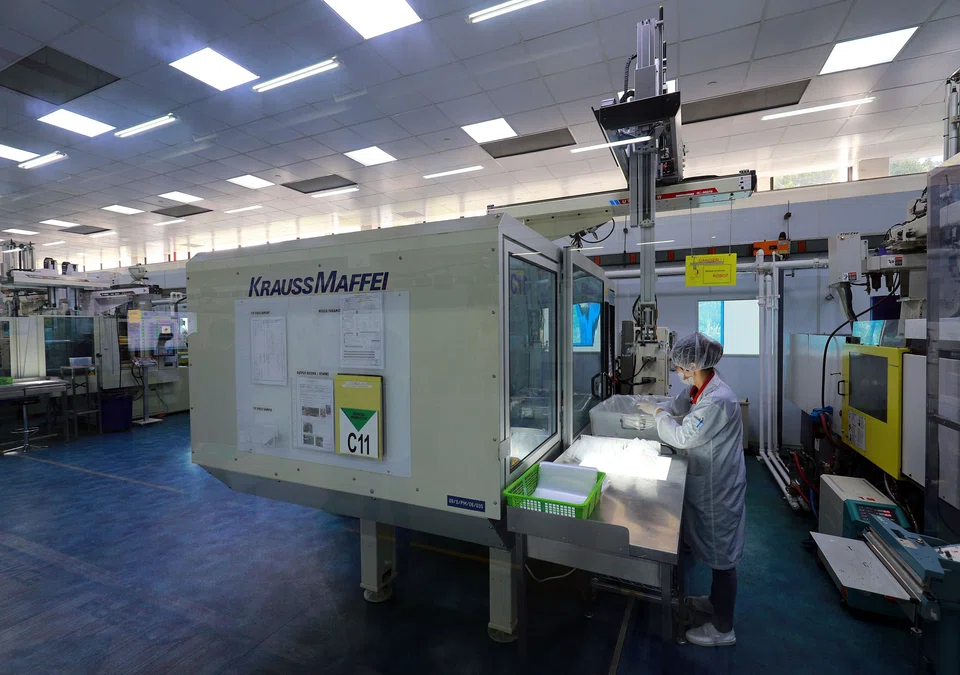
MOST Singapore manufacturers are not even at Industry 3.0, and market observers say they will need a leg-up to mount Industry 4.0 as they grow and internationalise.
Wu Hongyi, centre director for Europe at IE Singapore, told The Business Times: "Most of them are at Industry 2.5, (held back by) concerns like high capital investments and applicability."
He said this could hurt the long-term competitiveness and relevance of Singapore's over 2,000 manufacturers.
While Industry 1.0 entailed the use of the steam engine, 2.0 saw the use of electricity and assembly lines, and 3.0 the deployment of robots for automation.
Known as the fourth and latest industrial revolution, Industry 4.0 is the digitisation of the entire manufacturing process. It features cyber-physical streams and the Internet of Things (IoT) - integrating computing, networking and physical processes.
"Connectivity is key. On the production floor, each machine, robot, component and final product will have a digital model, connected via industrial Internet and with data shared via the cloud, allowing real-time monitoring, control and optimisation."
Mr Wu noted that it is imperative for Singapore firms to adapt to Industry 4.0 as they grow and internationalise. This is due to growing competition from low-cost countries such as Myanmar and Indonesia, and more stringent requirements from manufacturing clients, including quicker product turnover times and high-mix, low-volume manufacturing.
"There is a greater need for flexibility. Industry 3.0 cannot help machines adapt to new orders but 4.0 can. The latter improves productivity, efficiency and flexibility, allowing local companies to serve more global companies by co-sharing resources and activities globally.
Mr Wu added that by moving to Industry 4.0, companies can find new revenue streams by transforming business models and expanding into new business areas (eg, software integration). They can also tackle manpower shortages through productivity and efficiency gains, and meet global clients' needs through an optimised manufacturing process.
Industry 4.0 also helps transform low value-add labour to high value-add labour, in part because humans can be replaced by robots. Paul Lim, chief of Catalist-listed security company Secura Group, said that these robots "communicate with one another, pass along commands and data, and are controlled by humans at the top of the production process".
He pointed out that while Industry 4.0 has made its way into Singapore and the government has taken steps to improve industrial and cyber infrastructure, many firms, notably the small and medium ones, may find it challenging to adopt new technologies due to thinner resources.
"There are definitely more steps many companies need to take to catch up with the shift to Industry 4.0. The ones that are fast enough to ride the wave will find new opportunities and gain an edge over their competitors."
Tan Eena, business development manager at industrial automation systems firm Pixel Automation, highlighted that Industry 4.0 marks a "big step away" from the traditional manufacturing concept as it involves both hardware and software changes. "It will take time and effort to restructure processes and adopt the new concepts in the production line."
She suggested a top-down approach for the shift to Industry 4.0, as it requires high investment costs and big mindset changes. "Government initiatives to drive this change through educational efforts and financial assistance will be more effective."
Brian Kim, chief growth officer at Arcstone, agreed: "Many Singapore manufacturers have seen much success over many decades to grow their company, but what got them here will not get them there. It's important to continue to spread industry knowledge of both the importance of modernising production and the pitfalls of not improving continuously."
He added that Arcstone, a homegrown data analytics company, was founded on the belief that manufacturers will eventually transition the management of their production processes from manual tracking to utilising real-time data to gain visibility and control of their production - a key feature of Industry 4.0.
Mr Wu urged local manufacturers to start by taking small steps. He added that IE Singapore will support their efforts by helping them look out for demand markets overseas (such as China and South-east Asia), access tech expertise from German research institutes, and establish a track record overseas by working with partners to test-bed solutions.
The Europe centre director, who has been based in Germany since 2013, shared that it was Germany that had coined the term "Industry 4.0". In 2013, he witnessed Germany launch a massive initiative - led by the government, numerous trade associations and stakeholders - to transform the manufacturing industry.
Mr Wu noted that two key factors had aided Germany's shift to Industry 4.0. The first was a strong collaboration between big corporations and small and medium suppliers. The second was robust technological support from research institutes, which facilitated the commercialisation of intellectual property, and helped the manufacturing industry to innovate.
TRENDING NOW

Once staunchly pro-China, Malaysian Chinese businesses are now distancing themselves from Beijing

Stocks to watch: HPL, Aims Apac Reit, Zico, Advanced Systems Automation, ComfortDelGro
‘How many will survive?’: Bubble fears arise as China’s humanoid robotics face reality check
Smaller board lots can’t fix a market run by three banks

