

Forum panellists urge businesses to monitor policies of new Jakarta govt
An Indonesian minister's announcement of infrastructure plans triggers panellists' discussion of investment funding and risks at Indonesia Forum
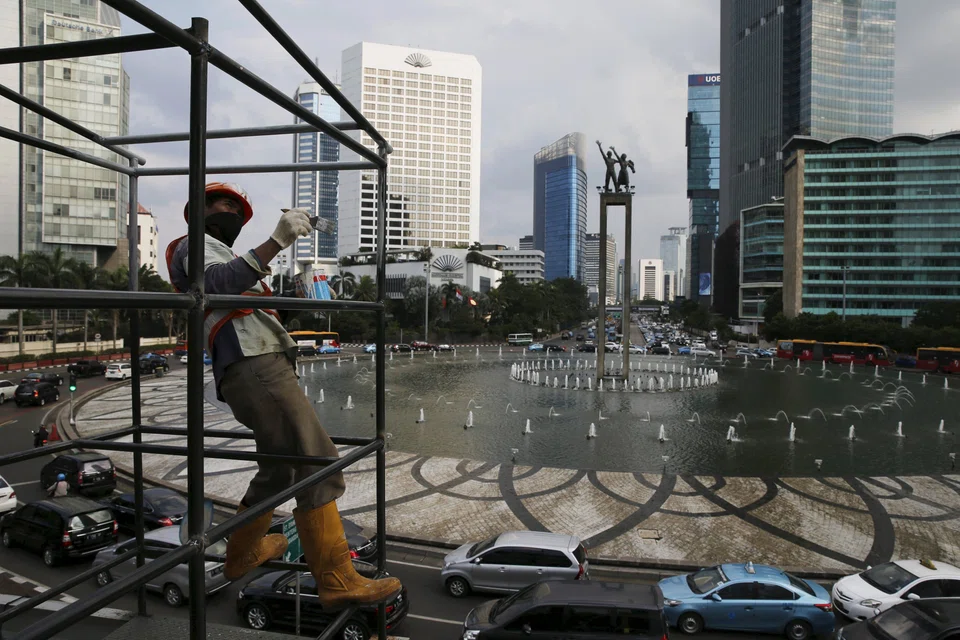
BEEFING up the country's infrastructure is top-most on the Jokowi administration's to-do list in the next five years. Looking to build on the archipelago's strengths as a maritime economy, Jakarta has plans to build 24 harbours and 198 shipyards in that time frame.
The country is also looking to build more than 5,000 km of rail and to generate 35,000 megawatts more of electricity through a network of new power plants by 2019.
These details came from Indroyono Soesilo, the country's recently appointed Maritime Coordinating Minister, who presented the keynote address at the Indonesia Forum 2015 in Singapore last Friday.
Building the infrastructure is one matter. The Jokowi government also wants productivity and efficiency to be watchwords at these facilities. Dr Indroyono noted, for example, that it now costs thrice as much to ship products within Indonesia than to ship them from Singapore to Indonesia, primarily because of delays.
"Improving our logistical system is part of Indonesia's process to prepare to join the AEC in 2016," he said, referring to the Asean Economic Community, the regional integrated market due to be launched at the end of this year.
Funding these projects might be an issue - the power plants alone, for example, will cost US$100 billion - and the country's first-quarter gross domestic product (GDP) growth had clocked in at only 4.7 per cent, its lowest since the 2008-2009 financial crisis, and far shy of President Joko Widodo's targeted 7 per cent annual average.
But Dr Indroyono said that the slow growth in the first quarter had been expected because of a delay in getting the budget approved; the government, which took over in the middle of last year, had been busy organising itself.
The 290 trillion rupiah (S$29.5 billion) allocated to infrastructure in the national budget will go primarily to state-owned enterprises (SOEs), which will be responsible for building the harbours and a trans-Sumatra toll road, he said. The SOEs will also work with investors, which will provide a "complementary budget" from which more capital can be drawn, he added.
But because the state budget makes up just 20 per cent of the financing required for the projects, the rest will have to come from investments - and this puts the Jokowi government on track to feel that pull between nationalism and tapping foreign resources.
Indeed, several panellists, speaking after Dr Indroyono at the forum organised by the Institute of Southeast Asian Studies (ISEAS) and the University of Michigan, said that working with foreign investors will not necessarily be easy.
ISEAS fellow Ulla Fionna said: "Jokowi is trapped in the need for a nationalistic approach to maintain public support. On one hand, he has to try to woo investors; on the other, he has to portray himself as a leader who does not bow to foreign interests."
Siwage Dharma Negara, a visiting fellow at ISEAS, said that China, a main target for foreign funding, is now Indonesia's foremost trading partner and its 13th largest foreign investor. "Now, Indonesian public and private sectors are becoming more comfortable with dealing with investors from China," he said, in a reference to ethnic tensions between the two sides in the past.
Chinese investors have also since built up some experience with Indonesian projects, such as the Surabaya-Madura Bridge and the West Java Indramayu power plant.
Mr Negara said that the China-led Asian Infrastructure Investment Bank (AIIB) would be an opportunity for further cooperation and could also close Indonesia's financing gap.
Michael Dunne, former president of General Motors Indonesia, said: "For most foreign investors in Indonesia, the biggest risk is regulatory. They're not sure what the rules are and they're not sure if they're going to change again soon."
Manggi Habir, independent commissioner from Bank Danamon, said that from a rating agency's perspective, the biggest risk in Indonesia used to lie in its oil subsidies. "When Indonesia did away with them, it was a positive sign. I think what the agencies are looking at is to see how things would follow through."
Others have taken a wait-and-see tack.
Despite the economic slowdown affecting economies worldwide, Indonesia's - driven by consumer demand - will continue to be attractive, said Sandiaga Salahuddin Uno, president-director of an Indonesian investment firm.
Ms Fionna said: "It currently remains unclear how Jokowi can clarify and follow through on his policies. This makes it imperative for businesses to keep a close eye on Indonesian politics."
INFOGRAPHIC: Shadow of uncertainty?
TRENDING NOW

Nvidia reinstates Jensen Huang as CEO; Trump says move poses no national security risk

Indonesia’s coal tycoon Low Tuck Kwong replaced as Bayan Resources president-director

Nvidia surges 33% after reinstating Jensen Huang, reviving AI trade; stocks soar in US and Europe

Consider lowering homeownership barriers for some non-resident foreigners

