

Gap in US-Sino influence in S-E Asia widening in China's favour
Survey respondents say the region should deal with US-China rivalry by beefing up Asean resilience, unity

Mindy Tan
Singapore
CHINA continues to wield the most influence in South-east Asia, and the gap between perceived American and Chinese influence is widening in China's favour, going by the findings of a survey released on Thursday.
However, confidence among respondents that China would contribute to global peace, security, prosperity and governance is sliding. Of the roughly 1,300 individuals polled, 60.4 per cent said they had little to no confidence that China would "do the right thing".
The first time this survey was done in 2018, 51.5 per cent said they had little to no confidence about this.
The survey, done last November, was undertaken by the Asean Studies Centre at the Iseas-Yusof Ishak Institute. The respondents were from government, inter-government and international organisations, academia, think-tanks and research institutions, as well as the media, civil society and businesses.
The proportion of respondents who viewed China as the most influential economic power in the region rose from 73.3 per cent in the 2018 survey to 79.2 per cent. In the latest survey, only 8.3 per cent thought Asean the most influential economically; 7.9 per cent said the US was.
Those who viewed China as having the most political and strategic influence grew from 45.2 per cent in 2018 to 52.2 per cent in 2019.
Among those who named China as the most influential economic power, 71.9 per cent expressed worry about its expanding influence. Among those who saw China as the most influential politically and strategically, 85.4 per cent were concerned.
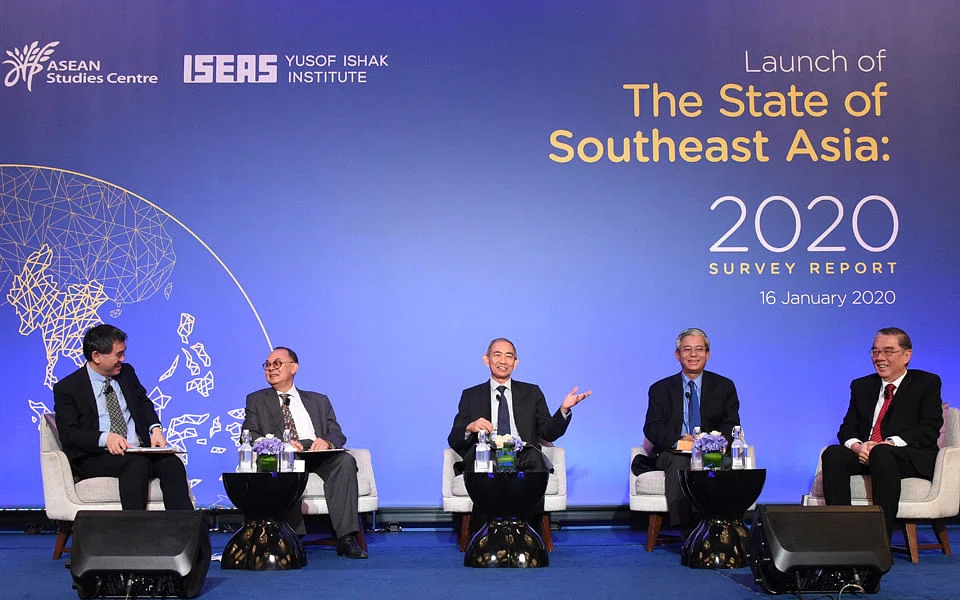
A panel of five, comprising academics, diplomats and former ministers, gathered at the Shangri-la hotel on Thursday to discuss the findings of the survey.
Pham Quang Vinh, formerly Vietnam's Deputy Minister of Foreign Affairs and now his country's ambassador in the United States, said it is too early to say for sure that the US' influence in the region was waning.
He also pointed out that trust in both China and the US was declining - but for very different reasons.
"For China, we don't know what its intentions are, how it will lead this region, or lead itself, (and if it) will be good for everyone in the region.
"For the US, it is its lack of sustainable commitment to the region."
The survey also found that respondents gave their vote to Japan as a country that would contribute to global peace, security, prosperity and governance; 61.2 per cent said they were confident to very confident of this.
This was followed by the European Union (38.7 per cent) and the US (30.3 per cent). China and India rounded up the five options available, at 16.1 per cent and 16 per cent respectively.
Notably, nearly all of these major powers experienced a fall in trust perception - except for the US, for which trust perception rose from 27.3 per cent to 30.3 per cent.
Perhaps for this reason, 53.6 per cent of respondents said that if forced to choose between the US and China, they would cast their lot with the US.
This is despite the fact that 47 per cent of the respondents said they had little to no confidence in the US as a strategic partner and provider of regional security; this is in part due to a drop in US engagement - 77 per cent have noted a drop in engagement under the Trump administration, compared to the Obama one.
When it comes to navigating the US-China rivalry, 48 per cent opted to deal with it by enhancing Asean resilience and unity; 31.3 per cent said the region should continue its position of "not taking sides" with either power. The third largest faction (14.7 per cent) chose seek out "third parties".
Kasit Piromya, formerly Foreign Minister of Thailand, stressed the importance of continuing to build on Asean connectivity: "We have to concentrate more on the enlargement of the Asean internal market, as well as the spillover border trade into southern China and the Indian subcontinent. ... We can do more if we could increase that 600 million domestic market."
On the subject of the US-China trade war, most respondents said it boded ill for the global economy, with 41.4 per cent worrying that the trade war would "spark a global economic downturn". Asean has benefited from manufacturing outflows and shifting supply chains, but 35.9 per cent of respondents said their economy has suffered from the trade war in the short term; another 28 per cent believe the fallout from the spat will endure.
Asked what their top three concerns for the region are, respondents cited domestic political instability (70.5 per cent), economic downturn (68.5 per cent), and the impact of climate change (66.8 per cent).
TRENDING NOW

Fed hike throws Singapore banks a margin lifeline; UOB most likely to feel impact

He built the Vingroup empire. Now South-east Asia’s richest man is handing some key roles to his sons

Real-estate veteran Desmond Sim quits from CEO roles at Realion, ETC
Chagee, Mixue and Luckin won the market. Sustaining their edge is the harder part

