

GDP contraction to worsen in Q2 on Covid-19 impact: MAS
Singapore's full-year growth could come in below official forecast range of -4 to -1 per cent, adds central bank

Singapore
SINGAPORE'S gross domestic product (GDP) is likely to contract more sharply in the second quarter than in the first, given the severity of the Covid-19 pandemic abroad and strict measures at home, said the Monetary Authority of Singapore (MAS) in Tuesday's Macroeconomic Review.
Apart from the external blow to electronics and oil-related manufacturing, modern services is likely to suffer, as will private consumption.
With Singapore's economic outlook depending on the global course of the pandemic, full-year growth could come in below the official forecast range of -4 to -1 per cent, said the MAS. This was last downgraded in late March, from an earlier range of -0.5 per cent to 1.5 per cent.
Minister for Trade and Industry Chan Chun Sing said in an interview with Bloomberg last week that it was "very likely" that Singapore would see a fall of more than 4 per cent.
The MAS saw this as likely if downside risks materialise. These risks include more stringent Covid-19 containment measures in Singapore or elsewhere, a prolonging of the pandemic, and persistent uncertainty due to the difficulty of completely containing the virus.
If so, it would be Singapore's deepest recession since independence. The country's full-year growth was 0.1 per cent during the Global Financial Crisis in 2009; -1.1 per cent with the bursting of the dotcom bubble in 2001; and -2.2 per cent during the Asian Financial Crisis in 1998.
UOB's forecast is for full-year growth of -4 per cent, with economist Barnabas Gan expecting growth to fall further in the second half of 2020, "with a pick-up likely to be in 2021".
The pandemic's economic impact on Singapore works through three main channels, said MAS: a fall in foreign final demand for exports; disruptions to cross-border supply chains lowering demand for intermediate inputs; and stricter Covid-19 measures hurting domestic demand.
Final demand in the US and China, the two countries to which Singapore has most exposure, generates value-added spillovers amounting to 13 per cent of nominal GDP. Export activities in those two countries result in further spillovers amounting to 3.3 per cent of nominal GDP, arising from Singapore's provision of inputs to exporters there.
Most trade-related activities will be hit as external conditions weaken, though the impact could be uneven across industries, said the MAS.
Within the manufacturing sector, "highly procyclical industries which are related to oil and electronics will likely be most negatively affected", but medical-related industries such as medical technology and pharmaceuticals could see positive growth.
The oil price crash will hit oil-related industries, which account for around 4 per cent of GDP. While the global electronics cycle showed signs of recovery in late 2019, Covid-19 has likely delayed the upturn.
In services, modern services face headwinds. Financial services growth is expected to moderate as the pandemic softens prospects in banking, other auxiliary activities, and insurance. Business services activity is not expected to pick up until the health crisis is resolved.
In information and communications technology, online consumer-facing businesses should gain, but overall demand for business-to-business IT services is likely to stay weak, apart from a boost for remote-working services in the circuit breaker period.
It is unclear when the worst-hit travel-related sector can see recovery, with "signs suggesting that the situation is unlikely to turn around decisively even at the end of this year".
Construction activity, though disrupted in Q2, should see some recovery in the second half of 2020, underpinned by infrastructure projects.
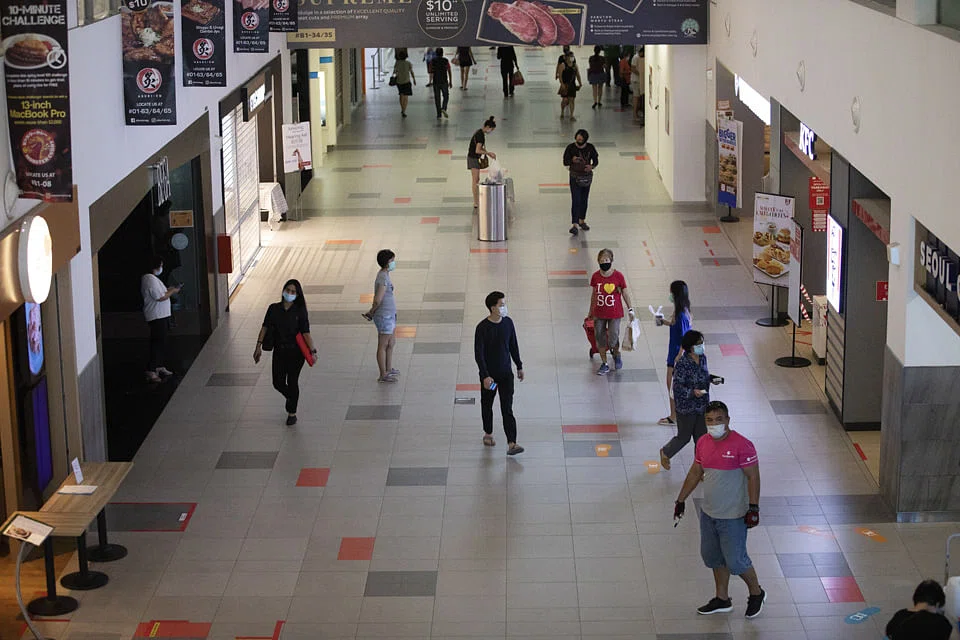
Meanwhile, circuit breaker measures will have "varying degrees of impact" on segments accounting for about 60 per cent of private consumption. These include transport, recreation and culture, and food services, which accounted for 13.6 per cent, 9.8 per cent, and 7 per cent of private consumption expenditure in 2019.
With the pandemic likely to be protracted, "intermittent rounds of re-containment measures may be required, thus hampering a decisive rebound in economic activity".
OCBC Bank chief economist Selena Ling, however, said that although there could be downside risks for both growth and inflation if the coming global recession worsens, "the current market focus is on the possibility of global Covid-19 infections stabilising and near-term lifting of lockdowns elsewhere".
In a Facebook post on Tuesday night, Deputy Prime Minister and Finance Minister Heng Swee Keat said the pandemic has led to a sharp contraction in economic activity, both in Singapore and globally. "Our immediate priority is to protect lives. We had to take strong measures, including implementing and subsequently extending the circuit breaker. These measures have had a severe impact on our economy," he noted.
Mr Heng added that the government "will act to further support" businesses and households if necessary. "We must continue to ensure that our monetary, financial, fiscal and regulatory policies work tightly to ease the impact on businesses and households. We are tracking both the global and our situation at home very closely."
READ MORE:
TRENDING NOW

Grab CEO’s wife Chloe Tong on life with Anthony Tan and finding her purpose
Stocks to watch: DBS, DFI Retail, Frasers Property, Clint, ESR-Reit, Centurion, Coliwoo
DFI Retail to bag US$340 million, Starbucks business in Asia in deal with Maxim’s Caterers
Green fuels, autonomous ships: How Singapore is future-proofing its shipping industry

