

'Hawkish' MAS takes action on rising prices
Watchers say that its latest decision to tighten the currency policy also signals confidence in an economic rebound

Singapore
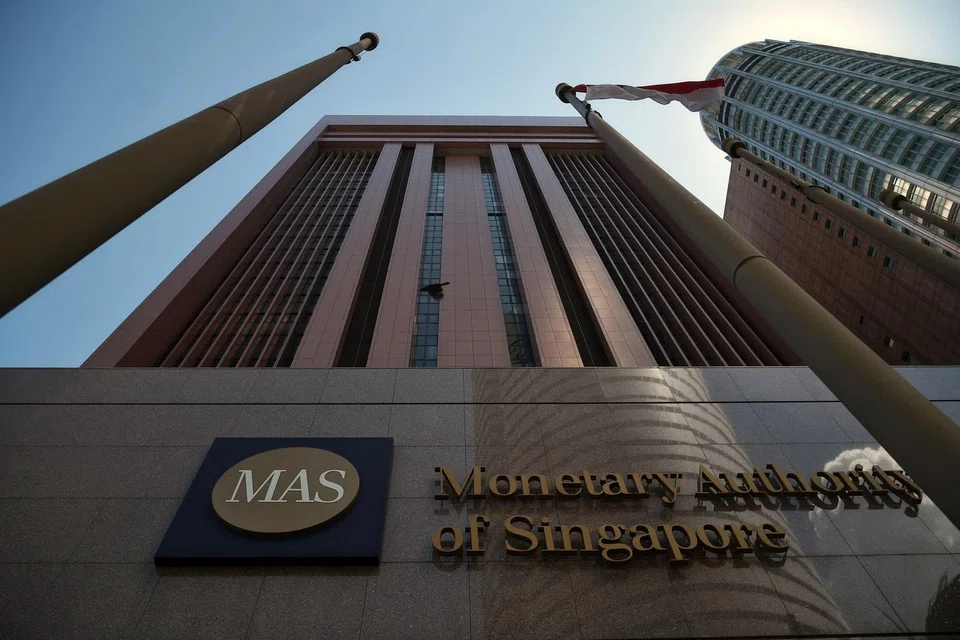
SINGAPORE'S central bank kick-started regional policy normalisation on Thursday (Oct 14), as it moved to "raise slightly the slope" of the Singapore dollar nominal effective exchange rate (S$NEER) policy band, up from a flat or "zero" slope before.
The decision, which caught many bank economists off guard, is not expected to stave off elevated core inflation in the short run. But it opens the door to more tightening in 2022, and could result in the Singdollar (SGD) making stronger gains in the year ahead.
Barclays analysts Brian Tan and Ashish Agrawal in their report: "With this expectation of a continued economy recovery both globally and domestically, the Monetary Authority of Singapore (MAS) likely decided there was flexibility to be pre-emptive to head off an eventual rise in demand-pull inflation pressures."
Thursday's tightening tweaked the path of appreciation for the S$NEER, but kept unchanged the width and midpoint of the band in which the SGD is allowed to move.
The MAS last changed its policy parameters in end-March 2020, unveiling an unprecedented "double easing" that both flattened the slope and lowered the midpoint of the band at the outset of the Covid-19 pandemic.
Most watchers had expected MAS policy normalisation to begin in April 2022, despite others warning that inflation pressures could push the central bank into an earlier tightening.
The MAS has now bucked consensus by tightening its policy parameters to tackle "accumulating" external and domestic cost pressures, which were blamed on both "normalising demand" and supply woes.
The MAS' latest move is probably not a "one and done", as OCBC chief economist Selena Ling put it; she told The Business Times that the MAS will likely follow this up with another round of tightening at its next half-yearly meeting in April 2022.
Indeed, the move marks "the start of a tightening cycle of MAS monetary policy, as domestic demand accelerates and output returns to its potential", Oxford Economics suggested.
JPMorgan analysts Ong Sin Beng and Arthur Luk wrote in a flash note: "Given the forecast path of core inflation over the next 6 to 9 months, we expect that there could be a further steepening of the S$NEER slope during the second quarter of 2022, especially if underlying pressures turn more persistent than we anticipate."
Meanwhile, UOB analysts added: "Further tightening in April 2022 and beyond is possible, to normalise policy stance to pre-pandemic levels."
Bank of America (BofA) economist Mohamed Faiz Nagutha also expects another slope increase in April, but added: "Given the pre-emptive move today, chances of upward re-centring in 2022 are now much lower in our view."
Taking the opposite tack, though, is Maybank Kim Eng; its base case is for the MAS to hold a "slight appreciation bias" in April, with senior economist Chua Hak Bin telling BT that "the outlook remains cloudy".
Similarly, DBS senior economist Irvin Seah said tightening at the next meeting is not expected, "unless there is further upside risk to both growth and inflation".
For now, the MAS has said in its policy statement that the S$NEER slope "will ensure price stability over the medium term, while recognising the risks to the economic recovery".
The MAS forecasts core inflation to fall near the upper end of the zero-to-1 per cent range in 2021 and stay "close to 2 per cent in the medium term", before coming in at between 1 per cent and 2 per cent in 2022.
The Barclays team added that "growing concerns around inflation globally may also have played a role in tilting the MAS" towards tightening.
Yet, even if inflation risks were the impetus, "the MAS also painted a rosy growth outlook" in its policy statement, HSBC economist Liu Yun noted, citing MAS' references to above-potential economic growth and a closure of the negative output gap in 2022.
The Singapore economy grew by 6.5 per cent year on year in the third quarter, according to official flash estimates also out on Thursday.
Said Mohamed Faiz: "MAS has commented on longer-term inflationary pressures due to structural changes in the economy, indicating lower labour market slack, along with near-term rising import price pressures. We believe the policy move is a pre-emptive one in anticipation of sustained inflationary pressures and recovering growth. S$NEER would draw more support from the confidence in growth outlook and potential for further policy moves over the next year."
The MAS regulates the slope, width and midpoint of the S$NEER band to manage the strength of the Singapore dollar (SGD) against other currencies and ensure medium-term price stability.
Joey Chew, senior currency strategist at HSBC, believes that the SGD could outperform other major and Asian currencies, as central banks in those markets are unlikely to tighten policy in the near term.
"But the SGD may not be able to completely withstand the broad-based strength of the USD (US dollar) , especially during times of severe risk aversion," she told BT. "The SGD can sometimes be very sensitive to shifts in risk sentiment because of its liquidity, depth and the economy's openness."
The SGD strengthened to 1.3477 against the USD in the wake of the decision, from 1.3517 earlier, and then retreated again.
Vishnu Varathan, economics and strategy head at Mizuho, told BT the SGD will likely move in tandem with other major currencies, as the policy settings mark "a very gradual and incremental linear lift in headroom".
"Gains from intra-band gains are mostly exhausted while potential for incremental headroom may amount to only 0.2 per cent to 0.3 per cent over the next 6 months. So, while the S$NEER slope will underline a bias for a slightly stronger trade-weighted SGD, this will be restrained," he said.
With the US Federal Reserve tipped to play catch-up with rate hikes in the year ahead, watchers expect the SGD to cap 2021 at between 1.35 and 1.37 against the USD, and then appreciate to around 1.32 or 1.33 in end-2022.
HSBC's Liu added: "Today's decision reflects the MAS' confidence about Singapore's bright inflation and growth prospects ... Despite lingering Covid-19 uncertainties, it has decided to make a pre-emptive move to normalise policy as the economy emerges from the pandemic."
READ MORE:
TRENDING NOW

Singapore identifies 7 firms responsible for haze fires, notices issued urging action: Grace Fu
DBS remains analysts’ pick ahead of Q3 earnings after Singapore banks’ share slump

High Court rules against Julius Baer’s Singapore trust arm in US$50 million family trust dispute

Could stablecoins be the future of money?

