

Higher foreign worker quotas in tourism, aviation only on case-by-case basis

Annabeth Leow
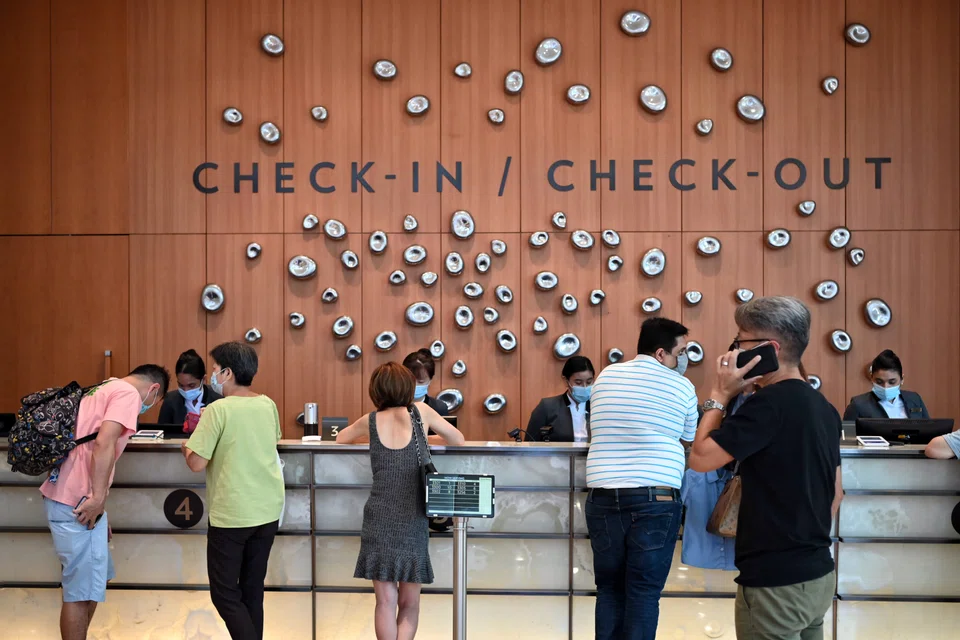
SELECT tourism-related businesses grappling with a staff crunch will be able to hire more foreign workers temporarily – but only on a case-by-case basis, with the allowances varying across companies, The Business Times has learnt.
Companies are assessed by government agencies on factors such as their commitment to local employment and “the progress of each company’s transformation journey”, a Ministry of Manpower (MOM) spokesperson told BT.
This flexibility was first disclosed in Parliament on Monday (May 9) by Manpower Minister Tan See Leng, who said that the authorities are working on “targeted support for the tourism and aviation industries with additional foreign worker quotas on a time-limited basis”.
MOM did not give further details in response to BT queries on what exact types of companies are eligible for the concessions, as well as the magnitude and duration of the increased quotas.
The Singapore Tourism Board has previously named hotels, attractions, tours, cruises, business travel and MICE (meetings, incentives, conventions and exhibitions) as some core tourism industries.
In the services sector, the share of work permit or S Pass holders in a company is usually capped at 35 per cent, with S Pass holders accounting for no more than 10 per cent.
Lam Yi Young, chief executive of the Singapore Business Federation (SBF), told BT that the temporary additional foreign worker quotas “will help to alleviate the manpower crunch which has led to a drop in service standards and longer waiting times”, although he added that members look forward to more details.
“With the reopening of borders, businesses in these sectors can look forward to higher demands for their services, but will require sufficient and suitable manpower, both local and foreign, in order to meet the demands satisfactorily,” he remarked.
Labour economist Walter Theseira stressed that Singapore’s broader economic status and reputation as an investment destination could be hurt if the travel and hospitality sector is “unable to meet the surge in demand from travel with general Covid-19 reopening globally”.
He added that temporary flexibility to hire more foreigners “buys time for the affected industries to adapt to the post-Covid-19 travel market”, as employers might otherwise be reluctant to expand at the risk of “significant local retrenchment later”.
The roles that could be filled under the additional quota will largely be “operational lower- to medium- skilled roles, particularly jobs such as housekeeping” that Singaporeans tend to shun, he said.
That’s as the Singapore Hotel Association recently told BT that the hotel industry lost about 25 per cent of foreign staff during the pandemic, while local workers left for other industries, contributing to a “critical shortage” in operations such as housekeeping.
The domestic labour market is also running near full capacity, with limited employment headroom. Singapore reported a job vacancy rate of 5.4 per cent as at end-2021, with 2.11 openings for every unemployed person, according to the latest MOM statistics.
Still, the MOM spokesperson noted that the concessions are “only for a time-limited period to ensure these critical industries have sufficient manpower to support their immediate-term recovery and capture opportunities”.
Asked about the possible impact on employers after the concessions expire, Lim Huishan, general manager of recruitment services firm FastCo, said that foreign workforce constraints stem from fluctuating movements in and out of the country, as borders reopen.
While “we expect the total pool of foreign workers to stabilise over time to pre-Covid levels”, the extra flexibility from the latest policy tweak should help until then, she said.
But a policy paper on Thursday (May 12) from the SBF, in consultation with other industry groups, separately observed that “the ability to take on foreign manpower is constrained by the ability to grow the local workforce”.
Lam told BT: “SBF also encourages our members to tap on the various schemes and support available to help with their digitalisation, automation and job redesign efforts.”
Theseira, an associate professor of economics at the Singapore University of Social Sciences, pointed to longstanding challenges in “attracting and retaining Singaporeans, and moving Singaporeans up the skills and value chain” in the affected service industries.
As foreign worker availability “reduces employer incentives to develop the local workforce”, businesses should offer locals good job opportunities during their ongoing expansion, while Singapore’s tripartite partners must work closely together “to ensure that the industry does not misuse the increased flexibility” in hiring foreign manpower, said Theseira.
TRENDING NOW
32 companies, 6 individuals bag accolades at Singapore Corporate Awards 2026

He built the Vingroup empire. Now South-east Asia’s richest man is handing some key roles to his sons
URA to review guidelines on floor space to give developers more design flexibility: Chee Hong Tat
Chagee, Mixue and Luckin won the market. Sustaining their edge is the harder part

