

India among most open in world for investment: Modi
He says his government has been successful in restoring the credibility of the nation in the eyes of global players
Singapore
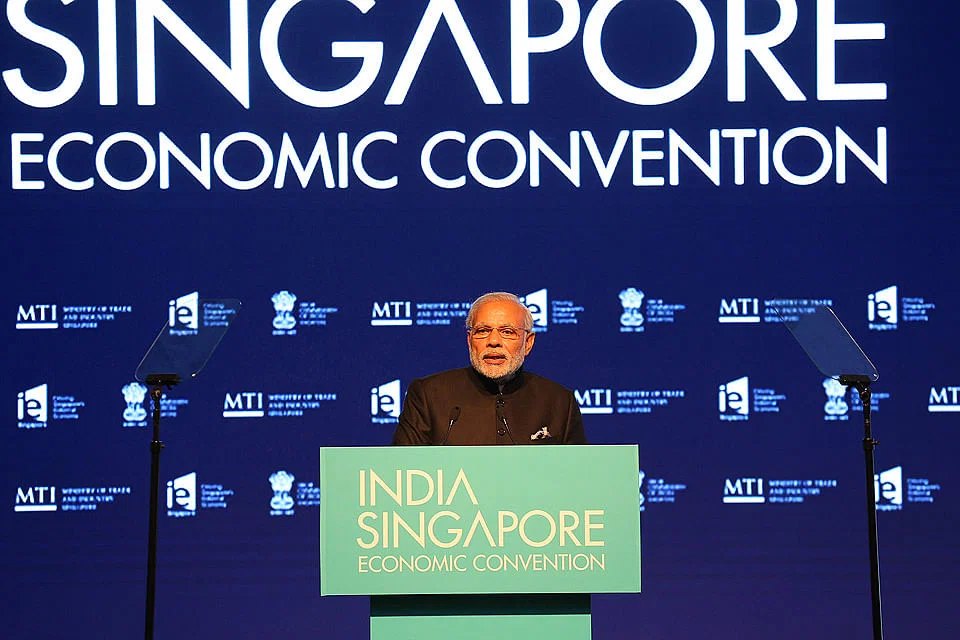
SPEAKING at the India-Singapore Economic Convention at Marina Bay Sands on Tuesday, Indian Prime Minister Narendra Modi made a forceful plea to Singapore-based companies to invest in India, saying that the country is now among the most open in the world for foreign direct investment (FDI).
Mr Modi told about 500 business delegates at the convention that over the past 18 months, his government has been successful in restoring the credibility of India in the eyes of global players.
"As soon as my government took over, we started liberalising the FDI regime along with other reforms. We are also conscious of the last mile operational issues in such policies. In that spirit, we are finetuning the procedures. Early this month, we have taken very dynamic steps to further open up the economy."
The Indian PM said that some new sectors have been fully opened and now, for most sectors, FDI clearances are on the automatic route. "In addition to greenfield areas, many sectors can freely absorb FDI in brownfield projects. This includes roads, construction and medical devices. Entry and exit conditions have been greatly relaxed for FDI."
Mr Modi noted that about 800 million people in India are below the age of 35 years and their aspirations, energy, enterprise and skills will be the force for India's economic transformation.
"But the immediate challenge is to productively employ the youth . . . we need to provide a huge push to manufacturing which has stagnated at around 16 per cent of the GDP (gross domestic product) for several decades.
"This share must reach around 25 per cent in the short and medium term. With this in view, we have launched the 'Make in India' initiative. We are working on all fronts to make India a global manufacturing hub. We are creating the global skill pool to establish a modern economy with a worldclass manufacturing sector."
Mr Modi noted that India's changing paradigm has created new opportunities for the global investor community. These range from building 50 million affordable houses to setting up 100 smart cities; modernisation of the railway network and redevelopment of stations to setting up new railway corridors; generation of 175 GW (gigawatts) of renewable energy to transmission and distribution networks. There is also opportunity in the construction of national highways, bridges and metro rail networks, he added.
Noting that Singapore is India's 10th largest trade partner globally, Mr Modi said that it is also the second largest in the Asean region. Bilateral trade has expanded manifold after the conclusion of the Comprehensive Economic Cooperation Agreement (CECA) in 2005, he added.
Mr Modi also noted that Singapore has emerged as the second-largest source of FDI into India. Outward Indian FDI to Singapore has also increased in recent times. "Singapore is now one of the top destinations for Indian investments."
In 2013, FDI from India into Singapore was S$23.7 billion, an increase of 3.34 per cent year on year and Singapore's direct investment abroad (DIA) to India was S$12.1 billion, an increase of 12.1 per cent year on year.
The prime minister added that he recently had the opportunity of laying the foundation for two projects in India with the participation of Singapore. One is the new capital city of Andhra Pradesh called Amaravati in which Singapore is involved in preparation of the Master Plan for the city. The other is the fourth container terminal at JNPT (Jawaharlal Nehru Port Trust), Mumbai which is being built in partnership with PSA Singapore. When completed in 2017, the new terminal will enable the port to handle an additional 4.8 million TEUs (Twenty Foot Equivalent Unit) per annum with greater efficiency.
Speaking at the event, Minister for Trade and Industry (Industry), S Iswaran, noted that Singapore's total trade with India has doubled from S$11.8 billion to S$24.6 billion, while its investments in India have grown nearly 20-fold from S$653 million to S$12.1 billion. This heightened economic activity has further enhanced people-to-people ties between Singapore and India, he added.
Mr Iswaran noted that apart from the Amaravati master plan project, Singapore has recently signed an MOU (Memorandum of Understanding) with the Rajasthan government to help come up with a concept plan for two townships in Jodhpur and Udaipur. "Our government agencies will also be working with India's Ministry for Urban Development to share our expertise in urban planning and to help build capacity through training Indian officials in sustainable urbanisation."
Giving some examples of major Singapore projects in India, Mr Iswaran noted that, apart from PSA's container terminal in Mumbai, the Singapore Airlines-backed Tata-SIA's Vistara Airlines started domestic flights in January. In the power sector, Sembcorp Utilities recently brought online its 1,320 megawatts power plant in Nellore and invested in 516 megawatts of renewable energy assets across five states in India.
The minister added that India and Singapore have committed to pursue five initiatives. They are: scaling up trade and investment; speeding up air and maritime connectivity and costal development; smart city development and urban rejuvenation; skills development and capacity building; and state focus to strengthen business and cultural links.
"While government leaders and officials on both sides will do their part, much will also depend on our business leaders and investors boldly seizing opportunities in India, Singapore and third country markets," Mr Iswaran added.
READ MORE: Singapore, India deepen ties with Strategic Partnership
TRENDING NOW

Britain’s mansion tax shows the difficulty of targeting wealth

Once staunchly pro-China, Malaysian Chinese businesses are now distancing themselves from Beijing

The only common thing in S-E Asia is that we all eat rice: Cisco’s Asean president

Singapore data centre operator DayOne opts for US IPO at likely US$20 billion valuation

