

Intra-Asia trade adds on muscle as US-Sino spat drags on
Citi sees double-digit intra-region revenue growth; other banks signal ambitions to capture more regional flows
Singapore
THE chills arising from trade tensions between the US and China has pushed Asia closer, with recent data from banks showing signs of the region's huddle in terms of intra-regional trade and capital flows.
Citigroup told The Business Times that the bank's corporate lending unit is recording higher revenues along the bank's intra-Asia trade corridors.
According to the bank's latest data, revenue growth for trade flowing between China and Asean in April rose 21 per cent over the year. This is roughly in line with the bank's 2018 full-year revenue growth for the China-Asean trade corridor, which stood at 23 per cent from a year ago.
All in, intra-Asia revenue booked by Citi's corporate banking unit in 2018 - this also includes key trade corridors between South Korea and Asean, as well as Japan and Asean - was up 22 per cent from 2017. Citi is targeting 25 per cent year-on-year growth in intra-Asia revenue in 2019.
To be sure, the bank has been capturing heavy Asia-to-Asia capital flows that broadly reflect the rising stature of the region. Citi told BT that Asia-to-Asia capital flows have grown steadily from 2010 to 2017, translating to more than five times the flows between the US and Asia in the same period.
But uncertainties around trade are also encouraging companies to re-evaluate and potentially reconfigure their supply chains, said Rajesh Mehta, Citi's head of treasury and trade solutions for Asia-Pacific.
"We are heavily involved in these discussions with clients and in some cases, we are already seeing shifts. These have involved shifts to Bangladesh and Asean markets including Vietnam and Thailand, across a number of industries and businesses," he told BT.
"Given that supply chains can be sticky, we would expect to see a measurable impact over the next 18 to 24 months. We believe these shifts will further drive intra-regional linkages and capital as well as trade flows."
Other banks have also signalled their ambitions to capture more regional flows within Asia.
UOB's figures in May show that of the entire group's wholesale banking income, a quarter of that reflected cross-border income in 2018. This cross-border income amount is also up 15 per cent from 2017. Most of those flows come out of the corridors connecting Asean and Greater China.
All in, UOB aims to have half of its revenue coming from outside Singapore by 2021, up from about 40 per cent, said its chief executive officer Wee Ee Cheong at the bank's annual corporate day event.
UOB is squeezing value out of its network as the Singapore bank with the largest Asean reach. It has been investing in recent years in the area of financial supply chain management, which captures the business of managing corporate clients and their working relationships with their upstream and downstream partners.
Fresh figures from the bank showed that in 2018, its transaction banking unit has grown by more than 50 per cent in the specific business of selling dedicated programmes to tackle clients' supply chain needs.
Critically, while the overall pie for UOB has expanded in the area of financial supply chain management, more than 70 per cent of its supply-chain coverage is now concentrated in Asean. This contribution is up from 30 per cent in 2015.
And as the bank expands through its supply chain coverage across sectors, it is also gaining new clients up and down the supply chain, deepening relationships through the chain by targeting the sector pain points of anchor clients.
With this approach taken over the last three years, roughly eight in 10 customers are fresh clients acquired, the bank said.
So Lay Hua, head of group transaction banking at UOB's group wholesale banking, said at the bank's corporate day event that this integrated approach allows the bank to work through customers' business model, and draw a deeper relationship.
"That is the power of conversation. If you don't have that depth, you are as good as any other bank that goes in to just sell a product," she said. "Leveraging on our network is very crucial."
DBS's chief Piyush Gupta said during the first-quarter results briefing that in the medium term, DBS can intermediate flows of some businesses moving to this region as part of a broader shift in the global supply chain. But both Mr Gupta and OCBC CEO Samuel Tsien have also cautioned that supply chains may not shift so noticeably in the short term.
Similarly, a recent JPMorgan report, which relied on Big Data analysis of supply chain shifts based on text mining of transcripts, noted that the bulk of relocation of the supply chain to South-east Asia is yet to come. On average, companies have indicated that their supply chains can shift in two to three quarters.
JPMorgan noted that some companies are disclosing increased production from South-east Asia from the first-half of this year, though more are expecting shifts in the second-half of this year or into 2020.
"Companies evaluating supply chain shifts could increase if trade tensions are not resolved. This can already be seen in company comments from May," said the report, adding that Vietnam and Malaysia are seen as the biggest beneficiaries in Asean.
A separate Citi report in May estimated that about 4 per cent of US imports from China are now being diverted into Asia to avoid US tariffs. That translates to a net gain of about US$9.4 billion for the rest of emerging Asia.
"It is not clear however if the growth cushion from trade diversion will be sufficient to completely offset the drag from sharper export declines from intensified negative supply chain spillovers and magnified cyclical weakness," the Citi report said.
As one sure sign of uncertainty brought on by trade tensions, trade-reliant Singapore is reviewing its 1.5-2.5 per cent GDP forecast for the year, with the Monetary Authority of Singapore's managing director Ravi Menon signalling last week that "we are now in the throes of a trade (and technology) war".
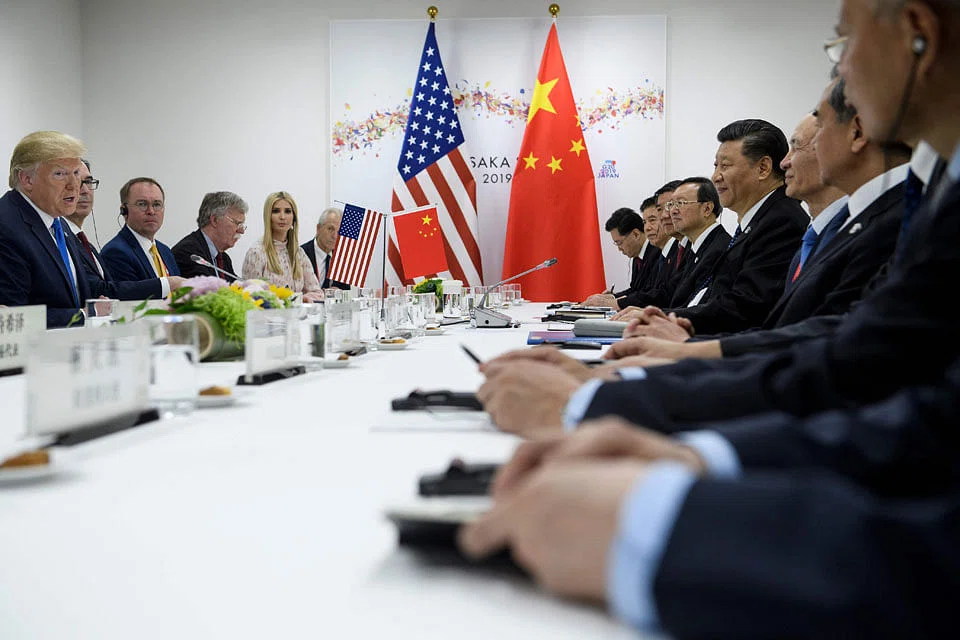
Over the weekend, a truce over the trade spat between the US and China was called, with US president Donald Trump saying he would hold off imposing another US$300 billion in tarrifs.
Additional reporting by Siow Li Sen
TRENDING NOW
‘We don’t want to stay as we are’: CEO Patrick Ng builds a more resilient Huationg
URA to review guidelines on floor space to give developers more design flexibility: Chee Hong Tat

He built the Vingroup empire. Now South-east Asia’s richest man is handing some key roles to his sons

32 companies, 6 individuals bag accolades at Singapore Corporate Awards 2026

