Job vacancies hit new high of 128,100 in Q1: MOM

Tessa Oh
JOB vacancies in Singapore rose to a new high in the first quarter of 2022, while a higher re-entry rate of 72 per cent was observed among residents 6 months after retrenchment, according to the Ministry of Manpower’s (MOM) Labour Market Report on Friday (Jun 17).
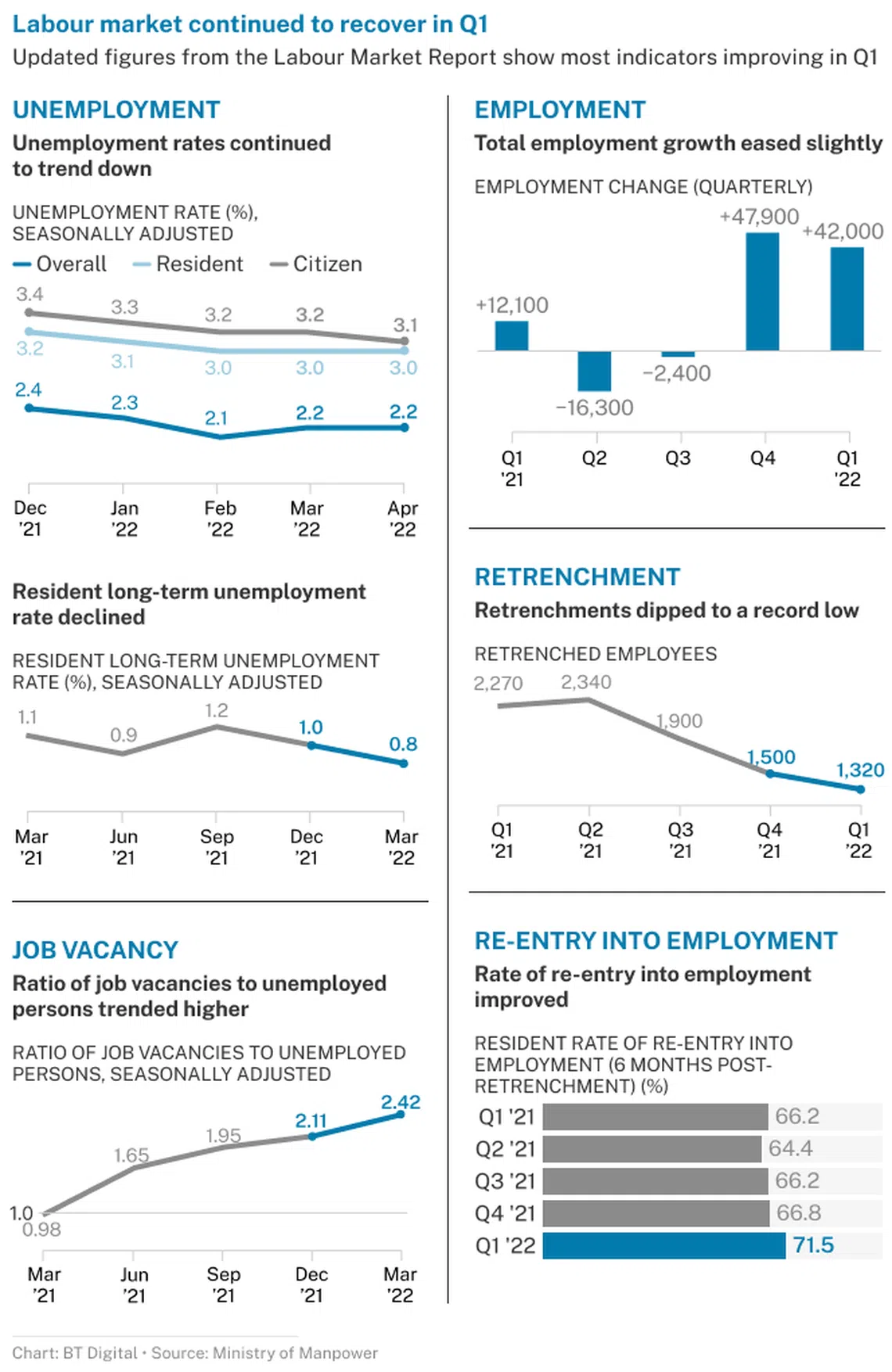
Job vacancies grew to 128,100 in March, though the rate of increase, at 9 per cent, was slower compared to the previous quarter.
The bulk of job vacancies were in the construction and manufacturing sector - mainly for non-PMET (professional, managerial, executive, and technical) job roles that are typically held by migrant workers - as well as in the financial services; information and communications; public administration and education; and professional services sectors.
The ratio of job vacancies to unemployment persons, at 2.42, also increased to its highest since 1998 due to a decline in unemployed people and increase in vacancies, said MOM.
CIMB Private Banking economist Song Seng Wun expects job vacancies to remain high in the second quarter, as restrictions ease and more industries resume in-person activities.
Total employment, excluding migrant domestic workers, grew by 42,000 in Q1 2022*. “Most of the total employment increase in Q1 were from non-residents, as border restrictions were progressively lifted and employers back-filled vacancies for jobs that are more reliant on migrant workers,” said MOM.
“With significant relaxation of border restrictions, we expect the non-resident workforce to continue to recover, catching up with the strong resident employment growth over the past 2 years,” said MOM, adding that this would help provide some relief to the current labour market tightness.
Maybank economists Chua Hak Bin and Lee Ju Ye expect the same, though they noted that the inflow “looks to be slower than initially expected”, with firms in sectors like aviation and hospitality struggling to find workers to fill vacancies.
Even so, the ministry noted that the deterioration of the external economic environment, partly due to Russia’s war in Ukraine, has weakened the demand outlook for some outward-oriented sectors, and this may cool the labour market.
But Song noted that this may not necessarily be a bad thing, given the current tight labour market. “Because if that indeed pans out and we do get that soft landing, that will be perfect. Ideally, every policymaker on the planet would love to see that happen.”
“But the reality often is that we over-tighten and we see a sharp pullback,” he added.
Even in such a scenario, skills mismatches may nevertheless persist, Chua told The Business Times. “Workers facing job cuts from crypto and e-commerce firms may not be interested in moving to the reopening sectors such as aviation and hospitality.”
“Wage pressures in the reopening sectors, including hospitality, construction and aviation, rely more on foreign manpower which remains in short supply,” he added.
As for whether labour demand may cool too much and lead to a rise in unemployment, Song said it is still too early to tell: “For now, we are still seeing revenge travel and revenge spending. But what happens after that? A lot depends on what happens with the central banks and interest rate policy and to what extent they can cool demand and soft land their own economies.”
While resident employment has grown to 3.9 per cent above pre-pandemic levels, non-resident employment in March remained 15 per cent below that in December 2019, before the pandemic.
Resident employment trends were mixed across sectors. While resident employment continued to expand in the financial services; information and communications; professional services; and health and social services sectors, it contracted in consumer-facing sectors, mainly due to the seasonal pattern of temporary workers hired for year-end festivities leaving in the following quarter.
Unemployment rates for citizens fell in April, to 3.1 per cent, from 3.2 per cent in March, and held steady at pre-pandemic levels for residents and the overall labour force at 3 and 2.2 per cent respectively.
However, while the unemployment rate continued to improve for most age and education groups compared to December last year, MOM noted that this was not the case for residents in their 50s and 60s and those with below secondary or degree qualifications.
“In particular for older residents, the rates in March 2022 were higher than their pre-Covid averages,” said MOM.
Resident long-term unemployment also improved between December 2021 and March 2022, falling to 0.8 per cent, from 1 per cent previously. However, it was still slightly above the pre-Covid quarterly average of 0.7 per cent in 2018/2019.
The number of retrenchments fell to 1,320 in Q1, from 1,500 in the previous quarter.
Among retrenched residents, the percentage of those who re-entered employment within 6 months after being retrenched rose to 71.5 per cent, from 66.8 per cent in the previous quarter - a high last seen in 2015.
Meanwhile, resignation and recruitment rates remained unchanged in the first quarter, after trending up in previous quarters.
Of note, however, were PMETs, who experienced “greater churn” as their recruitment and resignation rates have been creeping up and are now above pre-Covid averages, noted the ministry.
“Nonetheless, the rates in Q1 were still below record highs,” added MOM.
*Amendment note: An earlier version of the article said that total employment, excluding migrant workers grew by 42,000 on the quarter before. It has been edited to reflect the correct time period.