Jobs Transformation Map launched for wholesale trade sector
 Add BT as a preferred source
DeeperDive is a beta AI feature. Refer to full articles for the facts.
ABOUT eight in 10 jobs in the wholesale trade (WST) sector are expected to undergo a medium or high degree of change even as new job roles emerge.
Those in marketing and business development roles for instance, such as marketing coordinators, business analysts and market research analysts, might find themselves increasingly focusing on digital strategies and driving customer intimacy by leveraging real-time data. This may require them to pick up new skills including data assimilation and analytics, digital channel development, and marketing automation, said Manpower Minister Tan See Leng on Friday (Nov 5) at the launch of the Jobs Transformation Map (JTM) for the wholesale trade sector.
This is the fourth JTM launched to date, with 11 more being developed to cover more sectors. Each JTM is designed to provide a compass for employers and workers to prepare for and seize new opportunities as their sectors transform.
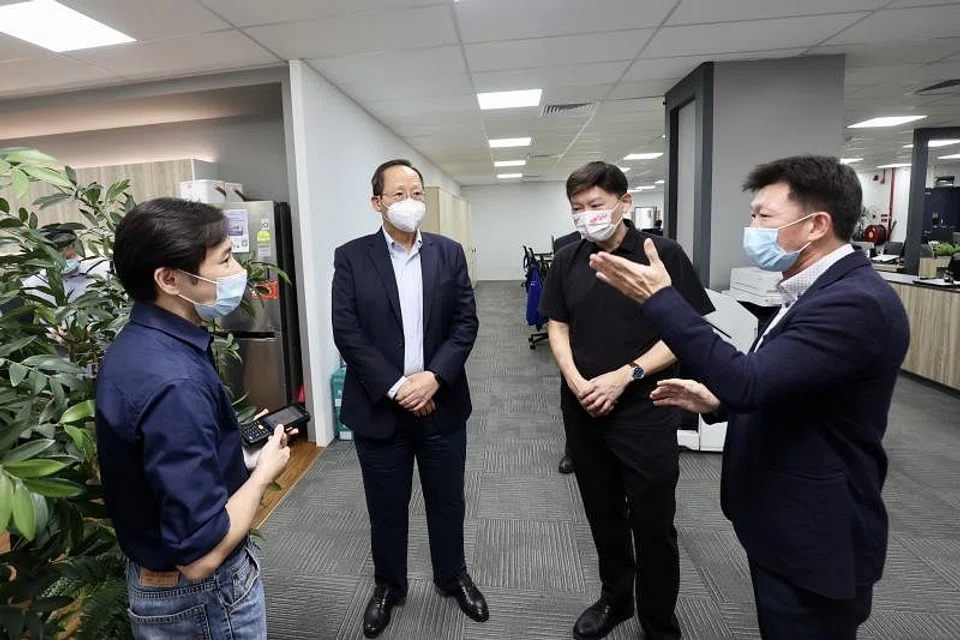
"Especially (roles) that require repetitive tasks, those may one day become automated and the scope of work of these roles will have to therefore be widened to encompass more value-added tasks," said Dr Tan, following a tour of IT product distributor, Ban Leong Technologies.
"With a greater focus on sustainability, we would expect growth linked to the green economy to also grow in demand. These include roles such as sustainability managers, which will implement corporate sustainability strategies to ensure that business practices are in line with government regulation and at the same time, to also raise the business appeal to customers, investors and business partners."
Trade is an essential pillar of Singapore's economy. In 2020, the WST sector contributed to 16.8 per cent of Singaporean's gross domestic product (GDP), generating about S$75.3 billion in value. The sector comprises about 50,000 companies and employs close to 10 per cent of the workforce.
Navigate Asia in
a new global order
Get the insights delivered to your inbox.
"I think we're at an inflection point where we think that there will be quite a huge uptick in terms of better working conditions... better opportunities in terms of career progression, as well as pay prospects," said Dr Tan.
He noted that among the various programmes made available to employers, the Career Conversion Programmes (CCPs) for instance helped Ban Leong Technologies relook its recruitment practices and move from hiring applicants who required minimal training to recruiting based on aptitude and potential and providing the required training to top up their skills.
Since 2018, Ban Leong Technologies has hired 16 employees through CCPs in emerging areas such as e-commerce, supply chain management, data analytics and software development in support of its business growth plans.
More than 1,600 workers have been placed through the CCPs since 2018, with more than 600 employers in the WST sector.
Asked if there will be more support measures or programmes lined up, Dr Tan said support measures will be more "precision-guided" to the different industries.
"I think the criticality of the industry itself, to the role it plays in anchoring and cementing our continued growth, all those factors mitigate the considerations. So rather than a blanket set of employment support initiatives, we'll be more targeted and we'll be more precision-guided in terms of our deliberations."
Also highlighted in the 27th Jobs Situation Report were four key trends that are impacting the sector. They include evolving operating models to meet new business needs and changing customer expectations, accelerating adoption of digital tools, growing significance of data analytics, and rising focus on sustainable practices.
NTUC deputy secretary-general Chee Hong Tat added: "We have always said that our end-in-mind when we transform our economy is to provide better jobs and higher pay for our people. To do this we have to focus on enhancing enterprise and also workforce capabilities because these are very closely tied to whether we are able to grow our economy to provide more opportunities, better jobs (and) higher pay."
And as sectors go through transformation, the pace of which was accelerated by Covid-19, it can be disruptive. But, he said, there are still growth opportunities.
"There will be companies that will grow, there will be companies that will shrink or even close down. Same for jobs. There will be jobs that will be created but there will also be jobs that will be disrupted, and some jobs will be lost. But overall, if we do it well, there will be a net gain."
Decoding Asia newsletter: your guide to navigating Asia in a new global order. Sign up here to get Decoding Asia newsletter. Delivered to your inbox. Free.
Copyright SPH Media. All rights reserved.