Labour's backing for UK remaining in EU now uncertain
The new Labour leader has made contradictory statements on whether country should be in the Union
London
JEREMY Corbyn's overwhelming hard left victory as the leader of the UK's main opposition Labour Party raises uncertainty about the outcome of Britain's European Union (EU) referendum, due before the end of 2017.
Sixty per cent of party voters - 171,000 votes ahead of the second best candidate - were in favour of anti-austerity campaigner Mr Corbyn. The victory, resignation of a dozen left-leaning moderates from Labour's shadow cabinet and media reports of a potential split in the party, however, will have limited impact on the Conservative government's domestic and foreign policy. The Conservatives currently have a small 12-seat lead majority in parliament, are in power until May 2020 and a spot poll of the right wing Mail on Sunday shows that their lead has widened considerably. Moreover, some 90 per cent of Labour MPs who opposed Mr Corbyn, fear that if the hard left remains in control, the party could lose again in 2020.
The key political event in the coming year is thus the referendum on whether the UK remains in or out of the EU. Following Mr Corbyn's victory, international businesses and investors will focus on whether Labour's previous overwhelming support for remaining within the Union will continue.
The new Labour leader, who voted in a 1975 referendum against joining the European Common Market as it was then known, has made contradictory statements on whether the UK should be in the EU. His critics fear that this ambivalent stance could alter the voter intentions of Labour EU supporters. There are already signs that Britain's working class fear job competition from western and eastern Europeans.
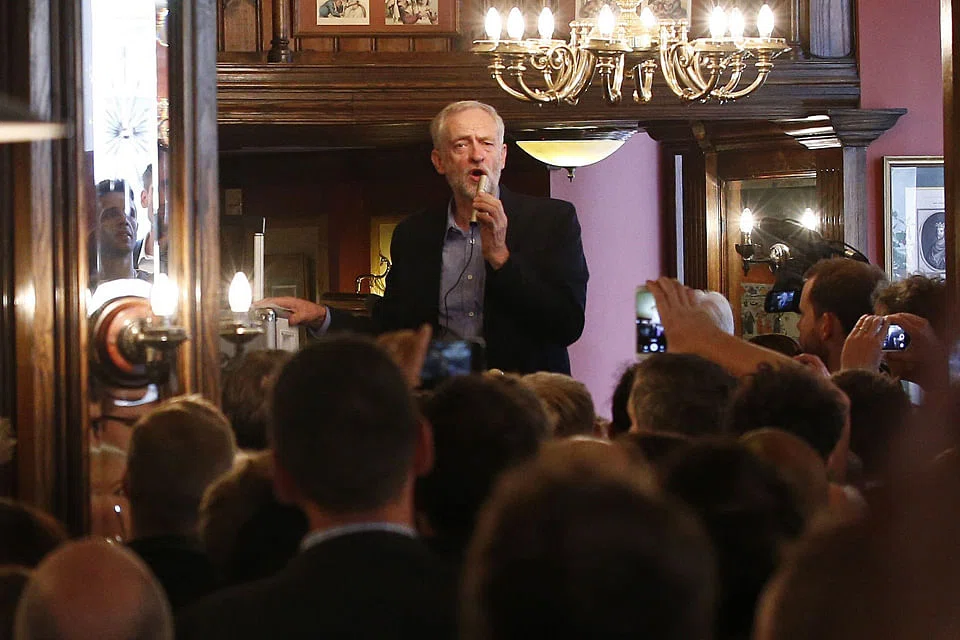
Mr Corbyn has stated that his preferred stance would be to stay in a reformed EU. But questioned on whether he would possibly campaign to leave the Union, Mr Corbyn said at a recent rally: "I wouldn't rule it out."
He reasoned that in his negotiations for EU reform, Mr Cameron "quite clearly follows an agenda which is about trading away workers' rights, about trading away environmental protection, about trading away much of what is in the social chapter".
"The EU also knowingly, deliberately, maintains a number of tax havens and tax evasion posts around the continent - Luxembourg, Monaco, " he said, adding that under his leadership, Labour should set out its negotiating demands on issues such as workers' rights, the environment, tax and wage protection.
"I think we should be making those demands and negotiating on those demands rather than saying blanketly, we're going to support whatever Cameron comes out with, in one, two years' time, whenever he finally decides to hold this referendum."
Former Labour government minister Alan Johnson, who is heading the party's "Yes" campaign ahead of the referendum warned that lack of clarity on such an important issue was not an option.
"The Labour party ditched its anti-European stance in the mid-80s, at the beginning of our long march back to electability," he said.
"The membership has a right to know if any leadership candidate wants to take the party (and the country) back to its isolationist past to the detriment of of British jobs, growth and influence in an increasingly interdependent world."
When Mr Corbyn originally stood as leader, the bookies rated his chances as 100 to 1. Those who took that bet would have won handsomely and in retrospect, his victory was an easy call. Large numbers of youthful Labour supporters detest former "New Labour" premier Tony Blair and his supporters because of the Iraq war and high spending economic policies that contributed to Britain's great recession in 2009. They are also annoyed with the ineffective opposition to government spending cuts, including large scale public sector worker layoffs, benefit cuts, relatively high middle income taxation and other austerity policies. The youth, including numerous graduates, are struggling to find fulfilling, reasonably paid jobs while ordinary workers are struggling to obtain jobs or maintain their job security.
In the meantime, the gap between the rich - who are a small proportion of the populace - and the poor has widened considerably since 2009. Quantitative easing, virtually zero interest rate policies, locally and internationally, for example have boosted London residential property prices way above affordability levels for middle to lower income employees.
The average worker is thus forced to rent in a poorly regulated rental market, or commute in crowded expensive rail journeys to their London workplaces. Illustrating the true divide in the United Kingdom, the Conservatives' share of vote in the May elections amounted to only 36 per cent, compared with Labour's 30.4 per cent. Including other left wing parties, the Scottish National Party and Greens, the left leaning potential alliance got 39 per cent, while centrist middle left Liberal Democrats obtained 8 per cent of the vote. The anti-EU, UK Independence Party (UKIP), with only one seat, obtained 13 per cent of the vote.
READ MORE: Left-wing radical elected UK Labour leader