

Layoffs double in Q2; total employment dives by quarterly record of 122,000
Actual numbers likely to be bigger; worst not over, say Manpower Minister Josephine Teo, economists

Singapore
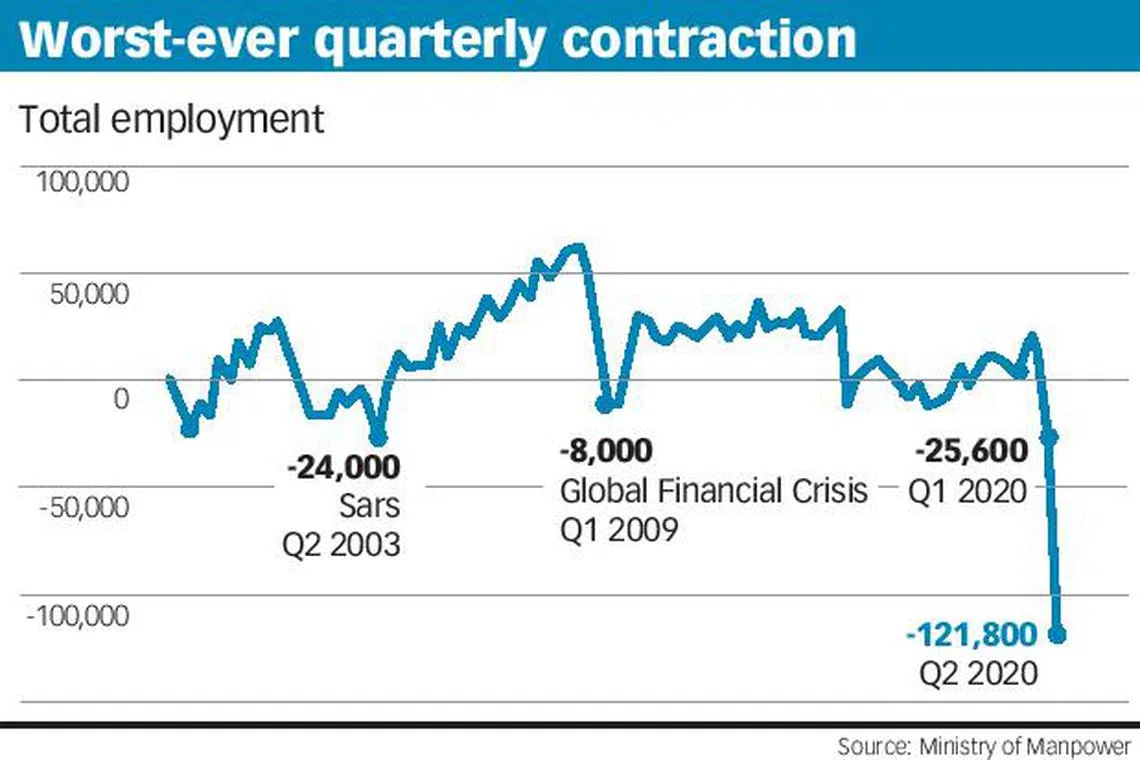
SINGAPORE'S total employment saw its worst quarterly contraction on record in the second quarter of 2020, according to preliminary data, and economists fear the worst is yet to come.
The total number of people working between April and June shrank by 121,800, almost five times the 25,700 seen in Q1, according to the Ministry of Manpower (MOM) on Wednesday. The contraction in employment in Q2 was broad-based across the manufacturing, services and construction sectors.
The poor showing in Q2 corresponds with Singapore's "circuit breaker" period, when the economy was partially shut down from April 7 to June 1 to curb the spread of Covid-19.
Retrenchments more than doubled in Q2 to 6,700, compared with 3,220 in Q1. MOM noted that while Q2's figure has surpassed the quarterly peak of 5,510 seen during the severe acute respiratory syndrome (Sars) outbreak in 2003, it is still lower than the 12,760 reached during the 2009 Global Financial Crisis.
While the preliminary data is dire, the actual situation is likely to be worse.
In a Facebook post on Wednesday, National Trades Union Congress assistant secretary-general Patrick Tay said: "The figures may not reflect the full impact of the retrenchment numbers as I do see and hear of workers being contractually terminated (though with adequate notice pay), older workers not being re-employed, as well as foreign workers on work permit, S-Pass and Employment Pass whose passes are not renewed. These do not count towards overall retrenchment numbers."
Maybank Kim Eng's senior economist Chua Hak Bin added that retrenchment figures only capture firms with at least 25 employees, and do not include contract workers or those in the gig economy.
"That's why we prefer to look at the total employment loss, which is about 148,000 in the first half (of 2020)," Dr Chua said. "This pandemic is a regressive shock which disproportionately hits the lower wage workers and also the smaller firms, including the self-employed and SMEs."
The overall unemployment rate rose to 2.9 per cent in June, up from 2.4 per cent in March. Resident unemployment rose from 3.3 to 3.9 per cent during this period, while citizen unemployment went up from 3.5 to 4 per cent.
Economists believe the worst is yet to come, echoing the ministry's view that the labour outlook remains soft in the months ahead, even though the economy began its phased reopening in early June.
Manpower Minister Josephine Teo told reporters during a briefing: "It is reasonable for us to adopt a more cautious attitude, and that is to expect that it hasn't bottomed."
Comparing Singapore with Hong Kong, Mrs Teo noted that Hong Kong's unemployment rate has risen to 6.2 per cent by June, even though both cities had comparable resident unemployment rates at end-2019. She pointed out that governments that prioritise minimising Covid-19 fatalities would have to take strict measures with regard to economic and social activities, and this would have an impact on employment.
United Overseas Bank economist Barnabas Gan said companies may also be reluctant to hire, while the pressure to retrench could increase, against the backdrop of a slowing economy.
OCBC Bank's chief economist Selena Ling said one key milestone to watch will be the upcoming expiry of the Jobs Support Scheme (JSS) in August and a calibrated extension to provide longer support for a longer period of time given the long tail nature of the Covid-19 pandemic cannot be discounted.
"The path of least resistance may be that fiscal stimulus remains on tap, as... is currently under consideration in the US Congress, and various forms of jobs and unemployment wage support schemes have also been extended in Australia and the UK," Ms Ling said.
However, for workers that have been laid off, wage support through the JSS is of limited help.
Maybank's Dr Chua said: "We think the government should also consider some unemployment income support for the retrenched workers, as they will struggle to find a job quickly in this pandemic recession."
Deputy Prime Minister Heng Swee Keat, during a visit to the SGUnited Jobs and Skills Centre at Kampong Chai Chee Community Club on Wednesday, told reporters the government has been in discussion about its next steps.
"We have been poring through the data and looking at what are the immediate things that we need to do and what are the longer-term issues we need to do. So in the immediate, I think we will have to look at how we can continue to protect the livelihoods of our workers, how do we create jobs and training opportunities. That is the top priority at this stage," Mr Heng, who is also Finance Minister, said.
Meanwhile, some 13,000 company attachments will be made available to local mid-career jobseekers from Aug 1 through the SGUnited Mid-Career Pathways Programme, Workforce Singapore said.
READ MORE: Foreign workers: boon or bane to Singapore?






