Manpower Minister urges companies to grow their headcount with locals
The Jobs Growth Initiative is not a permanent scheme, so employers should tap on it now to hire: Tan See Leng

Singapore
MANPOWER Minister Tan See Leng has urged employers to get on with hiring, as business confidence recovers and firms are adding to their local headcount.
His call came on the news that the Jobs Growth Incentive (JGI) scheme supported the hiring of some 140,000 workers between last December and February this year. The figure is on top of the 130,000 locals hired in the three months prior.
In his first Jobs Situation Report presentation since taking over the Manpower portfolio in May, Dr Tan described the JGI as "an extraordinary measure" but "not a permanent scheme".
He urged employers "not to delay their hiring plans in the hope that the scheme will be available indefinitely - but to take on the opportunities and to seize them now".
Asked about plans for the JGI, which expires in September, he said the government is "taking into consideration the potential economic, labour market situation as well as the outlook" as it reviews the programme.
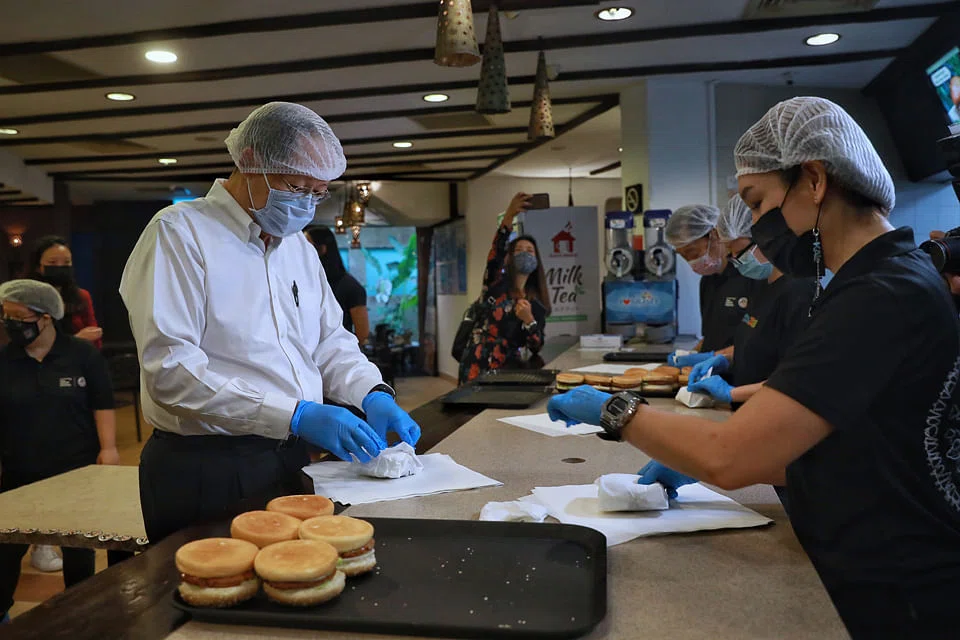
The minister spoke after a visit to The Social Kitchen @ Jurong Bird Park, a social enterprise eatery which has hired disabled and older workers with support from the JGI.
Noting that almost all participating employers on the JGI have so far been small businesses, he added that he was glad that the support has given these businesses the confidence to hire despite the crisis, and described the job growth as a sustainable uptrend "over the longer term".
The JGI offers up to 12 months of salary co-payment for most new local hires, or up to 18 months of support for mature workers, people with disabilities and former offenders.
Some S$1 billion was set aside for the JGI at its launch last September, with another S$5.2 billion added in the Budget in February this year to extend the scheme by seven months.
Dr Tan added that the JGI helps to add new positions, and exclusively benefits local workers. The Ministry of Manpower (MOM), which defines the local workforce as citizens and permanent residents, said the scheme aims to "create good and long-term jobs for locals".
Labour economist Walter Theseira, associate professor of economics at the Singapore University of Social Sciences, told The Business Times "there is particular urgency to ensure that the Covid-19 recovery is fuelled by local hiring in the first instance".
"In the past few decades, rapid economic expansion in Singapore has been fuelled by foreign hiring, because there was simply little room for expansion in the local labour force... This time is different, because the impact of Covid-19 has pushed up local unemployment and also resulted in substantial under-employment," he said.
Resident unemployment fell from 4.8 per cent in September 2020 (when the JGI kicked in) to 4.1 per cent in February 2021. It most recently clocked in at 3.8 per cent in May, when there were 88,600 unemployed residents.
Yet, the MOM noted in its report on Wednesday: "As unemployment remains elevated compared to before Covid-19, MOM encourages employers to take full advantage of the JGI to meet their manpower needs."
Said Prof Theseira: "A substantial increase in demand for manpower cannot be met by locals. Nonetheless, I think the key is to meet that demand first with locals to ensure that Singaporeans can benefit fully from the recovery."
Maybank Kim Eng senior economist Chua Hak Bin estimated that employment would grow by 50,000 to 100,000 jobs in 2021. He called the projected growth "healthy but insufficient" to fully recover the 167,000 jobs that were lost last year.
Resident employment is already above pre-pandemic levels, but total employment remains far below pre-pandemic levels as foreign employment has yet to recover, he told BT.
He added that border controls with South Asia will also dampen the jobs recovery in sectors such as construction, marine, and processing.
Still, Dr Tan told reporters that "it's very unlikely" that the jobs added under the JGI will be taken on by foreign workers in future - "unless the Singaporean core themselves decide to exit these jobs that were created, and the positions are left vacant".
He also stressed, in response to BT queries, that the scheme supports job creation, since businesses must increase local workforce size to qualify.
Some 60,330 hires under the JGI were in food services and retail. Another 54,940 were in wholesale trade, professional services, and information and communications, which the MOM has dubbed "growth sectors".
Overall, nearly half the new JGI hires were aged 40 and above, with one-third aged at least 50 years. More than 1,600 people with disabilities were hired with support from the scheme as of end-February.
In a Facebook post on Wednesday, National Trades Union Congress assistant secretary-general Desmond Choo said: "As we see clearer signs of economic growth globally, more opportunities will be available to our Singaporean workers. We encourage companies to prepare for the upturn by hiring and training workers early. In addition, continued growth requires our workforce to be vaccinated and workplaces to be Covid resilient."