

March factory output cues slight Q1 growth upgrade
But manufacturers will still face uncertainties in coming months
Singapore
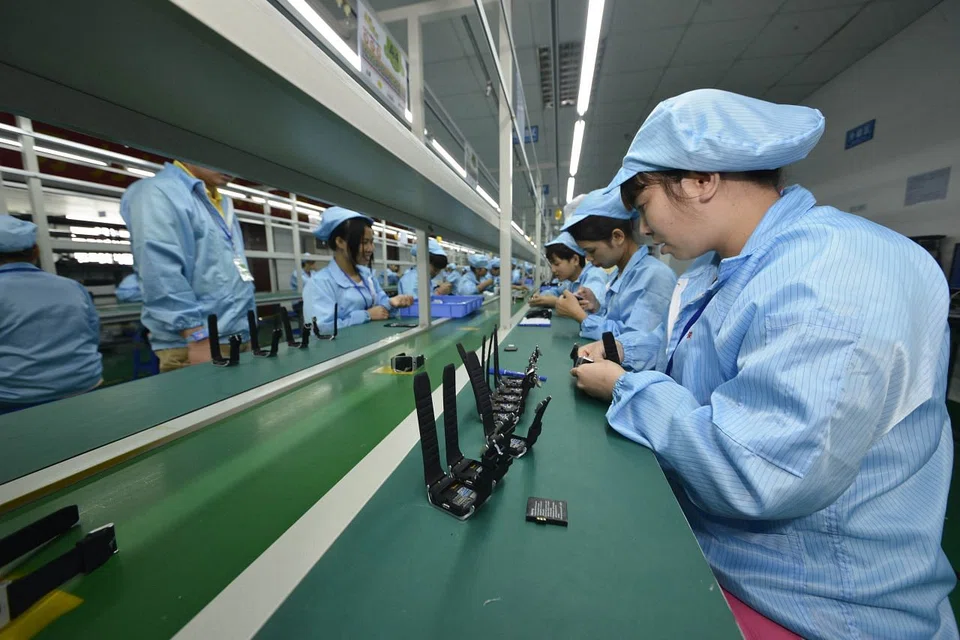
THE Singapore economy may have grown slightly more in the first quarter than advance GDP estimates suggest, economists said, after the manufacturing sector did better than expected in March, reinforcing last month's strong exports data.
Whether this can be sustained remains to be seen though, as manufacturers will continue to be challenged by economic uncertainty in export markets and the tight labour market back home.
Singapore's industrial production shrank 5.5 per cent in March from a year ago but beat economists expectations of a larger 5.8 per cent drop. This contraction - deeper than February's 3.3 per cent fall and the sharpest in two years - was partly exaggerated by the high base in March 2014 when volatile pharmaceuticals output surged.
In month-on-month terms, March's factory output rose 1.2 per cent after seasonal adjustments, also beating the consensus forecast of 0.8 per cent growth.
Economists - including those at Bank of America Merrill Lynch, Citi, Mizuho and OCBC - now expect the government to revise Q1 GDP growth to 2.2 per cent year on year, a notch above the flash estimate of 2.1 per cent. This is assuming no material change to the services and construction sector's growth, they said.
However, Friday's manufacturing report from the Economic Development Board (EDB) also showed up the demand challenges that certain industries faced - and may continue to face in coming months.
Pharmaceutical output shrank 13.9 per cent year on year, as production of active pharmaceutical ingredients and biologic products fell, EDB said.
This was offset in part by a 19 per cent expansion in the medical technology segment, which benefited from foreign demand for medical instruments, but the overall biomedical manufacturing cluster still contracted 8.5 per cent from a year ago.
Excluding the biomedical cluster, industrial output would have fallen a smaller 4.6 per cent year on year. That is because the electronics and transport engineering clusters shrank in March.
Electronics, which remains a key pillar of Singapore manufacturing and is the cluster with the largest weight on the industrial production index, saw output fall 5.2 per cent year on year in March - extending February's 4.5 per cent decline.
"The improvement in the electronics cluster," said OCBC economist Selena Ling, "still appears to be one step forward, one step back."
Semiconductors led that pullback with a 21.1 per cent plunge in output, offsetting the double-digit growth in other electronics segments such as computer peripherals, data storage and infocomms and consumer electronics.
Mizuho economist Vishnu Varathan thinks that weak semiconductor production, despite improved non-oil domestic export numbers, could imply one of two things. The jump in exports may have drawn down on existing stocks of goods, which would mean that future production would be ramped up if demand holds up, or, better pricing reflected in the export numbers was not fully picked up in the volume-based manufacturing data, which adjusts for price changes.
Either way, he expects a "modest recovery" ahead for the electronics cluster, especially given the US SEMI Book-Bill indicators and how "softer oil prices could bump up discretionary demand a little more".
But weak oil prices have had the opposite effect on the transport engineering cluster, as they dampened demand for deep sea oil rigs.
Output for that cluster fell a sharper 15.6 per cent year on year in March, following a 7.2 per cent drop in February. Lower demand for engine repair jobs hit the aerospace segment, while a fall in rigbuilding and shiprepair activities affected the marine and offshore engineering segment. The likelihood of a recovery in this segment is limited, even if oil prices recover modestly, Citi economists Kit Wei Zheng and Yap Kim Leng said.
As the high base effects from 2014 wear off, manufacturing may start to show positive growth from next month, said UOB economists Francis Tan and Jimmy Koh.
But they cautioned that the growth figures alone say little about where manufacturing is headed. "Headwinds over the next few months, such as the economic uncertainties in the eurozone, Japan and China, the still-low global oil prices that may continue to impact the marine and offshore engineering and petrochemical segments, and the tight domestic labour market, will continue to plague manufacturers," they said.
TRENDING NOW

Philippine power giant First Gen rebuffs foreign offers, plans up to US$2.6 billion in expansion

Cliff Tan has 7 million followers and a 4-month waitlist. Why won’t he expand his business?

Could stablecoins be the future of money?

From finance aspirant to Asean CEO: TUV SUD’s Jonas Strahberger on finding people who believe in you

