MAS expects slower but 'above-trend' growth in 2022

Singapore
SINGAPORE'S economic growth in 2022 is expected to be slower than in 2021, but still above trend, the Monetary Authority of Singapore (MAS) said in its latest Macroeconomic Review on Thursday (Oct 28).
While the MAS did not put a number to "above-trend growth", private-sector economists' estimates of Singapore's pre-Covid trend growth tend to land between 2 and 4 per cent. The MAS' full-year growth expectation for 2021 remains at 6 to 7 per cent.
Despite the Republic's recovery having stalled in the last 2 quarters amid a Covid-19 resurgence, aggregate output returned to its pre-pandemic level in the third quarter, though industry performance varied significantly.
In Q3, the trade-related and modern services clusters surpassed their respective pre-pandemic levels by around 10 per cent and 5 per cent.
In contrast, the domestic-oriented cluster was still some 10 per cent below its pre-crisis level, while the travel-related cluster's output was half what it was before Covid-19.
Recovery in the domestic-oriented cluster "was held back by several rounds of heightened alert measures", and "stabilisation phase" measures are expected to dampen domestic activity in the early fourth quarter of 2021. But in line with the strategy of treating the virus as endemic, restrictions are likely to be gradually relaxed in the latter part of Q4 and into 2022, said the MAS.
Domestic-oriented and travel-related clusters should see a gradual improvement as the economy reopens, while growth in the trade-related and modern services sectors will be supported by the global recovery.
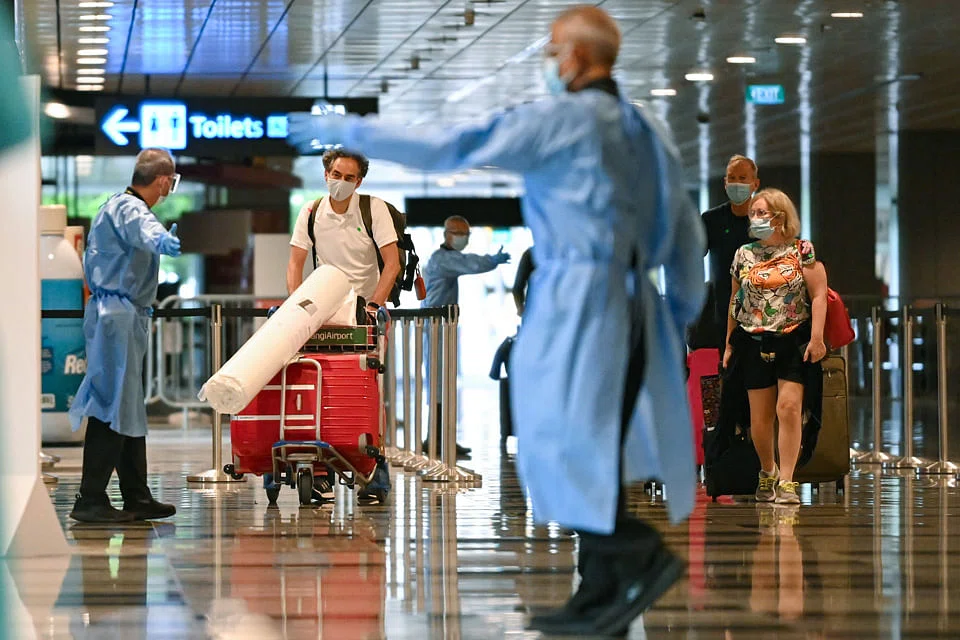
However, despite the opening of Vaccinated Travel Lanes, "travel demand is not expected to return quickly or substantially in the near term", it added. "A stronger rebound in the travel-related sector may only materialise over the course of next year when border barriers are removed more substantially, and a recovery to pre-Covid output level is only anticipated after 2022."
In the construction sector, recovery is expected to be hampered by elevated raw material costs and manpower shortages for the rest of 2021, but the easing of supply-side constraints beyond that should support higher activity levels.
The outlook for the manufacturing sector remains bright, with ongoing strength in the global electronics cycle providing support for the rest of 2021 and 2022.
Modern services, which supported growth in the second quarter and Q3, will be further lifted by the broader economic recovery. As business travel recovers, the outlook for the professional services sector - which "has been sluggish over the past year" - is expected to improve, with increased exports of segments such as business consultancy and head offices functions.
Barring major shocks such as the emergence of a vaccine-resistant virus strain, Singapore's economy should grow at an above-trend pace, said the MAS.
As a function of productivity and labour force growth, trend growth depends partly on population and immigration policy, said Maybank Kim Eng senior economist Chua Hak Bin, whose underlying assumption for trend growth is 2 to 2.5 per cent.
OCBC head of treasury research and strategy Selena Ling sees Singapore's medium-term trend growth as 2 to 4 per cent.
DBS senior economist Irvin Seah's expects 3.2 per cent growth in 2022, "marginally above the 2 to 3 per cent trend growth", but thinks that the MAS might be looking at a rate above 4 per cent instead.
The reason for his being "slightly more cautious", he said, is due to China-related risks and the uneven labour market recovery's effect on domestic consumption.
The trajectory of global recovery is similar to that of Singapore, with renewed Covid-19 infections having posed a setback in Q2 and Q3, but growth expected to stay above trend in 2022. Global gross domestic product growth is projected at 5.6 per cent in 2021 and 4.8 per cent in 2022.
Recent supply chain bottlenecks have forced up prices for commodities and manufacturing inputs, with some pass-through to consumer prices. But inflationary pressures should ease in 2022 as supply issues are resolved, though there is a risk this could take longer than expected.
Global inflation is projected at 2.6 per cent in 2021 - the highest since 2011 - and is expected to remain elevated at 2.4 per cent in 2022, reflecting a narrowing global output gap.
In Singapore, the large negative output gap that opened in 2020 and narrowed significantly in 2021 is expected to turn "modestly positive" in 2022, said the MAS.
READ MORE: