

Meeting infrastructure needs is a partnership venture: Indranee
She says Singapore is working to standardise project finance documents and developing a capacity building programme for regional officials
Singapore
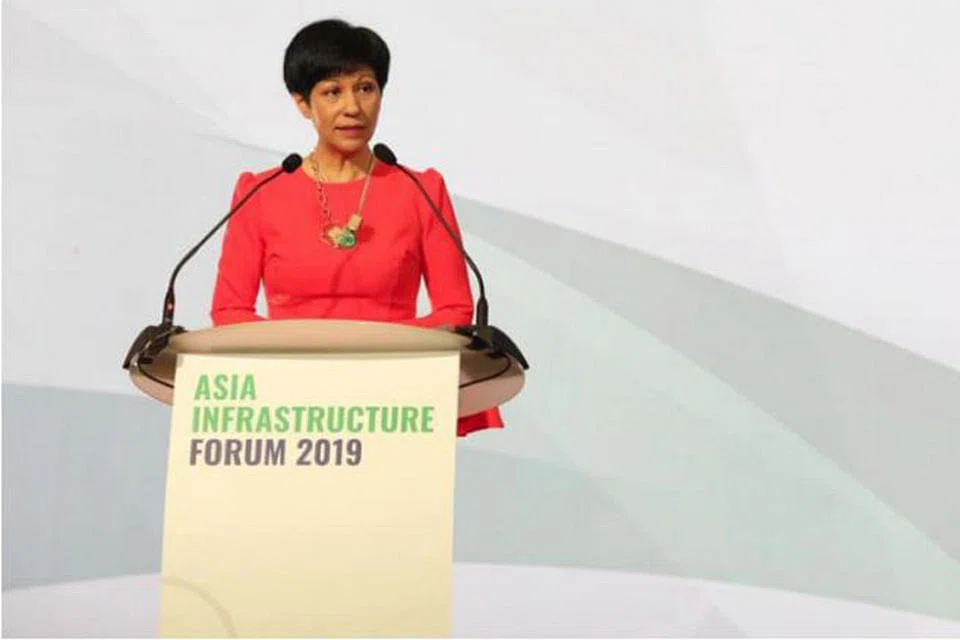
ASIA'S demand for highways, ports, railways, bridges, power plants, telecommunication services and water supply is huge, but governments, multilateral agencies and the private sector must work together to get these infrastructure projects off the ground, Minister in the Prime Minister's Office Indranee Rajah said on Wednesday.
There is no lack of money to fund the projects, estimated to cost US$51 trillion (S$70.89 trillion) through 2040, but many partnerships must be formed to make the projects "bankable", said Ms Indranee, who is also the Second Finance and Education Minister.
"There is a huge demand, there's a lot of supply as well - supply in terms of funds looking for projects," she told reporters on the first day of the two-day Asia Infrastructure Forum.
"The problem is bankability. You may have a project and you have investors looking for projects to put their money in, but the way the project is structured doesn't allow the investor to get revenue back within a certain time, or they are not assured of the viability."
She said that is why Singapore places much emphasis on "partnerships" along with "bankability" and "structuring" at the forum, which has attracted around 800 business and government leaders, including high-ranking officials from Asian countries, the Asian Development Bank and the World Bank.
"The key thing behind today's event is we want to emphasise the importance of partnership," she said. "We've brought together stakeholders in the infrastructure value chain, we've brought together multilateral banks - and of course, we have our partnership with the World Bank - and we also got leaders from some of the countries in the region. And the idea is if you pull everything together, you'll get a clearer insight as to what's going on in each country, what the latest developments are. Then you're likely to have a much better outcome."
Many of the services for structuring - financial, legal and technical and engineering - are readily available in Singapore, said Ms Indranee who delivered the keynote address at the forum hosted by Infrastructure Asia, which was set up a year ago by Enterprise Singapore and the Monetary Authority of Singapore.
In her address, she announced that Infrastructure Asia will standardise 50 per cent of the terms in project finance documents in the coming year.
"The use of standardised tools, where feasible, can significantly reduce project development timescales and bring transparency into procurement and contracting processes for host governments and procuring bodies," she said.
These are often cited as key challenges in the infrastructure development process.
"We hope this will, over time, contribute to a more vibrant secondary market in infrastructure debt and start attracting non-bank investors into this asset class."
Infrastructure Asia will also work with the World Bank Group to develop a capacity-building programme for regional government officials. Entitled "Growing Infrastructure - Enabling and Structuring for Private Sector Participation", it will address the oft-cited needs of key project officials lacking capabilities in designing and implementing projects as well as in creating an enabling regulatory environment for public-private partnership. Ms Indranee spent quite a bit of time in her speech on the "need to build green infrastructure that is sustainable and fights against or, at the very least, mitigates climate change even as it allows countries to pursue their developmental goals".
Sustainable infrastructure is "infrastructure with a specific focus on better management of energy, water and land; it incorporates green areas, uses innovative solutions and technology as well as responsibly-sourced, durable building materials", she said.
Six Memoranda of Understanding (MOU) were inked at the forum, including five that will deepen Infrastructure Asia's collaborations with multilateral banks, public-sector agencies and private-sector companies.
The sixth MOU was signed between Enterprise Singapore and the Japan Overseas Infrastructure Investment Corporation for Transport & Urban Development to share information and coordinate with each other on third-country projects where smart infrastructure is to be used.
TRENDING NOW

Fed hike throws Singapore banks a margin lifeline; UOB most likely to feel impact

He built the Vingroup empire. Now South-east Asia’s richest man is handing some key roles to his sons
Real-estate veteran Desmond Sim quits from CEO roles at Realion, ETC

Chagee, Mixue and Luckin won the market. Sustaining their edge is the harder part

