

Minority PM inevitable, but Tharman rules himself out
PM Lee enjoys S'pore's trust and confidence, he says, and younger candidates are in the wings
 Add BT as a preferred source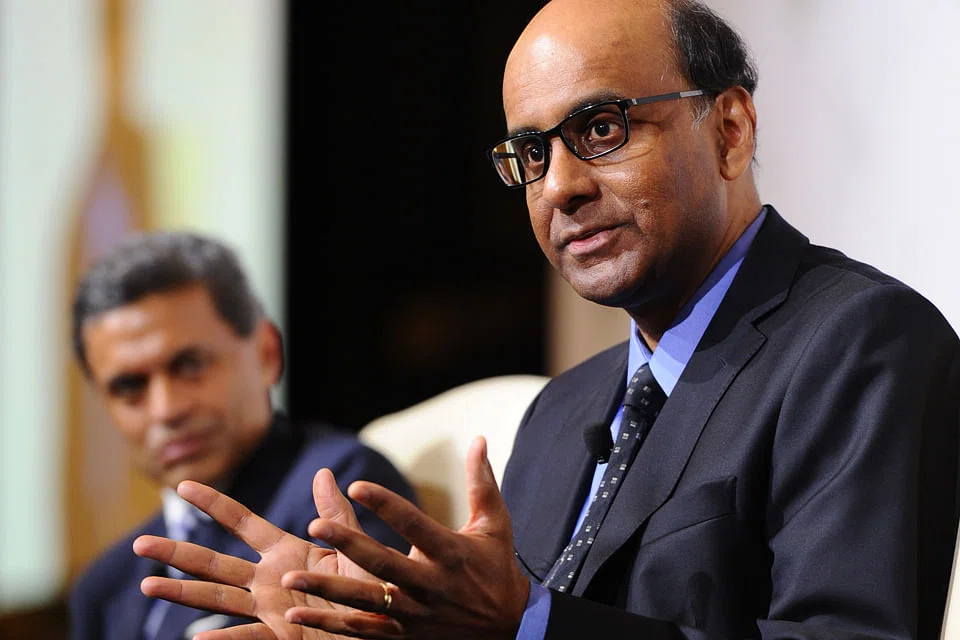
Singapore
IT is only a matter of time before Singapore has its first minority-race prime minister, said Deputy Prime Minister Tharman Shanmugaratnam on Friday - but it won't be him because he isn't interested in the job.
He said: "Let me put it this way. We all have our preferences, and I was always, in sports, playing centre-half rather than centre-forward. I enjoy playing half-back and making the long passes, but I am not the striker. Unless I'm forced to be, and I don't think I'll be forced to it, because I think we've got choices.
"We won't always get it the way we expect it to be, but we think very hard about succession in Singapore."
Mr Tharman, who is also Finance Minister, was speaking at at the two-day SG50+ conference jointly organised by the Institute of Policy Studies and the Lee Kuan Yew School of Public Policy, and themed "Singapore at 50: What lies ahead?".
His preferences aside, Mr Tharman said he doesn't need to become prime minister because there is a great deal of trust and confidence in Prime Minister Lee Hsien Loong, who is fortunately very healthy, and also because younger candidates are already waiting in the wings; those already in the fray and those entering it will provide Singapore's future leadership, he said.
"It seems to me inevitable that at some point, a minority prime minister - Indian, Malay, Eurasian, or some mixture - is going to be a feature of the political landscape, because we've got a meritocracy; it's an open system. It's just a matter of time."
He had been asked, during a dialogue with American journalist and author Fareed Zakaria, which was a part of the conference, whether Singapore could have an Indian prime minister.
As for the set-up of Singapore's political landscape, Mr Tharman rejected the idea that Singapore is a one-party state - one where the People's Action Party (PAP) faces no serious competition.
In response to Dr Zakaria, who asked: "You have 80 out of 87 (elected) seats (in Parliament), how is that serious competition?", Mr Tharman replied: "That's an outcome, that's not a design," to appreciative applause from the 640-strong audience.
The minister was making the broader point that one inherent advantage in having a dominant player in politics is that longer-term investments and policies can be planned for and implemented.
A one-party state, however, would be a disadvantage, he said: "It lacks the competition, it lacks the contest - and we don't have a one-party state. We've got to be subjected to serious competition, as we are."
Saying he and his fellow Singapore politicians spend a lot of time interacting with people, he added: "It's not what you see in typical one-party states. It's not even what you see in multiparty states where you have a dominant party that fixes the system."
Still, he stressed that a political structure in which one player is dominant will work only under two conditions: The leading party must be subject to competition, and it must be held accountable to the people - at every election and during its term of government.
Share with us your feedback on BT's products and services
TRENDING NOW
Canada’s fight with the US has far bigger stakes than trade
Can Bali swop beach capital for global capital without the skyscrapers?

Stripe’s Apac business should grow faster than any other region, says its chief revenue officer

What’s luck got to do with it? Everything, says Malaysian jewellery king Tomei’s chief

