Modest recovery in factory output for September
Economists expected a contraction, but a star turn by biomedical manufacturing pushes y-o-y growth to 0.1%

Singapore
SINGAPORE'S factory output made a modest recovery in September with a year-on-year expansion of 0.1 per cent boosted by biomedical manufacturing, much to the surprise of economists who had largely expected a further contraction.
A poll of private economists by Bloomberg put the median contraction at 4.8 per cent; OCBC economists predicted a 2.6 per cent decline; and Barclays economists forecast a 3.3 per cent drop.
Excluding the volatile biomedical manufacturing sector, however, total manufacturing output fell by 4.3 per cent, according to estimates released by the Economic Development Board of Singapore (EDB) on Friday.
On a seasonally adjusted, month-on-month basis, manufacturing output grew 3.7 per cent during the month.
With biomedical manufacturing stripped out, output grew 5.9 per cent.
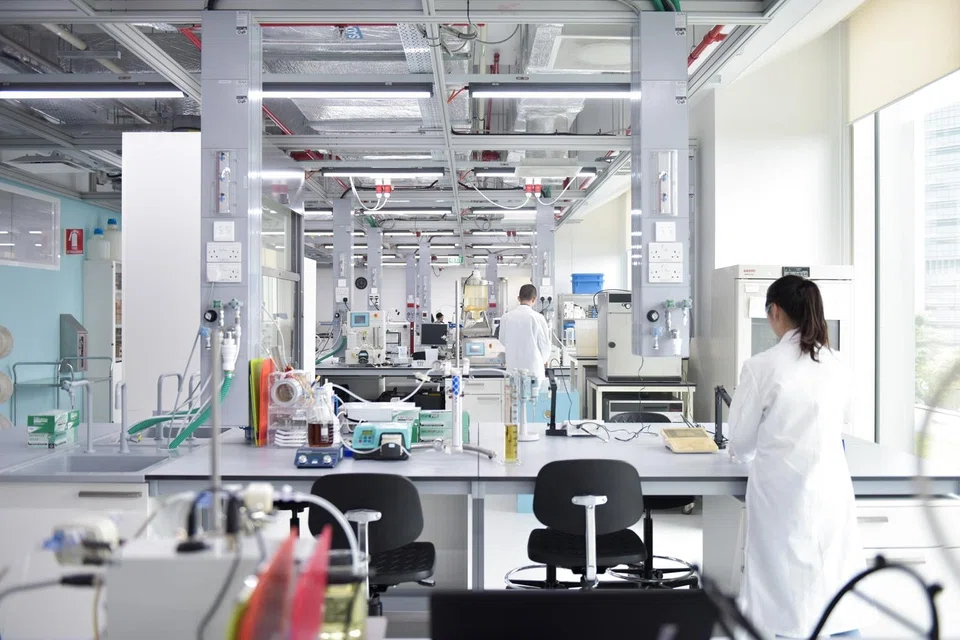
Biomedical manufacturing was the star performer during the month, with an expansion of 21.9 per cent.
The pharmaceutical segment grew 26.2 per cent, with higher production of active pharmaceutical ingredients; the medical technology sector rose 10.8 per cent on the back of higher export demand for medical devices, EDB said.
Even though electronics continued to be the worst-performing sector with a year-on-year contraction of 9.6 per cent, this was an improvement over August, which registered a 25 per cent year-on-year decline then.
The cluster was dragged down by the semiconductors and computer peripherals segments, with a decline of 13 per cent and 10.4 per cent respectively, even though data storage grew 16.1 per cent, and infocomm and consumer electronics expanded by 15 per cent.
Maybank economists Chua Hak Bin and Lee Ju Ye said in a report that the electronics and precision engineering cluster, which grew by 4 per cent, have "likely bottomed out", having been hit hard by disruptions from the US-China trade war.
They believe the "Phase 1" US-China trade deal, which could be signed in November, will "support the electronics recovery cycle".
Transport engineering clocked a year-on-year growth of 3 per cent in September, boosted by the aerospace and land transport segments, which grew 39 per cent and 18 per cent respectively.
The EDB attributed the growth in aerospace manufacturing output to an increase in repair and maintenance jobs from commercial airlines.
Selina Ling, head of treasury research and strategy in OCBC Bank, said: "With the upward revision in the July and August industrial output data and the upside surprise in the September manufacturing data, it now looks increasingly clear that the Singapore economy has escaped a technical recession in Q3."
She added that Singapore's full-year gross domestic product (GDP) could come closer to the mid-range of the official zero growth to 1 per cent forecast, at 0.5 per cent.
Brian Tan, Barclays regional economist, said: "Taking into account other high-frequency economic data on construction and services activity, we estimate Q3 GDP growth is tracking 0.6 per cent year on year, implying an upward revision from the advance estimate of 0.1 per cent and a pick-up from Q2, also at 0.1 per cent.
"This implies slight upside risks to our GDP growth forecasts of 0.6 per cent in 2019 and 0.7 per cent in 2020."
Maybank economists are more optimistic, revising their Q3 GDP prediction to 0.8 per cent and the full year GDP to 0.9 per cent, even though they said growth recovery will likely be sluggish.