More tax perks down the road to promote use of electric cars in Singapore
Singapore
MORE electric-car incentives are on the way as the government hastens the phasing-out of vehicles running purely on fuels in Singapore.
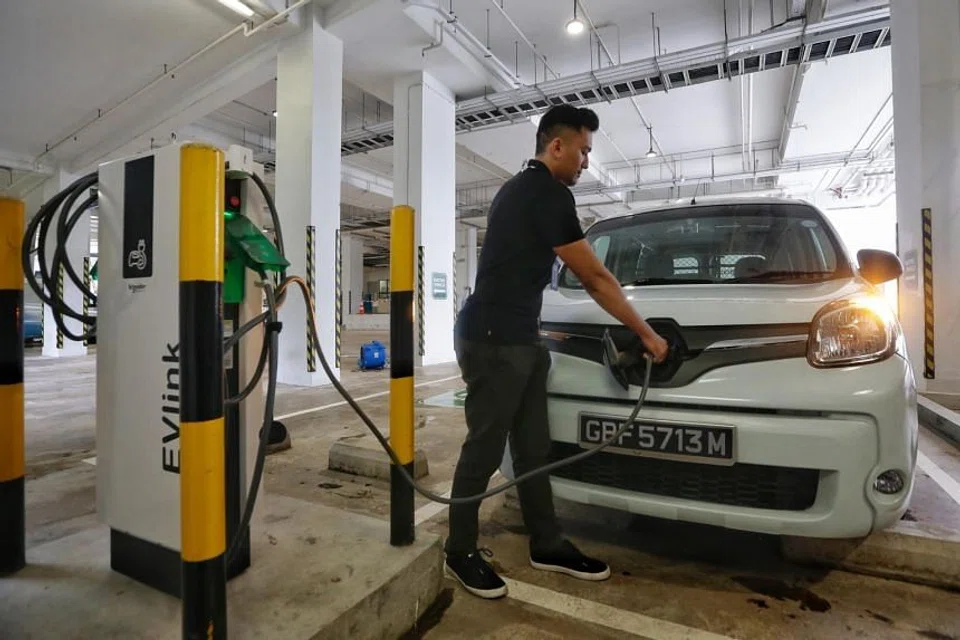
Under the inter-ministry Singapore Green Plan 2030 unveiled on Wednesday, the government said it will revise Singapore's multi-layered vehicle tax structure to "make it easier to buy and own" electric vehicles (EVs).
EV incentives were enhanced just last month, when bigger rebates under the Vehicular Emissions Scheme as well as the Electric-Vehicle Early Adoption Incentive kicked in. Together, they could give an EV buyer as much as S$45,000 in tax breaks. The road tax formula has also been revised to make it less onerous for electric car owners.
The government said all new cars registered from 2030 must be "cleaner-energy models", but did not elaborate. It will also raise the targeted number of EV charging points from 28,000 to 60,000 by 2030.
The goals for public transport under the Green Plan were largely reiterations of those set several years ago. These include gradually converting all buses to "cleaner-energy" models, and expanding the rail network to 360 km by early-2030s, from around 230 km today.
Singapore aims to have three-quarters of morning-peak commutes done by buses and trains; car-free town centres are being developed, with Tengah being the first.
To encourage walking and cycling, Singapore's network of cycling paths will be tripled to 1,320 km by 2030; roads will be repurposed for active mobility use where possible.
The Green Plan is spearheaded by the ministries of Education, National Development, Sustainability and the Environment, Trade and Industry, and Transport. The 10-year plan sets out sustainability targets to achieve net-zero emissions as soon as viable and to enhance Singapore's livability.
The statement also said Jurong Island will be a sustainable energy and chemicals park by 2030, in the push to make industrial production processes and energy usage greener and improve energy efficiency.
Singapore also aims to develop itself into a sustainable tourism destination, a carbon-services hub and a centre for green finance to facilitate sustainability efforts in Asia. The government said in the statement that these sustainability efforts will bring new business opportunities.
The Green Economy, one of five key pillars of the new Green Plan, will seek green growth opportunities to create new jobs, transform Singapore's industries and harness sustainability as a competitive advantage, the statement said.
This also entails ensuring that new carbon-intensive investments brought into Singapore are among the best in class in terms of carbon and energy efficiency.
Other initiatives include strengthening Singapore as a place for global and local companies to develop new sustainability solutions for Asia, in areas such as sustainable packaging, decarbonisation, waste upcycling, urban farming and water treatment.
New technologies for carbon capture, utilisation and storage will be developed and trialled; the potential of low-carbon hydrogen and other emerging technological approaches to decarbonisation will be studied.
The government will also support local enterprises in the adopting of sustainability practices, solutions and standards, enhance their resource efficiency and tap new business opportunities in sustainability, the statement added.
The government has also reiterated its plan to review the carbon tax by 2023, a move that lawmakers on both sides of the aisle in Parliament have strongly supported. At the last Parliament sitting on Feb 1, MPs called for the carbon tax to be raised significantly and for the review to be brought forward. THE STRAITS TIMES