New A*Star facility enables firms to test advanced manufacturing technologies

Claudia Chong
Singapore
THE Agency for Science, Technology and Research (A*Star) has launched a facility that will be a test-bed for companies to develop advanced manufacturing technologies.
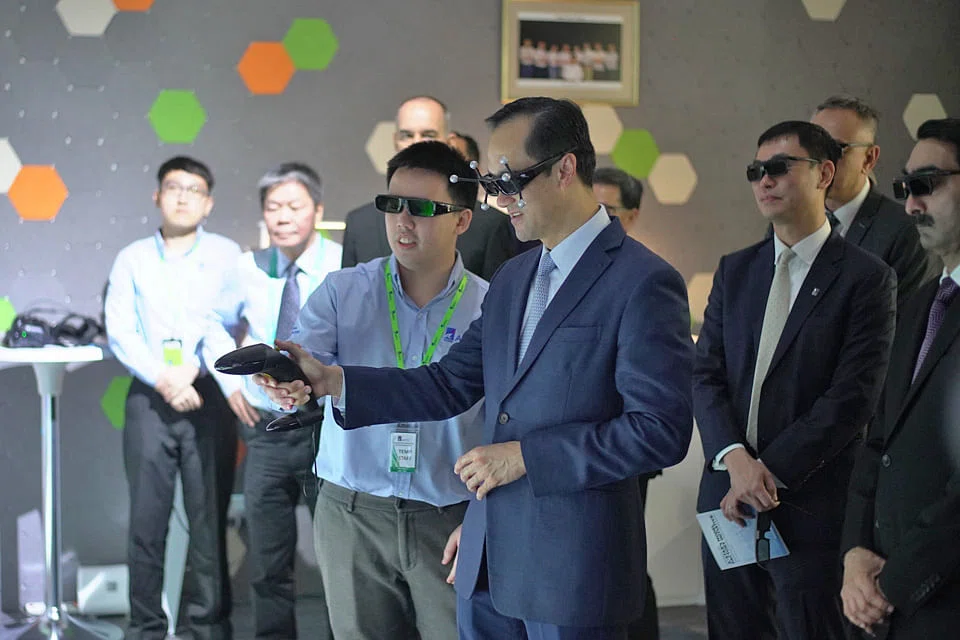
Called the Model Factory located at the Advanced Remanufacturing and Technology Centre (Model Factory@ARTC), it houses more than 10 technologies, including those for virtual manufacturing and digitised assembly lines, and makes use of virtual and augmented reality, collaborative robots, autonomous guided vehicles, the Industrial Internet of Things (IIOT) and big analytics.
At its launch on Thursday, multinational firms Nestlé, Procter & Gamble (P&G) and Shell signed up to join the ARTC as industry members, which gives them access to the Model Factory's facilities.
Nestlé and P&G, both giants in fast-moving consumer goods, will focus on improving productivity along their respective value chains to accelerate delivery of products and meet fast-changing consumer needs; energy and petrochemicals firm Shell will pilot technologies in areas such as plant automation.
A*Star managing director Raj Thampuran said he expects an interesting mix of companies to get on board the Model Factory initiative, including also companies from sectors outside of traditional manufacturing, such as retail, communications and service.
"The thing about Industry 4.0 is that it doesn't distinguish between the type of companies that can embark on it," he said.
The Model Factory initiative is partly supported by the Advanced Manufacturing and Engineering (AME) domain fund under the Research, Innovation and Enterprise (RIE) Plan, with the remaining funds coming from industry.
Companies looking to use the facility to test-bed advanced manufacturing methods will have to approach A*Star, and pay a fee depending on the services they need.
One of the main features of the model factory, which spans 15,000 sq ft, is the Virtual Manufacturing Lab, where engineers can be trained using a life-sized virtual model of the factory.
Big data can also be used to enable live monitoring of factory operations and plan new production lines or to design the factory floor. This is done through digital twin technology, which pairs historical and real-time data to create a virtual model of a physical process.
The Model Factory@ARTC also features a Manufacturing Intelligence Control Room, which collects and analyses data from machines and presents it on a dashboard. It alerts users to problems, offers solutions and executes decisions made.
Among the small and medium-sized enterprises (SMEs) which have already teamed up with the ARTC to enhance their manufacturing processes ahead of the model factory's official launch is Abrasive Engineering (AE).
The company, which produces machines for and provides services in shot peening, is tapping the model factory's resources to digitalise its entire manufacturing process.
Shot peening strengthens metal components to make them last longer. Though the process can be done via a robotic arm, several of the post-processing procedures are still being done manually.
Tan Ser Hean, managing director of AE, said: "In three years, we should be all ready for Industry 4.0, with quality check systems online to reduce manpower and to increase productivity."
The firm invested about half a million dollars in the project. "Right now, our turnover is only S$7 million. We believe that with all these systems and connectivity built in, we should be able to reach S$12 million in about three years," he added.
Local SME Arcstone, which has partnered the ARTC to enhance its digital manufacturing solutions, has achieved about 20 per cent gains in productivity and up to 90 per cent reduction in equipment downtime.
A*Star's Model Factory initiative also includes the Model Factory@SIMTech, launched last October; it caters to companies in earlier stages of technology adoption.
About 50 companies are now participants in the initiatives at ARTC and SIMTech.