New framework will allow vaccinated travellers to enter Singapore quarantine-free from Apr 1
DBS equity research analyst Jason Sum sees Singapore reaping a first-mover advantage in Asia, widening the capacity gap between SIA and its rivals

Singapore
FROM Apr 1, Singapore will allow fully vaccinated travellers and non-vaccinated children to enter quarantine-free and without the need to use Vaccinated Travel Lanes (VTLs) or apply for related passes, in a move that analysts see as providing a boost to the travel and tourism sector.
Singapore may even reap a first-mover advantage in Asia, widening the capacity gap between Singapore Airlines (SIA) and its rivals, DBS equity research analyst Jason Sum told The Business Times.
Fully vaccinated travellers will still need to take a pre-departure test within 2 days of leaving for Singapore, but will not be subject to the antigen rapid test (ART) upon arrival.
Transport Minister S Iswaran, said at a press conference by the multi-ministry task force on Thursday (Mar 24) that it is a major step forward to restore air connectivity to the world and to rebuild and reclaim Singapore's position as an air hub.
As a cautionary measure because coronavirus cases are rising in some parts of the world, the pre-departure test is still required for now. But he added: "We will review this requirement in 2 to 4 weeks, by mid-April."
The new Vaccinated Travel Framework (VTF) applies to travellers arriving via air or sea checkpoints from countries or regions in the General Travel Category - provided that they had in the prior 7 days not been in Restricted Category areas. There are currently no places listed in the latter category.
Previously, fully vaccinated residents who develop symptoms or test positive for Covid-19 within 14 days of returning to Singapore had to cover their own bills in hospitals and dedicated Covid-19 treatment and recovery facilities. Such travellers will no longer be charged for such treatment, in line with the policy for local community Covid-19 cases, as long as they have not visited Restricted Category areas in the last 7 days.
There is no change to the charging policy for short-term pass holders and travellers who are not fully vaccinated, who must still pay their own Covid-19 medical bills.
Fully vaccinated travellers who are eligible for but have not received a booster shot may stay in Singapore for up to 30 days.
Beyond that, they must get a booster shot in Singapore, at their own expense.
Non-fully vaccinated long-term pass holders and short-term visitors aged 13 and above are generally not allowed to enter Singapore.
With the move to the VTF, existing VTLs and unilateral opening arrangements will be retired. The VTF will also replace sea-based VTLs for all ferry routes. There will no longer be designated VTL (Sea) ferry services, and the weekly quota will be lifted.
Entry visas are still needed for short-term visitors with travel documents issued by visa-required places. Foreign short-term visitors must also purchase travel insurance before entering Singapore, with a minimum coverage of S$30,000 for Covid-related treatment and hospitalisation costs.
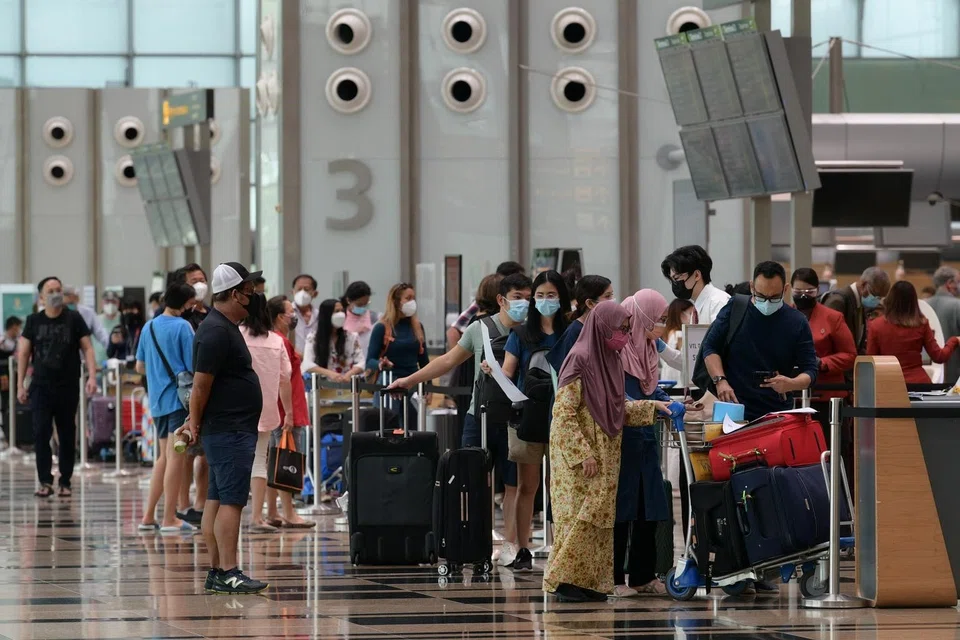
The Civil Aviation Authority of Singapore has been working with aviation firms to gear up for higher traffic volumes. Food and beverage (F&B) and retail outlets in the airport transit areas will also be reopened.
Said Iswaran: "With these moves, our aim is to welcome airlines back to Singapore... raise passenger volumes to at least 50 per cent of pre-Covid levels this year and restore the travel experience that Changi is renowned for."
Passenger traffic at Changi reached 18.2 per cent of pre-Covid levels last week - the highest since Singapore closed its borders in March 2020. As of Mar 22, nearly 585,000 travellers have entered Singapore via VTLs.
DBS' Sum sees Singapore reaping a first-mover advantage over Asia's other developed economies. He noted: "This can be seen in the passenger capacities that airlines in each country have been able to restore. Based on statistics by (data provider) Capa, SIA's total passenger capacity stood at 63 per cent of pre-Covid-19 levels this week, marginally ahead of (Japan's) ANA which was at 61 per cent, but markedly ahead of Korean Air and (Hong Kong's) Cathay Pacific which were only at 27 per cent and 3 per cent respectively.
"Naturally, the longer it takes for these countries to reopen, the more likely they will continue to cede ground to Singapore, and the gap would continue to widen. As an example, even though Hong Kong recently lifted flight bans to 9 countries, Cathay Pacific is only able to reinstate 1 flight on a bi-weekly basis to these countries for fear of breaching a rule that bans airlines from flying any routes that leads to imported cases, whereas SIA does not have the same constraint."
But University of Sydney professor of transport Rico Merkert does not see a first-mover advantage on a global scale, as his recent travel experience showed that some countries have already reopened and dropped testing.
Shukor Yusof of aviation consultancy Endau Analytics feels that China's continued closure and growing geopolitical instability require Singapore to be realistic. He stated: "(This) obsession to make Changi No 1 again, at a time when Covid is still a risk and the Ukraine war could escalate and scuttle recovery, is a bit naive."
The Greater China market - Singapore's top inbound tourist market pre-pandemic, contributing 23.8 per cent of arrivals - may remain closed off into 2023, but DBS' Sum believes that significant pent-up demand will be unleashed over the course of 2022, fuelling a "meaningful" rebound in inbound and outbound air travel.
Alton Aviation Consultancy's managing director Mabel Kwan pointed out that Singapore's key air travel markets in Asia-Pacific such as Malaysia, Indonesia, Thailand and India have reopened or scrapped quarantine requirements for fully vaccinated travellers.
"The reopening of Singapore's borders this time should thus have a larger stimulus on air travel compared to previous rounds where Singapore re-opened its borders unilaterally," added Kwan.
While aviation counters could get a boost from the reopening, she noted that the emergence of new coronavirus variants, high oil prices or geopolitical tensions could bring volatility to their performance and prices.
READ MORE: Mask rules, group size cap, border curbs eased as Singapore reaches 'turning point'