

No light at the end of manufacturing tunnel
Singapore factory output back in the red in May; economists even more doubtful about recovery

Singapore
THE fate of the Singapore economy hangs on US-China trade outcomes, analysts warned on Wednesday, after more gloomy factory numbers.
Singapore's manufacturing output was down year on year by 2.4 per cent in May, after a brief reprieve in April, according to the latest preliminary Economic Development Board data.
Factories are now down by 0.7 per cent for the first five months of the year, compared with the year-ago period - and economists do not expect a let-up in data from June, either.
Maybank Kim Eng has now cut gross domestic product (GDP) expectations below the official forecast of between 1.5 per cent and 2.5 per cent.
The house's full-year prediction of 1.3 per cent growth assumes a shallow technical recession - two straight quarters of quarter-on-quarter contraction - in the three months to September, economists Chua Hak Bin and Lee Ju Ye wrote in their report.
ANZ also scrapped hopes of an export recovery in the second half.
"The global technology downturn, slowing global growth and the effects of last year's US-China trade spat have all taken a toll on the export-oriented sectors of the economy," bank analysts said in a fresh research note.
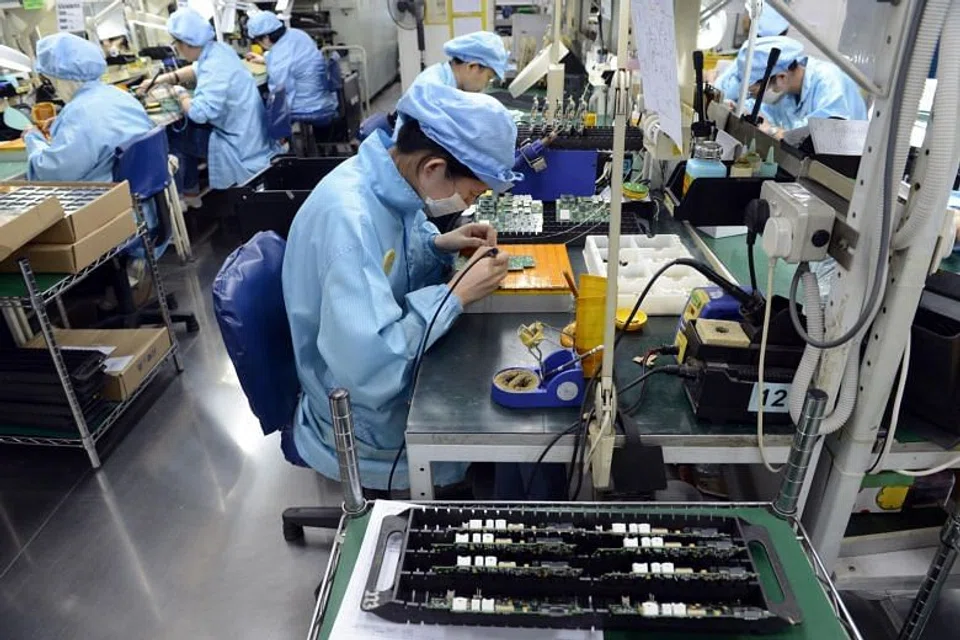
The struggling electronics cluster was once again the Achilles heel for manufacturing, posting a 10.8 per cent plunge in production for its seventh negative print in nine months.
The drag on electronics output came from Singapore's key semiconductor segment, as well as computer peripherals and data storage.
But lower production of semiconductor-related equipment took a toll on the precision engineering cluster, which shrank by 4.7 per cent despite more optical and plastic precision goods output in the precision modules and components segment.
Chemicals output saw a flattish dip of 0.4 per cent - largely on maintenance shutdowns in some petrochemical plants, eroding gains in specialties, petroleum and other chemicals.
Shoring up industrial output was the biomedical manufacturing cluster, which grew by 8.8 per cent on double-digit expansion in the volatile pharmaceuticals business - despite the hit to medtech production, from lower export demand for devices.
General manufacturing production increased by 4.9 per cent, while transport engineering added 2.9 per cent, led by the aerospace segment, which made up for a decline in marine and offshore engineering.
Economist Tan Khay Boon, senior lecturer at SIM Global Education, noted that the impact of the tech and tariff fights "has changed from a negative sentiment to an actual decline in manufacturing demand" as bilateral talks failed to deliver resolution.
Dr Chua and Ms Lee also noted that, as the US-China trade war spills over into technology, export controls could touch US chipmakers such as Broadcom, Intel and Micron here.
And United Overseas Bank economist Barnabas Gan warned that "the outlook for Singapore's industrial production environment will likely hinge on US-China trade developments, even as the cyclical downturn in the global electronic space continues".
Based on the past two months' data, factory output fell more sharply than in the first quarter, noted Barclays economist Brian Tan, who does not expect improvement this month. "Not only is there an unfavourable base effect, early data on Korean exports point to still-weak external demand in June," he said in a note.
Barclays analysts have predicted that economic growth will slow to 1.6 per cent this year - just a hair above the bottom of the official forecast range - in what they called "an increasingly dismal backdrop" globally.
Fallout from the US-China trade dispute should hit even harder next year, they said in a separate report, adding that a continued economic slowdown "should sink the output gap deeper into negative territory".






