Payment delays worsen for manufacturing, services sectors
Retail sector improves with a q-o-q drop in slow payments, Singapore Commercial Credit Bureau report shows

Singapore
SINGAPORE'S manufacturing sector again suffered the largest increase in slow payments among five sectors in the third quarter of this year, while the services and wholesale sectors also deteriorated quarter on quarter (q-o-q).
On the other hand, the retail sector improved with a q-o-q drop in slow payments, while payment performance for the construction sector was unchanged, according to a report by the Singapore Commercial Credit Bureau (SCCB) on Tuesday.
Overall, Singapore firms' payment performance remained weak, with prompt payments still accounting for less than half of total payment transactions in Q3, while slow payments made up more than one-third.
Prompt payment refers to when at least 90 per cent of total bills are paid within agreed payment terms, while slow payment is defined as when less than 50 per cent is paid.
Prompt payments by Singapore firms remained on a downtrend q-o-q, falling by 0.63 percentage point from Q2 to 48.81 per cent in Q3. However, year on year (y-o-y), prompt payments improved by 0.5 percentage point from 48.31 per cent.
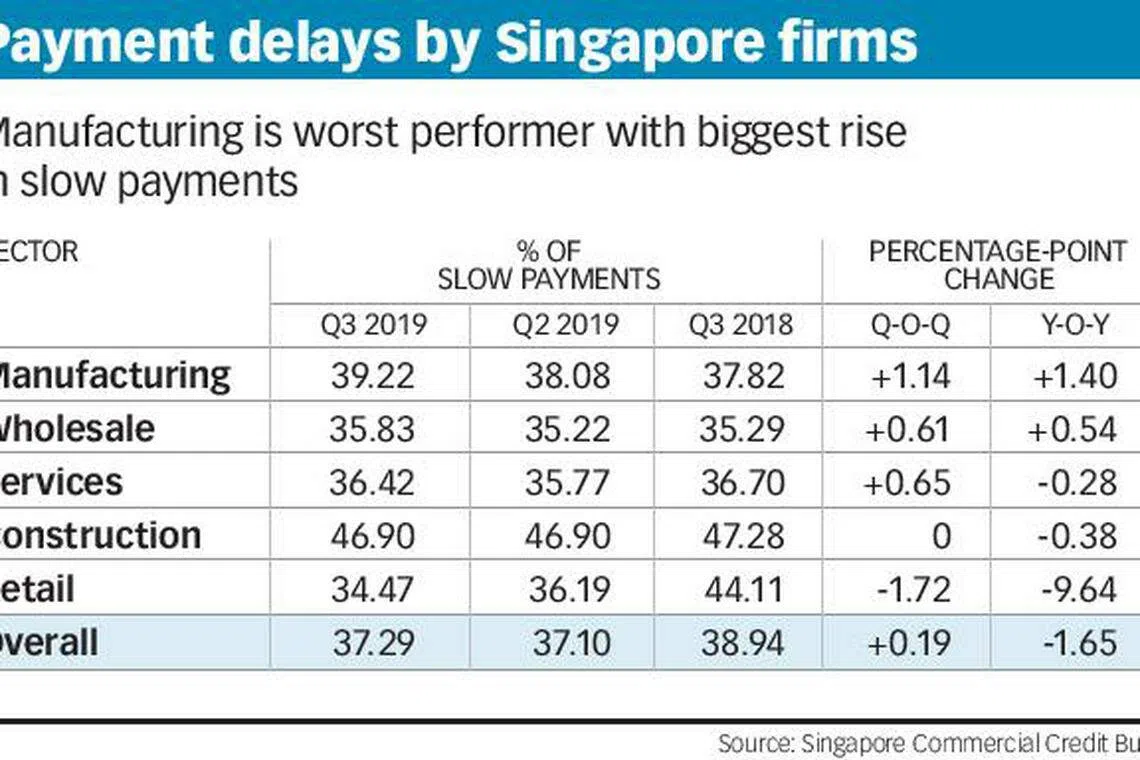
Slow payments inched up by 0.19 percentage point to 37.29 per cent in Q3 from 37.1 per cent in the previous quarter, but fell by 1.65 percentage points y-o-y from 38.94 per cent.
Meanwhile, partial payments was up by 0.46 percentage point q-o-q to 13.91 per cent for the quarter, and also increased by 1.17 percentage points y-o-y from 12.71 per cent. Partial payment occurs when 50-90 per cent of total bills are paid within the agreed payment terms.
The y-o-y improvement of overall payment performance may be a sign that creditors have tightened their credit limits even more, in anticipation of less-prompt payments, according to Audrey Chia, chief executive officer of D&B Singapore, which compiles the study figures by monitoring more than 1.6 million payment transactions of firms.
"Hence, we are seeing greater prudence in the extension of credit terms by companies here," she said.
Operating under D&B, the SCCB maintains a database of local enterprises and their credit history.
The manufacturing sector's payment performance worsened because of more payment delays by manufacturers of leather products, printing and publishing, and food products.
Slow payments in manufacturing increased by 1.14 percentage points q-o-q to 39.22 per cent of the sector's total payment transactions, and was also up 1.4 percentage points y-o-y from 37.82 per cent.
In the services sector, slow payments rose for the second straight quarter, largely due to a rise in payment delays within consumer services, legal and social services.
Slow payments made up 36.42 per cent of the services sector's total payment transactions in Q3, up 0.65 percentage point q-o-q but down 0.28 percentage point from a year ago.
In the wholesale trade sector, slow payments deteriorated among wholesalers of both durable and non-durable goods. Q-o-q, slow payments rose by 0.61 percentage point to 35.83 per cent. They also increased by 0.54 percentage point y-o-y.
In contrast, the retail sector saw improved payment performance both q-o-q and y-o-y , thanks to a better showing by retailers of general merchandise, cars, and food and beverage (F&B).
Slow payments stood at 34.47 per cent for retail in Q3, down 1.72 percentage points from 36.19 per cent in Q2 and sliding 9.64 percentage points y-o-y from 44.11 per cent.
Meanwhile, the construction sector's slow payments remained the same at 46.9 per cent from Q2, despite accounting for the highest proportion of slow payments across all sectors in Singapore. Y-o-y, slow payments in the construction sector fell 0.38 percentage point.