

Pick Network not created to stifle competition in parcel locker sector, says Sim Ann
Some MPs question whether IMDA subsidiary could become overly dominant

Singapore
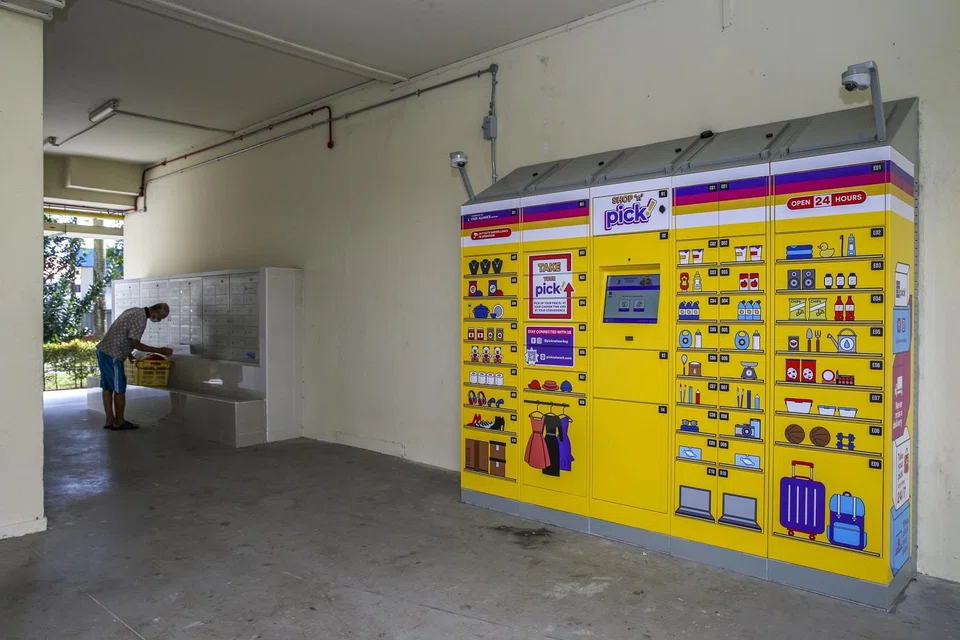
PICK Network, the government-owned entity that will operate Singapore's upcoming parcel locker network, was not created to stifle competition among private-sector parcel locker operators, Senior Minister of State for Communications and Information Sim Ann told Parliament on Monday.
Formed last July, Pick is a subsidiary of the Infocomm Media Development Authority (IMDA). It will deploy, own and operate 1,000 parcel locker stations in areas such as HDB estates, public-transport nodes, and community centres and clubs.
Addressing concerns that Pick could become a monopoly, Ms Sim said: "Let me clarify that our intention is not to put Pick in a favoured position. Pick's exclusive privileges are confined to the provision of parcel lockers at specified premises only.
"In this regard, the network, which will be available for use by all e-commerce marketplaces and delivery service providers, will serve to complement, but not compete with, existing locker offerings from the industry, which are accessible only by selected operators."
Ms Sim was speaking on the proposed amendments to the Postal Services Act, to grant the IMDA the privilege to establish, install, operate and maintain the parcel locker network, as well as to appoint a network operator for these duties. The amendments were passed on Monday.
While expressing support for parcel-locker infrastructure, some MPs raised concerns during the session. For instance, PAP MPs Ng Ling Ling and Louis Ng questioned whether Pick could become overly dominant and dampen market competitiveness.
Ms Ng said: "(We) need to be mindful that such an arrangement will not stifle innovation, or worse, create an unintended monopoly by the network operator, which may increase the cost of operations for delivery service providers."
Meanwhile, Workers' Party MP Gerald Giam asked why the IMDA did not contract existing private-sector parcel locker operators to operate the network.
"They already have the experience of running parcel lockers and can take on the investment risk and bear the cost of expanding the network. Is Pick's mandate to fulfil a need that is distinct and complementary to the services already provided by the private parcel locker providers or would it be competing with them?" he asked.
Mr Giam also asked whether Pick may go against the so-called "yellow pages" rule, under which the government should exit from market segments that already have active private-sector players.
PAP MP Darryl David flagged the possibility of "unintended consequences" with market consolidation, such as whether "a single player will end up dominating the market", impacting long-term affordability.
Addressing these questions, Ms Sim said that having a "neutral" parcel locker operator is key to ensuring that the parcel-locker network can be efficient.
"The current private-sector driven market for parcel lockers is largely fragmented, with competing players deploying their proprietary networks which are accessible only by selected delivery service providers. This has given rise to deep inefficiencies for local operators.
"The lockers are duplicated at high-traffic commercial locations and e-commerce marketplaces and delivery service providers are unable to access all lockers which may be available," she said. Existing parcel locker operators include Singapore Post, Blu and Parcel Santa.
The rollout of 1,000 parcel locker stations could solve this inefficiency. But for productivity gains to be realised, the network needs to be deployed expeditiously, and "by a neutral operator to ensure open and non-discriminatory access", Ms Sim said.
"We believe that these twin objectives that are outlined would be best served by a network operated by the government. In this case, it would be IMDA and to give effect to this intention, IMDA formed a subsidiary, Pick," she added.
TRENDING NOW

Two Singapore-listed palm oil firms named in Greenpeace report on Indonesian plantation fires
Singapore Airlines flight returns to San Francisco after ‘unruly’ passenger incident

Singapore looking into which companies responsible for haze-causing fires: PM Wong

Deluge IPO 3.86 times subscribed ahead of SGX debut

