

PM Lee: Fusionopolis Two to bring manufacturing to next level
Complex will bring four public research institutes together, helping to build and integrate capabilities
 Add BT as a preferred source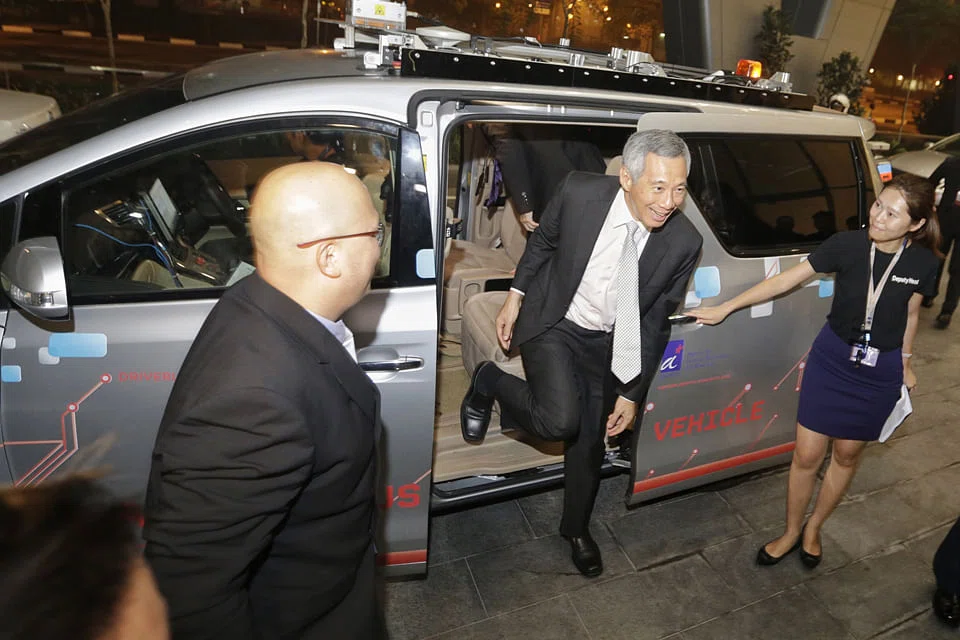
DeeperDive is a beta AI feature. Refer to full articles for the facts.
Singapore
FUSIONOPOLIS Two in one-north's research and development (R&D) hub will marshal and integrate all the capabilities needed to support manufacturing - a key pillar of Singapore's economy - and bring it to the next level.
Prime Minister Lee Hsien Loong made the point at the launch of the new Fusionopolis Two building that will bring together four more public research institutes - Data Storage Institute, Singapore Institute of Manufacturing Technology, Institute of Materials Research and Engineering and Institute of Microelectronics.
Already, manufacturing is being transformed by digital technologies such as the Internet-of-things, data fusion, greater automation and new methods of manufacturing such as additive manufacturing, said Mr Lee.
"So, with this project, we will be able to build and integrate capabilities, for example in materials science, chemistry, semiconductor processing, computational modelling and machine design, to support multinational corporations and the small and medium enterprises."
Fusionopolis One, launched seven years ago, brought together the Institute for Infocomm Research as well as the Institute of High Performance Computing.
Navigate Asia in
a new global order
Get the insights delivered to your inbox.
Through their co-location, the two have enhanced their capabilities and found many more applications for their research, said Mr Lee, noting that the integration has catalysed many industry projects, as they collaborate with companies such as Singtel, DBS, Rolls Royce, Lloyd's and Fujitsu.
With Biopolis and Fusionopolis next to each other, the biomedical and science & engineering capabilities have also been brought together and seeded new areas, he said, adding that startups will also be able to tap the R&D in the area for their own needs.
In outlining the progress of the government's R&D investments, Mr Lee said that companies have tapped the public research institutes and collaborated on joint projects.
In the last decade, the number of startups here has more than doubled from 24,000 in 2005 to 55,000 last year, while the number of research scientists and engineers have grown six times to 32,000 in the past 25 years.
To date, the one-north area is home to 16 public research institutes, more than 250 companies and over 600 startups, as well as five corporate universities and institutes of higher learning.
Specifically, the Biopolis and Fusionopolis campuses house some 16,000 employees including scientists, researchers and innovators, said Mr Lee.
"So the whole estate has become a vibrant research, residential and student hub, with commercial developments and new MRT lines. All that is just the infrastructure. To make our R&D innovation hub work, we need the ideas, initiative and a strong network of enterprises and institutions, driven by the spirit of research and entrepreneurship, where enterprises and people are never satisfied with the world as it is, and constantly strive to improve and are forever hungry and bold."
In addressing the crowd, Mr Lee also touched on his scheduled ride in a self-driving car developed by the research agencies.
If Singapore were to take this further and develop a network of such vehicles, he said it could solve commute problems, relieve congestion on the roads and also help businesses be more efficient.
"But for innovations like self-driving cars to succeed, we need not just the technology. Many different pieces have to come together - the regulation, infrastructure, the network planning and working with the population to experiment and adapt to these new gizmos."
Mr Lee said that he hopes to see "bolder ideas, more innovation and a feeling that the sky is the limit" with the launch of Fusionopolis Two.
Copyright SPH Media. All rights reserved.
TRENDING NOW
Japan stocks look set for new highs in 2025 on earnings, reform

Beijing’s calculated silence on the Iran war

China pips the US if Asean is forced to choose, but analysts warn against reading it like a sports result

Richard Eu on how core values, customers keep Singapore’s TCM chain Eu Yan Sang relevant

