Queues form for final issue as Apple Daily closes
 Add BT as a preferred source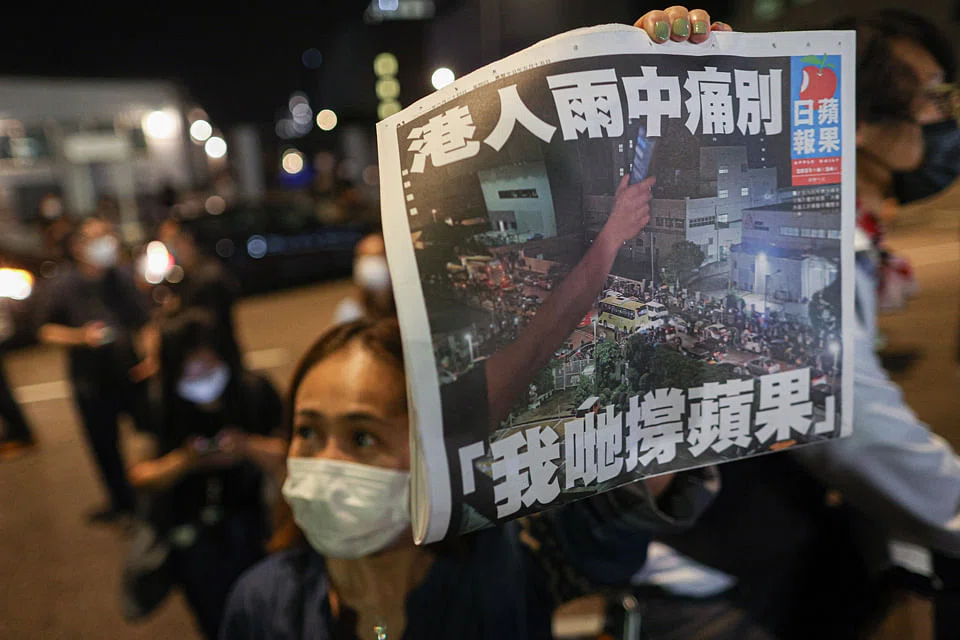
Hong Kong
HONG Kong residents snapped up last-edition copies of the final issue of pro-democracy newspaper Apple Daily on Thursday after it was forced to end a 26-year run amid a national security crackdown that froze the company's funds.
But Hong Kong cyber activists are backing up articles by the pro-democracy tabloid on censorship-proof blockchain platforms to preserve the paper's content.
Apple Daily, owned by staunch Beijing critic Jimmy Lai, who is in jail, is an unapologetic tabloid that mixes pro-democracy discourse with celebrity gossip and investigations of those in power. It has been a thorn in Beijing's side for years.
Emotions ran high as supporters of the paper, which has faced an unrelenting squeeze since tycoon Lai was arrested under the security law in August 2020, queued for their last copies of the popular newspaper just after midnight.
"I couldn't sleep well for the past few nights," said a woman who wanted to be known only as Tse, 60. A former medical worker, she leaned on a cart to support herself as she queued outside a newspaper vendor in the working class district of Mong Kok. "I hope the reporters can stay true to their faith and keep working hard."
Queues stretched at newsstands across the city after an emotional final print run at the paper's headquarters.
"Thank you to all readers, subscribers, ad clients and Hong Kongers for 26 years of immense love and support," the paper said in an online article. "Here we say good-bye, take care of yourselves."
Some staff expressed anger and frustration at the shutdown.
"(After) today, there is no press freedom in Hong Kong ... I cannot see any future in Hong Kong," said Dickson Ng, 51, a designer at the paper.
"I feel very disappointed and angry today. I don't understand why our limited group, company, and the newspapers were forced to stop operating under such circumstances." In anticipation of robust demand for its final print run, Apple Daily printed one million copies, or more than 10 times its usual print run.
The shutdown deals the most serious blow yet to Hong Kong's media freedoms and could potentially destroy the city's reputation as an open and free media hub after Beijing imposed the security law on the global financial centre last year, media advocacy groups say.
Critics of the law say it is being used to crush dissent in the former British colony, an assertion authorities in Beijing and Hong Kong reject.
Officials in Hong Kong and China have repeatedly said media freedoms are respected but are not absolute.
Fearing the security law could bring elements of China's great firewall to Hong Kong, limiting access to dissenting views, 21-year-old Ho - who works in tech and did not give his first name because of the sensitivity of the matter - began this week to upload Apple Daily articles on decentralised file storage platform ARWeave.
After midnight, as the printers ran one final time, Apple Daily shut off its website and erased all its social media platforms after authorities froze company-related assets as part of a national security probe.
"I'm not doing this because I love Apple Daily, it's what needs to be done," Ho said. "I never thought that Apple Daily would disappear so quickly."
Authorities have said dozens of Apple Daily articles may have violated the security law, but there was no suggestion that Apple Daily content would be blocked or censored.
Similar to BitTorrent, ARWeave breaks down a file into bits of information distributed over an open network of anonymous computers around the world. On its website, it describes itself as a "collectively owned hard drive that never forgets".
As of Thursday, more than 4,000 Apple Daily articles had been uploaded on ARWeave. Hundreds of RTHK programmes dating back to 2012 are also available.
Another programmer, Kin Ko, 47, has been building a decentralised registry called LikeCoin. The blockchain platform helps Internet users identify the metadata - creator, date, time, location, version - of the content through a unique number called an International Standard Content Number (ISCN), akin to a book's distinctive International Standard Book Number.
Mr Ko's initial idea was to create a platform that could authenticate any type of content, and did not expect his platform to be embraced so enthusiastically by pro-democracy activists. But, he said: "History must not be determined by those in power." REUTERS
Decoding Asia newsletter: your guide to navigating Asia in a new global order. Sign up here to get Decoding Asia newsletter. Delivered to your inbox. Free.
Share with us your feedback on BT's products and services