Quick takes: US Federal Reserve approves largest rate hike since 1994 to fight inflation
 Add BT as a preferred source
Vivienne Tay
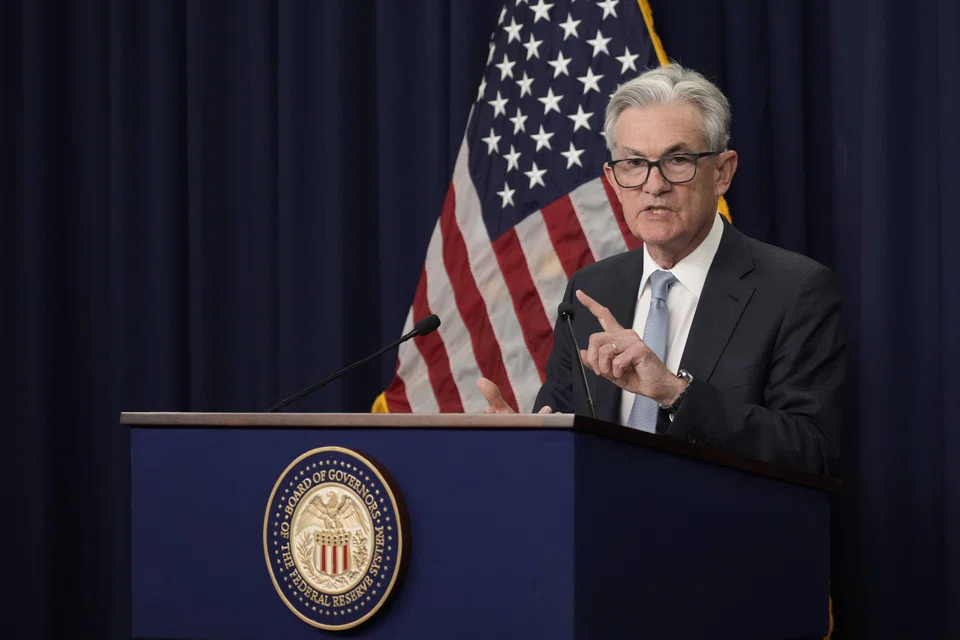
THE US Federal Reserve on Wednesday (Jun 15) approved its largest interest rate increase since 1994 to slow the ongoing surge in inflation.
The widely-expected move raised the target federal funds rate by 75 basis points (bps) to between 1.5 per cent and 1.75 per cent.
Here are some quick takes from market observers and analysts on the rate hike:
Selena Ling, chief economist and head of treasury research and strategy, OCBC
- “While Asian markets may be celebrating that the red ink has finally paused after a tremulous past week of FOMC (Federal Open Market Committee) anticipation, it may be too early to break out the champagne yet.”
- “First, recent economic indicators suggest the Chinese economy is not out of the woods yet. Second, food and fuel price pressures continue to increase, implying further upside inflation risks for Asean economies.”
- “This implies the pressure is still on for Asian central banks like the Monetary Authority of Singapore, Bank of Korea, Bank Negara Malaysia and others to press on with further monetary policy tightening, and also puts pressure on central banks like the Bank of Thailand that have not joined the bandwagon of monetary policy tightening yet to do so sooner rather than later.”
- “Since the Fed is likely to press on with at least 50 bps rate hikes in the subsequent FOMC meetings this year, while not excluding the possibility of more 75 bps rate hikes if the US inflation data warrants it, we expect investor sentiments to remain fickle and financial market conditions to stay choppy into Q3 2022.”
Christian Hoffmann, portfolio manager at Thornburg Investment Management
- “With the Fed’s credibility on the line, today’s rate decision and press conference make this FOMC meeting one of the most consequential in recent memory.”
- “A sky-high inflation report last week and ensuing violent market reaction forced the Fed’s hand to wager more on a larger rate hike. Media leaks this week and the bounce in bond and equity levels today helped us arrive at the hike decision with little surprise and repositioning.”
- “Despite nearly 400 PhDs working at the Federal Reserve, their track record at projecting and forecasting is atrocious.”
- “Long-term stagflation is unlikely. That’s a bet against humanity and human ingenuity. A recession is all but certain. So, whether or not we’re sliding into recession isn’t the question we should be asking, but rather ‘how much will it hurt?’.”
- “Powell predicting a 50 to 75 basis point hike at the next meeting takes a ‘medieval’ full percentage point off the table.”
Clifford Bennett, chief economist, ACY Securities
- “Markets may want to play their own deluded clever games of looking across the valley and spinning this into a buying moment, but there is now a sea of distressed investors who want out of the market.”
- “Expect the Wall Street types to be buying on the day, only to be eventually overwhelmed by real money selling in the days, weeks and months ahead.”
- “The US dollar had a big ‘buy the rumour, sell the fact’ day. A similar story here, in terms of the immediate selling on the basis that such a Fed move had already become priced in, will face a wall of reality of ever-higher US rates buying.”
- “Investors should take advantage of the immediate market volatility, higher stocks and lower US dollar, to protect their portfolios on a medium to long-term basis from the fast arriving freight train of recessions in the US and other nations.”
- “The risks are very high. The next 1-3 days could see the best levels for investors to hedge their portfolios further. Selling stocks, buying the US dollar, as well as gold and oil.”
Greg Baker, chief executive, TD Ameritrade Singapore
- “Much of the market’s future direction will likely depend on the pace of inflation and the factors behind it. Beyond inflationary pressures, market growth continues to be dampened by supply chain disruptions, escalating Russia-Ukraine tensions, rising food shortages and food exports restrictions.”
- “Investors are closely watching to see if the Fed can generate a ‘soft-landing’ to avoid a potential recession, and this uncertainty will continue to be an overhang on the market.”
- “Investors can expect continued volatile trading, until we see signs of slowing inflation.”
Ray Sharma-Ong, investment director, multi-asset investment solutions, abrdn
- “Fed dot plots for 2022 are now significantly above the neutral rate, and well into restrictive territory. With the dot plots in 2023 still remaining well into restrictive territory, the tightening of financial conditions, and maintaining it for a prolonged period, will end up killing the economic growth cycle.”
- “Powell has indicated that the Fed will do whatever it takes to bring inflation back to its 2 per cent Flexible Average Inflation Target. Powell did not offer guidance in the coming meetings ahead, setting up further uncertainty down the road.”
- “It appears that the Fed is willing to put its credibility at risk, with the lack of forward guidance at this meeting and with how its members made last-minute switches to a 75 bps hike. As such, we should not rule out the possibility of a 100 bps hike in future meetings.”
- “We expect markets to move on for now with the 75 bps hike by the Fed fully priced in, and do see a relief rally taking place with this Friday being a triple witching date.”
ING

- “We believe the risks to the Fed’s rate hike projections are to the upside. To get inflation lower quickly we ideally need the supply-side capacity of the economy to better balance with strong demand.”
- “However, the geopolitical backdrop, Covid-19 containment measures in Asia and the lack of worker supply in the US suggests this isn’t going to happen soon. Consequently, inflation is likely to be slow and sticky on its descent, thereby putting the onus on the Fed to weaken demand via higher interest rates.”
- “We now favour the Fed to follow up today’s move with another 75 bps hike in July – note Fed Chair Powell acknowledging this possibility in the press conference.”
- “We then expect 50 bps moves in September and November with a 25 bps hike in December. This is close to where the market is pricing, which would be the most aggressive Fed tightening path since 1988. The bank’s quantitative tightening plans will complement these actions.”
DBS Group Research
- “We think that rate cycle runs its course this year, with 3 more 50bps and 1 25bps hikes ahead.”
- “That would take the policy rate to 3.5 per cent by the end of the year. Inflation will have well peaked by then, but the pace of disinflation or ensuing growth slowdown may not be sufficient for the Fed to cut rates in 2023, in our view.”
- “Still, growth will get dragged down by housing and investment, both highly interest-rate sensitive, through the course of next year. That could tip the US economy into a recession in Q4 2023 or a tad later, which in turn could make 2024 the year of rate cuts.”
- “The impact of this uncertainty will continue to weigh in on global capital markets and risk sentiments on the entire spectrum of assets.”
Preston Caldwell, head of US Economics, Morningstar
- “With the 30-year mortgage rate now closing in on 6 per cent, housing affordability has suffered immensely. This is bound to have a large negative impact on housing demand and (ultimately) building activity.”
- “We had already expected about a 10 per cent drop in housing starts in 2023 prior to the uptick in rates in recent weeks, but now the downturn is likely to be even greater. A downturn in housing will be a major factor in slowing the overall rate of gross domestic product growth.”
- “For now, we don't expect an outright recession, but with our base case incorporating a slower rate of GDP (gross domestic product) growth, the risk of a recession has become elevated.”
- “We project 2.2 per cent real GDP growth in 2023, while the Fed expects 1.7 per cent. While the Fed hopes to avoid a recession as collateral damage in its fight against inflation, it appears comfortable with the risk.”
Salman Ahmed, global head of macro and strategic asset allocation at Fidelity International
- “We remain cautious with underweights in equities and credit. We are also underweight in US versus other DM (developed markets) countries in fixed income.”
- “As we pass through this phase of strong hawkishness, we think this set-up of views makes sense.”
- “Already, we think that credit markets remain vulnerable given the scope for a serious slowdown and recession the current Fed induced tightening can precipitate.”
- “However, we also think we are nearing the point where damage to growth which is in the pipeline will start to dominate inflation as the primary concern for both policymakers and markets.”
Decoding Asia newsletter: your guide to navigating Asia in a new global order. Sign up here to get Decoding Asia newsletter. Delivered to your inbox. Free.
Copyright SPH Media. All rights reserved.