Return to May's restrictions a setback to Singapore's recovery: economists
Q3 growth and business confidence could take a hit; earlier curbs saw Republic's economy shrink by 2% in Q2

Singapore
SINGAPORE'S return to Phase 2 (Heightened Alert) has thrown a spanner in the works on the short-term outlook of its economy, with watchers concerned that third-quarter growth and business confidence could be dented by the extended restrictions.
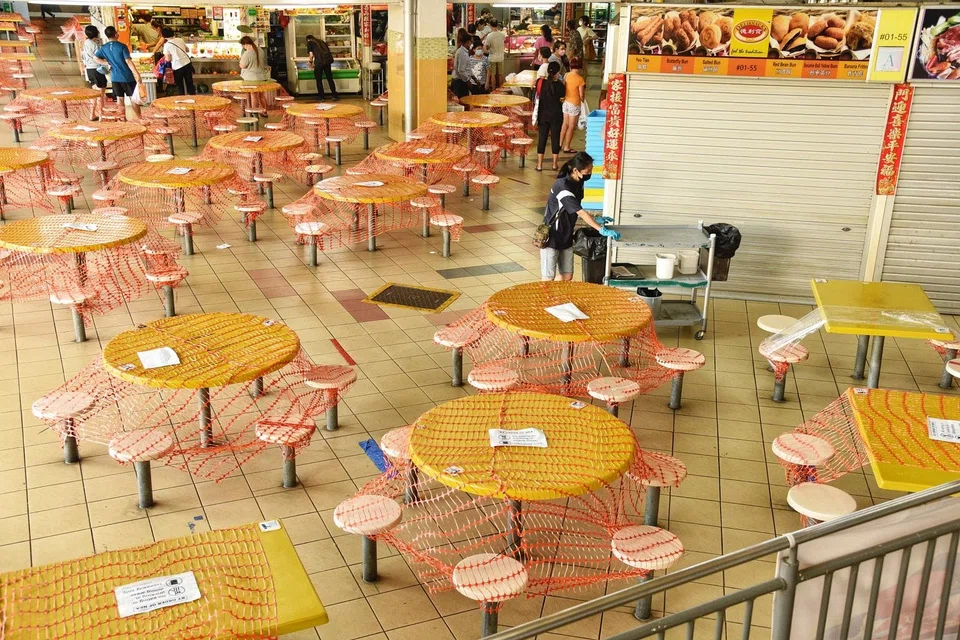
On Tuesday, Singapore's Covid-19 taskforce announced a ban on dine-ins again for four weeks from July 22, while social gatherings will be limited to not more than two - a throwback to May's Phase 2 (Heightened Alert).
Even then, restrictions were only lifted cautiously and in phases after a month. The slowdown had already resulted in the Singapore economy contracting by 2.0 per cent in the second quarter of 2021, a reversal from the 3.1 per cent growth in the preceding quarter.
The Republic was on the verge of relaxing its Covid-19 restrictions when a large cluster involving several KTV lounges emerged last week. The cases have since spread to an increasing number of markets and food centres islandwide.
Most economists The Business Times spoke to appeared bleak about the impact of the latest measures on the economy but stopped short of downgrading their Q3 gross domestic product (GDP) forecast.
Asked if another sequential decline could be in store for Singapore, DBS senior economist Irvin Seah said: "It's too early to call at this point in time, but the risk is there."
Describing the latest restrictions as "another setback", OCBC chief economist Selena Ling said they present a downside risk to Q3 "for sure".
However, she added that it might not be as bad as the "circuit-breaker" period during Q2 last year, since takeaways are still allowed and activities such as business events and weddings can continue.
Guillaume Sachet, partner of advisory at KPMG Singapore, said the measures could pull Q3's GDP down, but this depends on how long the restrictions last, and whether they will be extended beyond Aug 18.
Mr Seah said there is a possibility the measures could last beyond a month, adding: "We've learnt from previous waves of infection that typically, it takes about a month or more to bring the situation under control.
"This would definitely weigh down on growth prospects and the recovery momentum for the F&B (food and beverage) and to some extent, the retail sector."
Maybank Kim Eng senior economist Chua Hak Bin said he was keeping his full-year growth forecast of 6.8 per cent for now, adding: "Manufacturing has been driving the recovery and has not been dampened by the lockdowns."
Even so, the stop-start nature of the measures is shaking business confidence, said Dr Chua.
Gedeon Lim, a Singaporean economist at The University of Hong Kong, said: "It must be said that the world has been watching us closely, and though the rapid resurgence is not entirely due to human error, Singapore's inability to prevent this leakage - as opposed to a counterfactual where we sustain low cases for a few months from the date of Health Minister Ong Ye Kung's endemic announcement - is definitely a point against us."
Barely a month ago, Mr Ong and his fellow co-chairs of the multi-ministry taskforce had painted a scenario of the new normal of living with an endemic Covid-19.
Still, Asst Prof Lim said the only countries where the highly transmissible Delta variant has not sparked off a resurgence are "essentially closed off to the world", which means business confidence may not take "such a big hit".
Kurt Wee, president of the Association of Small and Medium Enterprises (ASME), believes the current climate could trigger "a bit more caution" when companies make decisions on investments or commitments in the short term.
Meanwhile, business chambers are urging the government to upsize support measures for firms affected by the latest restrictions.
"The impact of this round of Phase 2 (Heightened Alert) is expected to be worse for affected businesses, as they have not had the chance to recover from the previous Phase 2 (Heightened Alert) and last year's 'circuit breaker'," said Lam Yi Young, chief executive of the Singapore Business Federation.
Mr Lam added that affected businesses urgently need support with their fixed costs, especially in terms of manpower and rental costs.
Agreeing, Mr Wee said: "We certainly would hope that the government would consider a very, very high level of JSS (Jobs Support Scheme) for all the frontline sectors - probably 75 per cent. We probably might be needing at least one month, if not two months, of rental rebate for July and August."
Already, the government has spent S$1.2 billion on support measures during the "heightened alert" period from May to June, with part of it funded by a reallocation of monies previously budgeted for infrastructure spending.
While infrastructure projects would likely still need to continue, the government would have to rebalance priorities, said Mr Sachet.
This means business that work on these projects may expect some delays to milestones or cutbacks.
Ms Ling said the fiscal impact of further government support could be cumulative, "depending on whether policymakers can squeeze out more from development project deferrals and savings and whether the new restrictions get extended beyond a month".
"A larger deficit for FY2021 may be reasonable to expect if we get more such episodes," said Ms Ling, adding that another tap on reserves is also possible.
On Tuesday, finance minister and task force co-chair, Lawrence Wong said the government intends to try its best to cover and finance the latest support package without having to draw on past reserves.
READ MORE: