

As lagging sectors close recovery gap in 2022, inflation could be new risk
DBS economists see broader developments in China as the largest risk to Singapore's growth in the next 6 to 12 months

Singapore
If 2021 was a tale of 2-speed recovery for Singapore, then 2022 should see the laggards finally catching up - assuming that Covid-19 complications do not derail this. But as growth stabilises, inflation is emerging as a new risk.
The official gross domestic product (GDP) growth forecast range for 2022 is 3 per cent to 5 per cent, slowing from this year's predicted growth of around 7 per cent.
Private-sector economists have similar views. In the latest Monetary Authority of Singapore (MAS) survey of professional forecasters on Dec 8, the median expectation was for 4 per cent growth in 2022.
Their likely range mapped that of the official forecast: 3 per cent to 4.9 per cent, with a combined probability of 68.8 per cent that growth would fall in this range.
But this slowdown is "only natural" given that 2021 has been a year of recovery, said Bank of America (BofA) Asia and Asean economist Mohamed Faiz Nagutha, noting that 2022 growth of 4 per cent or so is still "well above trend".
Catching up
The Covid-19 recovery story has been an uneven one. Outward-oriented sectors such as manufacturing have performed well, while progress is sluggish in pandemic-hit sectors such as travel, food and beverage (F&B), and retail.
But this gap is expected to narrow in 2022, as manufacturing demand moderates and continued reopening revives other industries.
Maybank analysts Chua Hak Bin and Lee Ju Ye see growth in 2022 being driven by a broader services and construction recovery.
"With the economic reopening and expansion of Vaccinated Travel Lanes (VTLs), consumer-facing and travel-related sectors - F&B, retail, recreation, hospitality - will catch up and recover more strongly in 2022," they said.
DBS economists expect manufacturing to remain the main growth engine, but note that its momentum is waning, as the key electronics cluster loses impetus.
"Although semiconductor equipment billings and global shipments of semiconductors remain robust amid strong investment in digital solutions and new technologies, recent data is suggesting that global demand in this aspect has peaked," they said in their 2022 outlook.
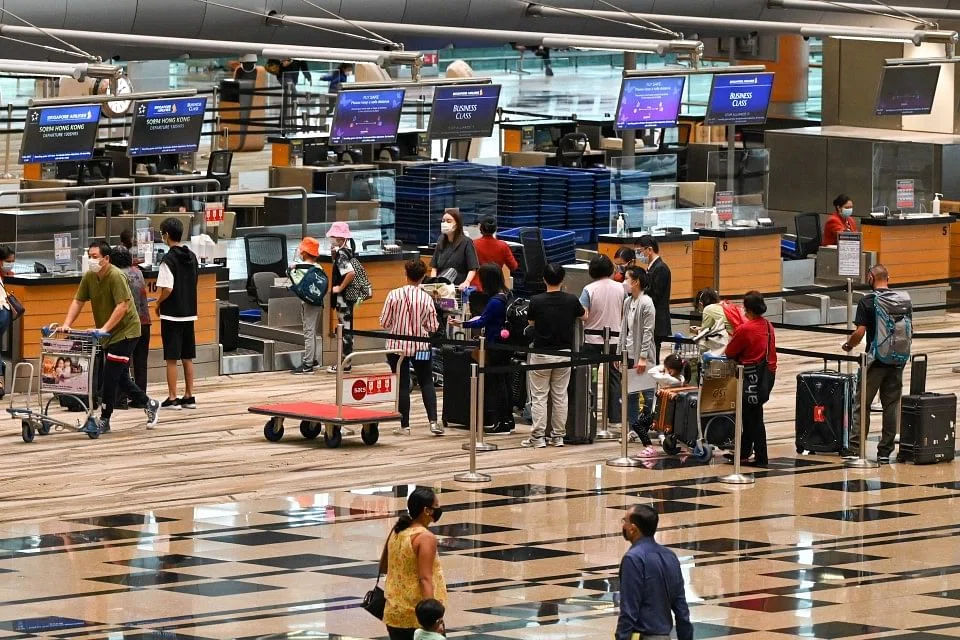
In contrast, barring the risks of a Covid-19 resurgence or disruptive mutation, they expect global travel to gain momentum from mid-2022 onwards, prompting a speedier recovery in the hospitality, F&B, aviation and tourism-related services.
"Overall, we believe the recovery in the services sector will become more broad-based as we head into 2022," they said.
In the MAS survey, private-sector economists' median expectation is for manufacturing to grow 4 per cent in 2022, slowing from the 2021 pace of 6.9 per cent for 2021.
In contrast, accommodation and food services is expected to see 9.6 per cent growth next year, up from 5.9 per cent in 2021.
Nevertheless, the extent of recovery should not be overstated. Official estimates suggest that F&B services, aviation and travel-related sectors, and construction will fall short of pre-pandemic output levels even by end-2022.
From pandemic to endemic
All this is premised upon an approaching light at the end of the pandemic tunnel. Yet as shown by the Omicron variant's emergence, uncertainty over the trajectory of the pandemic remains a major risk. As it is, the arrival of winter has accompanied another flare-up of cases in Europe and the US.
Granted, it is still too early to tell whether the Omicron variant will significantly set back the world's progress in tackling the virus.
Even if it is not more severe than the Delta variant, higher tranmissibility means that the sheer number of causes could still result in mass hospitalisations and delay further reopening, said Nagutha.
But the prevailing hope is that if it is no deadlier, and if existing vaccines prove effective, then reopening may continue.
Apart from a continued booster rollout, 2022 should bring hopes for effective Covid-19 treatment as well, said CIMB Private Banking economist Song Seng Wun.
Citi economists Kit Wei Zheng and Ang Kai Wei also see Singapore as being in a position to press ahead with both domestic and border re-openings despite Omicron.
The population has greater protection not just from booster shots but also natural infections during the last exit wave, they noted. "The gradual shift towards the endemic phase will allow for continued, if gradual domestic reopening, with increasingly limited economic damage from new infection waves."
And as both consumers and firms have adapted to Covid-19, future restrictions could be less disruptive. They noted that the correlation of retail spending to mobility has decreased in the past 2 years, as with every round of restrictions and relaxing, the share of online spending has generally stayed higher than before restrictions.
Yet not all major economies are making the journey towards endemic Covid-19.
One risk for 2022 is China's hardline stance towards Covid-19, said BofA's Nagutha. He noted that in Asean, Singapore has one of the highest exposures to final demand from China as a share of domestic GDP, at about 9 per cent.
Covid-19 policy is not the only worry. The DBS economists see broader developments in China as the largest risk to Singapore's growth in the next 6 to 12 months, citing factors such as the power shortage; policy shifts against tech companies; and the "common prosperity" philosophy,
"The biggest risk is that with so many different factors, both policy driven and unintended outcome from shifts in economic fundamentals, there is a real danger of growth undershooting in China," they said. This would have both a direct and second-order impact on Singapore's growth prospects.
A slowdown in China will be felt mainly through weaker investment demand, than consumption, said the Citi economists. A property-related investment slowdown in China could hurt non-electronics manufacturing, and real estate-related demand could be hit if Chinese developers operating in Singapore face financial difficulties, they added.
If China sticks to a Covid-zero strategy, there is also a greater risk of supply chain disruptions when breakthrough infections are dealt with severely, added CIMB's Song.
This could increase inflationary pressures - which are already a major theme of 2022.
Inflation watch
If Covid-19 remains under control and the growth recovery holds steady, then the main worry in 2022 looks set to be inflation - though the MAS is expected to act decisively to keep this in check.
In October, the MAS surprised the market by tightening policy. As inflation pressures persist, economists expect further tightening in the year ahead, by as early as the next meeting in April.
The Maybank economists expect core inflation to rise to 1.8 per cent in 2022, and headline inflation to reach 2.6 per cent, above the MAS forecast range of 1.5 per cent to 2.5 per cent. This is assuming that the goods and services tax (GST) hike does not occur in 2022, given existing inflation risks.
The DBS economists, in contrast, see a chance that the GST hike may be implemented in July.
But their forecasts are lower, at 1.5 per cent for core inflation and 2.4 per cent for headline inflation.
After a year of largely external pressures from global supply shortages and disruptions, however, one difference next year is that the balance inflationary pressures will shift towards the internal.
For Nagutha, the key drivers of inflation in 2022 are a gradual improvement in the labour market slack and a corresponding recovery in demand - admittedly alongside energy prices too.
The Maybank economists expect external pressures to ease in the second half of the year, after inflation peaks in the second quarter.
Instead, wage cost pressures and services inflation may then intensify, as the Progressive Wage Model is extended to more sectors and a new Local Qualifying Salary (LQS) requirement kicks in.
The LQS determines the local headcount used in calculating a firm's foreign worker quota. From next September, employers of foreign workers will have to pay at least the LQS - currently S$1,400 - to all local workers.
Apart from these policy moves, wages might be driven up by tighter labour market conditions, said the Maybank economists.
Perhaps the silver lining is that wages will be a significant source of inflation, rather than simply being eroded by it.
TRENDING NOW
Unhealthy air quality in Singapore enough to trigger haze pollution law; NEA is monitoring situation

Once staunchly pro-China, Malaysian Chinese businesses are now distancing themselves from Beijing

Could stablecoins be the future of money?
Johor’s investment boom is real, but actual contribution from JS-SEZ unclear

