

Should Singapore further tighten border controls on new Covid wave?
Rising local cases prompt some to call for border closure; others say better to strike a balance between restrictions and risks of importing infections

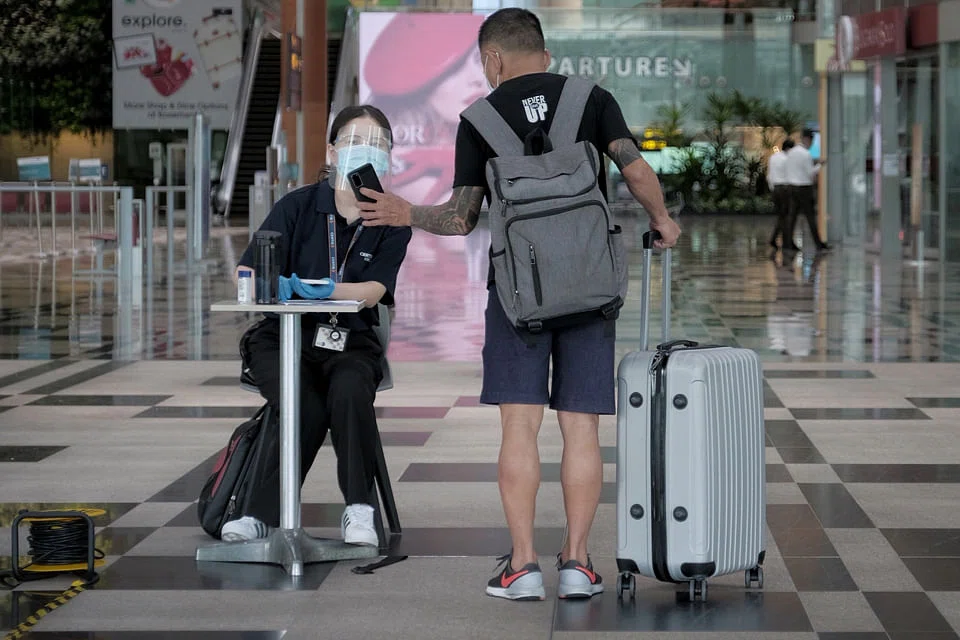
Singapore
THERE have been renewed calls for Singapore to completely shut its borders to high-risk countries, as the Republic battles a more infectious wave of Covid-19, but economists say the net costs and benefits may not be that clear-cut.
On May 16, the number of community cases climbed to 38, the highest in over a year, with 17 among these deemed unlinked. At the same time, the Changi Airport cluster has now become the country's largest community cluster, with 78 cases to date. According to sequencing results, the B1617 variant from India is behind this resurgence.
The government moved to ban visitor arrivals from India from April 24, and then extended the ban to four other South Asian countries from May 3. However, netizens, alarmed by the sudden escalation in Covid-19 cases in the last three weeks, cannot resist asking whether this is too little too late, especially since India's struggle against Covid-19 had been well-documented even in mid-April.
DBS senior economist Irvin Seah believes the authorities should impose a ban on all flights from high-risk countries at least temporarily, given that there are still flights and borders remaining open to Singapore citizens and permanent residents (PRs).
He told The Business Times: "If you continue to keep your borders porous, how are you going to effectively stabilise the domestic situation when new imported cases keep coming in from high-risk countries? There is basically persistent risk of spreading to the community."
He added that closing the borders to arrivals from high-risk countries would "significantly lower" the risk of Singapore having to resort to a lockdown or "circuit breaker", like the one between April 7 and June 1 last year.
The Ministry of Health (MOH) has maintained, however, that citizens and residents must be allowed to return home at minimum. Mr Seah said one possible solution the authorities could consider is chartering evacuation flights to bring them back, as was done in the early days of the pandemic with Singaporeans in Wuhan, the Chinese city believed to be ground zero of the coronavirus.
Other economists approached by BT presented a more nuanced view, believing that tightening border controls would harm Singapore's business links and reputation, particularly since trade and travel are in fact Singapore's lifeblood.
Instead of a blanket ban, Singapore could consider banning specific flights for a fixed duration, based on a hard cutoff on the number of positive cases from the on-arrival or seventh-day polymerase chain reaction test, something that Hong Kong is already doing, said Gedeon Lim, an economist at The University of Hong Kong.
"This helps to somewhat alleviate the concerns of arbitrary, or perhaps what might be perceived as unfair, nationality-based blanket bans. It also serves as an early-warning mechanism and places the incentives to carry only Covid-19 negative individuals on airlines and individual traveller responsibility," he said.
"It's imperative for us to keep our borders open, even while others close theirs, even if it is just a sign to the world that our policies are working, and to continue building our reputation as a global travel hub, for example, for Mice (meetings, incentives, conferences and exhibitions), even amid a pandemic," said Dr Lim, who is Singaporean.
He said that Singapore's efforts in maintaining open borders have paid off in both tangible and intangible ways. For example, it has helped the country gain recognition from thought and business leaders, as evidenced by their decision to organise trademark conferences in Singapore this year, while also helping to ensure a supply of essential workers for the medical and construction sectors.
In addition to those sectors, Singapore's "open borders without leakage policy" may have helped instill consumer confidence while the virus raged in the rest of the world, thus benefiting the food and beverage (F&B) and retail sectors to some extent, Dr Lim said.
But such open borders have also come at the cost of having to institute Phase 2 (Heightened Alert) measures, which now disproportionately affect F&B and retail, he said.
"So I think it's important to think about these costs and benefits in terms of their cross-sectoral impact, and it's not clear if one sector deserves to be prioritised over another," he said.
Walter Theseira, an economist from the Singapore University of Social Sciences, believes Singapore's border-control strategy has been an effective one, allowing inbound travel to resume without exposing the population to significant risk for most of 2020 and early 2021.
This should be contrasted with the policy in Australia and New Zealand, he said, which are so restrictive that those systems have been criticised by their own citizens for not letting those who want to return home do so at a reasonable cost.
"Despite those restrictions, Australia and New Zealand have had breakthrough cases from time to time. So too have China and Taiwan's restrictive systems," he said.
However, the problem is that the system did not adapt quickly enough to heightened risk from outbreaks in the last few months. For example, more attention should have been placed on the widespread positive cases from certain regions where a negative test is required to fly to Singapore, indicating that pre-departure testing is likely falsified. Other areas include the appropriateness of the 14-day stay-home notice (SHN) duration and the risks associated with contact at the airport SHN facilities.
"We do need to understand why our border-control strategy failed to be adapted in time. Then going forward, the question is whether we have confidence that our revised border-control strategy is able to deal with flights from high-risk areas that are restricted to citizens and PRs," said Dr Theseira.
Other economists believe the discussion on border controls is moot at this juncture, since the B1617 variant has already arrived in Singapore and border controls have already been tightened.
Eric Chiang, associate economist at Moody's Analytics, said: "The problem is flights could only be banned after high-risk areas are identified. But that may be too late as infected persons may already have entered Singapore before their points of origin were known to be high-risk. Thus ultimately, the need is to better protect workers at Changi airport and better isolate passengers upon arrival."
Echoing this view, CIMB private banking economist Song Seng Wun said: "It's the local cases and the local infection and spread that we should be more worried about. We can't wind back the clock, so the point about banning flights is moot."
Moreover, now that the SHN has been extended to 21 days for travellers from high-risk countries, the gains from flight bans would be "marginal" at this point, said Darren Tay, senior Asia country risk analyst at Fitch Solutions.
Chua Hak Bin, senior economist at Maybank Kim Eng believes the focus should be on achieving a high vaccine rollout, which would help reduce fatality and infection rate, allowing for less restrictive lockdowns.
Noting that resorting to the extreme option of circuit-breaker measures may unnecessarily bring severe damage to the economy and businesses, he said: "A high vaccination ratio should help change the trade-offs between stricter lockdowns and the infection and fatality rate."
TRENDING NOW

Once staunchly pro-China, Malaysian Chinese businesses are now distancing themselves from Beijing

Inside Singapore’s government team that kills its own products
Johor’s investment boom is real, but actual contribution from JS-SEZ unclear

Inside F1: How ‘reactive’ DHL acted quickly to fit Malaysia race just before Singapore’s

