

Singapore adapts to electronics trade shifts by focusing on high value-added activities

Mindy Tan
Singapore
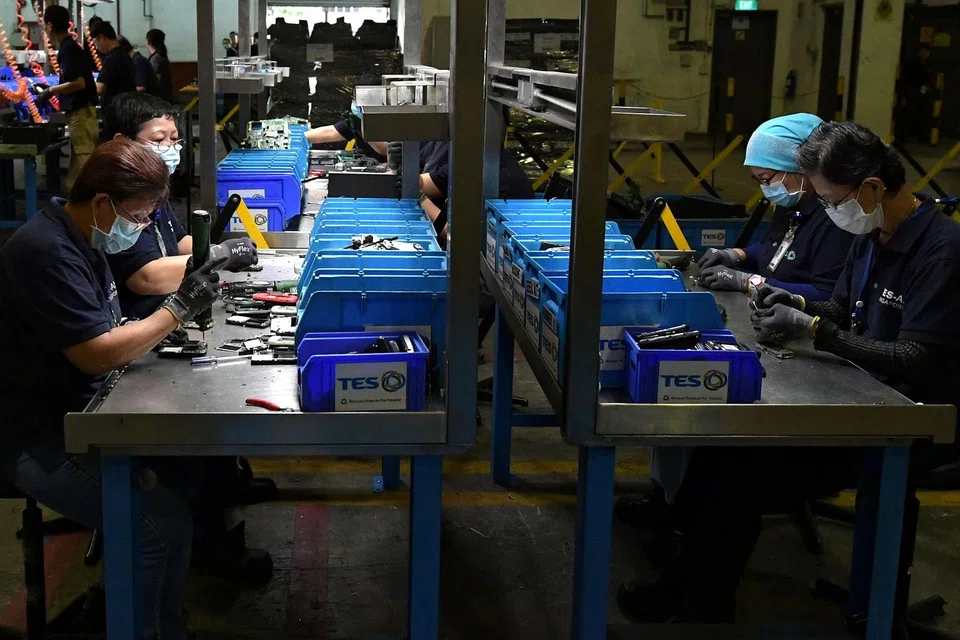
DESPITE shifts in electronics trade flows, Singapore has adapted by focusing on high value-added activities in the global supply chain, helping to cement its position as a trade hub.
While increased US-China trade barriers and technological restrictions in the last wo years have raised the prospect that China and Asia's China-centric electronics production network will cede market share in the US market, at this juncture the Asian supply chain is more mature, accounting for a dominant share of global electronics production, in both final and intermediate goods.
The advanced development of Asia's production chain gives the region a competitive advantage over the US-Mexico one, and the range and sophistication of the firms involved would not be easily duplicated, noted the Monetary Authority of Singapore's Economic Policy Group in its Macroeconomic Review.
In addition, upstream, mid-stream and downstream producers are all found in the region, clustered together to benefit from economies of agglomeration and scope.
In terms of how electronics supply chains have shifted since the implementation of additional US tariffs on China's products, it appears that the major nodes in Asia's electronics supply chain have remained broadly intact, although there has been some reorganisation of production away from China and towards manufacturers elsewhere in Asia, particularly Vietnam, Taiwan, and Malaysia.
China appears to be adjusting to the tariffs by shifting production away from final goods and towards intermediate products. There is also tentative evidence of in-sourcing by the US and gains by Mexico, which suggest that the tariffs have catalysed the growth of the US-Mexico electronics production network.
Meanwhile, Malaysia has established itself as the largest supplier of integrated circuits (ICs) to the US and Mexico, and plays a significant role in the IC imports of the EU and China. Given that Malaysia's exports to Mexico are channelled through the US and a part of that trade comes through Singapore, Malaysia's significant role in these major markets has bolstered Singapore's re-exports.
However, to meet the growing demand for ICs from China, Malaysia is forwarding more of its IC exports to Hong Kong instead while the Philippines has almost halved the proportion of ICs exported through Singapore over the last decade.
In general, the regional countries are sourcing more directly from the Northeast Asian economies or via Hong Kong instead of importing from countries such as the EU and Japan through Singapore. However, Singapore's IC re-exports to markets outside of China, including the US and EU, remain much larger than Hong Kong's by about 1.3 times on average.
It is also worth noting that Singapore re-exports other electronics components and final products from China to the Asean countries. Singapore's re-exports account for the largest proportion of electronics imports into Indonesia (32 per cent) and the lowest in Vietnam (5 per cent).
For exports out of Southeast Asia, Singapore plays a much smaller role as a distribution centre, with notable volumes from only Malaysia. Malaysia ships to Singapore about 10 per cent of the mobile phones, and 15 per cent of PC parts. Among the HDD producers in the region, only Malaysia exports a small portion (of less than 10 per cent) via Singapore.
Today, Singapore accounts for as much as a fifth of the world's production of semiconductor equipment, in large part due to the country's focus on high value-added activities in the global supply chain. Many of the world's top semiconductor companies have a presence in Singapore, which serves as their regional headquarters, research & development centres or advanced wafer fabrication facilities. This has helped to entrench Singapore as a major global distribution hub for ICs and resulted in a rich domestic ecosystem of materials and equipment and EMS (electronics manufacturing services) players.
TRENDING NOW

Fed hike throws Singapore banks a margin lifeline; UOB most likely to feel impact

He built the Vingroup empire. Now South-east Asia’s richest man is handing some key roles to his sons

Real-estate veteran Desmond Sim quits from CEO roles at Realion, ETC
Chagee, Mixue and Luckin won the market. Sustaining their edge is the harder part

