

Observers support government's push for electric vehicles

Singapore
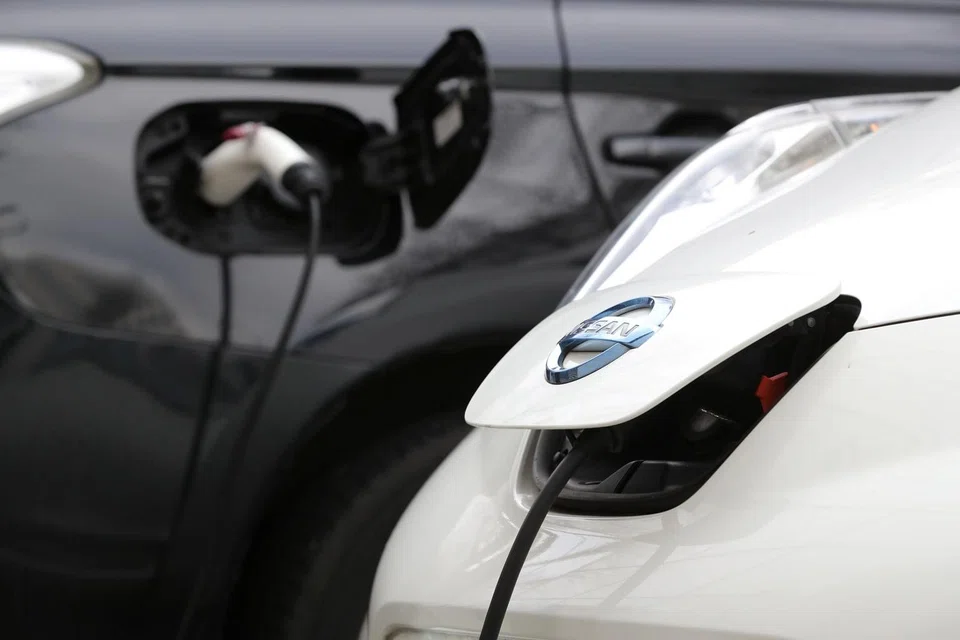
BUDGET 2020 delivered a pleasant surprise for climate-change watchers, who say measures to spur the adoption of electric vehicles (EV) are a step in the right direction, and that the government's vision to phase out vehicles with internal combustion engines in 20 years is achievable.
Deputy Prime Minister and Finance Minister Heng Swee Keat on Tuesday announced three measures to promote the use of EVs, with the government taking the lead to progressively use cleaner vehicles.
Incentives to encourage environmentally friendly vehicles will be enhanced through the Commercial Vehicle Emissions Scheme for light goods vehicles, which is similar to the Vehicular Emissions Scheme introduced in 2018 for cars and taxis that offered an upfront rebate.
The EV Early Adoption Incentive will offer those buying fully electric cars and taxis a rebate of up to 45 per cent on the Additional Registration Fee, capped at S$20,000. This will be implemented for three years from January 2021.
The road tax methodology for cars will be revised, leading to an across-the-board reduction in road tax for EVs and some hybrids.
Subodh Mhaisalkar, executive director of the Energy Research Institute @ NTU, said this timeline takes into account projections by carmakers that the price difference between EVs and petrol cars will be very small beyond 2023. The effectiveness of the measures however, depends on whether fleet owners like taxi operators, ride-hailing and car-rental firms take the bait, he said.
"Taxis run a lot more kilometres than private cars, so really, an acceleration of adoption of EVs by taxis would make a huge impact," he said.
Sanjay Kuttan, who chairs the sustainable infrastructure committee under the Sustainable Energy Association of Singapore, said the government's plans to deploy 28,000 chargers in public carparks is a definite game changer, as the first barrier that prevents EV adoption has always been the lack of infrastructure, which gives rise to range anxiety.
But where these chargers are installed is key. Dr Kuttan said: "It's not just the number, but how they think about distributing the infrastructure across the country to maximise the utilisation of the charging infrastructure."
Melissa Low, a research fellow at the National University of Singapore's Energy Studies Institute, is hoping that the new chargers can draw power from a renewable energy source. Currently, 95 per cent of Singapore's grid is powered by liquefied natural gas, which is a fossil fuel.
"By 2030, Singapore will also have two Gigawatts of solar energy capacity, so it would be great if some of that solar power can actually be used to charge cars directly, because then it would truly mean decarbonisation," she said.
There was one little caveat though. Fuel excise duties yield around S$1 billion a year and are a form of mileage tax to discourage car use. Since EVs do not pay these duties, a lump-sum tax will be built into the road tax schedule for them to partly account for the loss in fuel excise duties, Mr Heng said.
The six-monthly EV lump-sum component will be S$100 in 2021, S$200 in 2022 and S$350 from 2023.
However, observers do not see this as a big setback, given that EVs have a lower overall cost of ownership.
As for long-term measures to adapt to climate change, Mr Heng also announced a new Coastal and Flood Protection Fund, with an initial injection of S$5 billion.
KEY POINTS
TRENDING NOW

Philippine power giant First Gen rebuffs foreign offers, plans up to US$2.6 billion in expansion

Vietnam’s data-centre investment rush faces reality check on power and site constraints

Singapore should prepare for prolonged haze until November, says Grace Fu
Is stagflation returning? That mostly depends on the Iran war

