

Singapore doubles down on tighter foreign worker quotas

Singapore
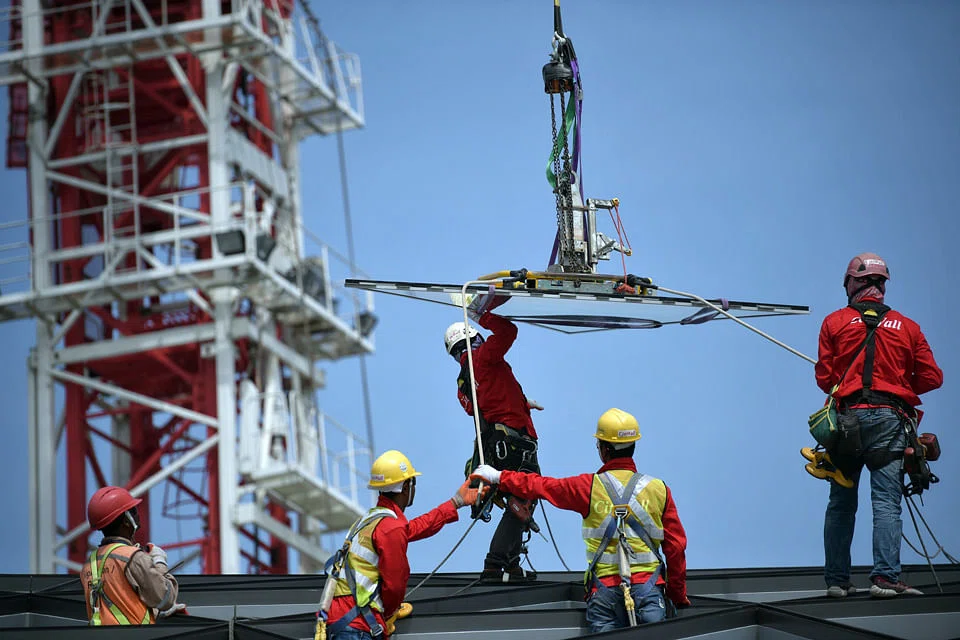
AFTER foreign labour caps in the services sector were tightened in last year's Budget, the same fate has now befallen the construction, marine and shipyard and process industries.
The limit on how many S Pass holders companies in these sectors can hire will be cut from 20 per cent to 15 per cent, said Deputy Prime Minister Heng Swee Keat on Tuesday, citing the need to give local workers a fair shake.
Despite the short-term pinch for businesses that are already grappling with a sharp economic slowdown, observers were unsurprised by the cuts, which OCBC Bank chief economist Selena Ling called "a timely reminder that... there is no unwinding of foreign manpower curbs" as Singapore moves towards leaner industry.
"Even during this current crisis, the government is not looking at the easy route," remarked Ajay Kumar Sanageria, KPMG's deputy tax head, noting that this ensures "our productivity targets are not compromised".
The S Pass cap in the three sectors will drop from 20 per cent to 18 per cent on Jan 1, 2021, then to 15 per cent in 2023, in a move that Barclays Bank economist Brian Tan said "will also imply greater wage pressures".
Still, the S Pass, for mid-skilled foreigners earning at least S$2,400 a month, "should not be a means by which enterprises hire low-cost foreign workers, when qualified locals are available", Mr Heng said.
Manufacturing, which was in contraction last year, will have its S Pass quota tightened "when conditions allow", he added, although foreign worker levy rates will be kept unchanged for all sectors this year, "in view of the economic conditions".
The number of S Pass holders in the construction, manufacturing, marine shipyard, and process fields grew by 3.8 per cent annually in the last two years, and could pick up further.
But "the government has been working closely with industry and educational institutions to build up a pipeline of local manpower, including mid-career workers", Mr Heng said. "We want them to have fair opportunities to grow, while supporting the manpower needs of enterprises."
For instance, Institute of Technical Education or polytechnic graduates could become draughtsmen or junior engineers, DBS senior economist Irvin Seah told The Business Times.
Still, Ng Yek Meng, president of industry group Singapore Contractors Association Ltd (SCAL), said in an e-mail that the sector will be challenged "as more than half of the construction supervisory staff are S Pass holders".
Although Lum Chang Building Contractors has tapped digitisation and other measures to lift productivity, managing director Tan Wey Pin told BT that "this quota cut will still prove challenging", adding: "We now need to hire, train and retain even more local talents with different skill sets."
David Ng, executive chairman of building solutions group ISOTeam, also cited barriers to hiring qualified citizens, even though it has expanded workers' skill sets and even encouraged long-term staff on S Passes to take up permanent residency.
Maybank Kim Eng senior economist Chua Hak Bin told BT: "Many firms in these sectors are already struggling and we fear that the tightening will only push some over the edge, especially marine and shipyard."
But, for businesses concerned about a looming labour crunch, government agencies SkillsFuture Singapore and Workforce Singapore will help to match them with skilled fresh grads and mid-career professionals in the local labour pool, said Mr Heng.
They can also still apply for programmes like the Lean Enterprise Development scheme, which lets companies hire foreign workers temporarily while recruiting and training locals.
Still, "in the coming one to two years, companies will have to attract and retain more locals to work in the construction industry", said SCAL's Mr Ng, citing the trade group's ongoing initiatives, such as scholarships at institutes of higher learning for students to explore a career in construction.
Singapore Business Federation chief executive Ho Meng Kit told BT that more measures such as internships for young locals would help too, and trade groups "can also step up and take the lead in vocational training".
KEY POINTS
TRENDING NOW

Cracks emerge in AI borrowing boom as CoreWeave, Oracle and SoftBank debt worries grow

Could stablecoins be the future of money?
‘How many will survive?’: Bubble fears arise as China’s humanoid robotics face reality check

Philippine power giant First Gen rebuffs foreign offers, plans up to US$2.6 billion in expansion

