New electric vehicle measures expected to jolt sales
Car company executives welcome moves but would have liked to see more incentives for hybrid cars
Singapore
THE car industry is looking forward to an uptick in sales of electric vehicles (EV), following plans announced by Finance Minister Heng Swee Keat to spur Singapore's switch to cleaner energy vehicles.
Mr Heng announced in his Budget speech on Tuesday that S$30 million has been set aside over the next five years for EV-related initiatives entailing public-private partnerships. This could include measures to improve charging availability at private premises.
Referring to climate change as an existential threat as well as a "gradual and intensifying risk", Mr Heng identified cleaner-energy vehicles as a way to reduce emissions. He announced that the floor for Additional Registration Fees (or ARF, an upfront tax) payable for some EVs will be reduced to zero in January next year, from S$5,000 currently. That will make some EVs cheaper by up to that amount next year.
At the same time, Mr Heng said, road tax bands will be adjusted so that mass-market electric cars will be taxed comparably with internal combustion engine (ICE) equivalents.
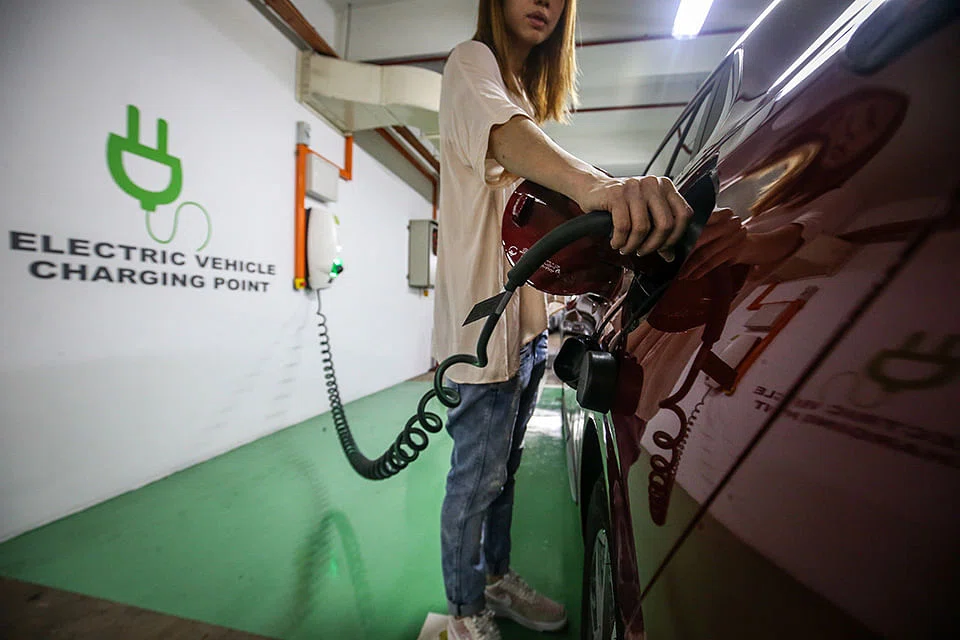
While the tax adjustments aim to make EVs easier to buy and own, Mr Heng also announced a measure to make them easier to live with. "We will accelerate the development of our charging infrastructure to better support the growth of EVs in the next decade," he said. "We aim to deploy 60,000 charging points at public carparks and private premises by 2030 - more ambitious than our previous target of 28,000."
Car companies that have launched EV models or have them waiting in the wings cheered the initiatives from a climate change point of view. "The country is clearly kicking up a gear to embrace EV adoption as part of the bigger conversation and commitment towards environmental sustainability," Markus Schuster, the managing director of Audi Singapore, told The Business Times. He said such moves would help Audi achieve a stated aim to reach carbon neutrality, in line with DPM Heng's own view that tackling climate change is a shared problem. "Our emissions may be just a small fraction of the world's, but we must do our part," Mr Heng said yesterday.
Preeti Gupta, the director of corporate affairs for BMW Asia, called the new measures "a clear demonstration of the government's commitment to a cleaner and greener Singapore". She said the goal to put 60,000 charging points on the island was a concrete step to "ensure mass adoption of electro-mobility has a viable chance here". BMW is planning to launch two EVs this year, while Audi has two in its lineup with another on the way.
Ron Lim, head of sales and marketing for Nissan at Tan Chong Motor Sales, is particularly moved by the adjustment of road taxes. "Road taxes of EVs are still almost double that of comparable ICE models," he said. A year's road tax for the Nissan Leaf currently costs S$1,205, about the same as what it costs for the X-Trail, a larger car with seven seats and a 2.0-litre engine.
Mr Lim is more muted in his response to next year's ARF reduction, however. "While beneficial, it might not really move the needle much since the savings are negated any time the Certificate Of Entitlement price rises by S$5,000 or more," he said.
Other car company executives said they would have liked to see more incentives for hybrid cars (which run on a combination of petrol and electric power) and plug-in hybrids (which typically offer enough electric-only range for roughly a day's motoring).
Jasmmine Wong, CEO of Inchcape Singapore and Greater China, which owns the sole dealerships for Toyota and Lexus here, is one of them. She said: "It would be great to see hybrids included in these initiatives so that our consumers can seamlessly transition from now till 2030 when the charging infrastructure reaches maturity and widespread availability."
Yet, Tan Chong's Mr Lim pointed out that incentives that took effect this year have already done much to drive EV adoption. "The higher VES incentives and EEAI that just kicked in from Jan 1 this year have already helped make EV prices more palatable," he said, referring to new Vehicular Emissions Scheme and Electric Vehicle Early Adoption Initiative tax rebates that together knock as much as S$45,000 off the prices of some electric cars. Figures from the Land Transport Authority show that EV sales are up sharply so far this year. In January alone, 57 new electric cars were registered here, compared to 97 EVs for all of 2020.
"Any additional incentives thrown in will only be a bonus to potential buyers," Mr Lim said.
KEY POINTS
- S$30 million for public-private partnerships.
- Additional Registration Fee floor to be lowered to zero.
- Road tax treatment for electric cars to be adjusted.