Singapore considers giving more people at least one Covid-19 vaccine dose
Strategy may help given rising community cases, limited vaccine supply: Ong Ye Kung; all schools to shift to full home-based learning from Wed

Singapore
THE Singapore government is considering giving as many people as possible at least one dose of the Covid-19 vaccine in the second phase of the nation's vaccination exercise.
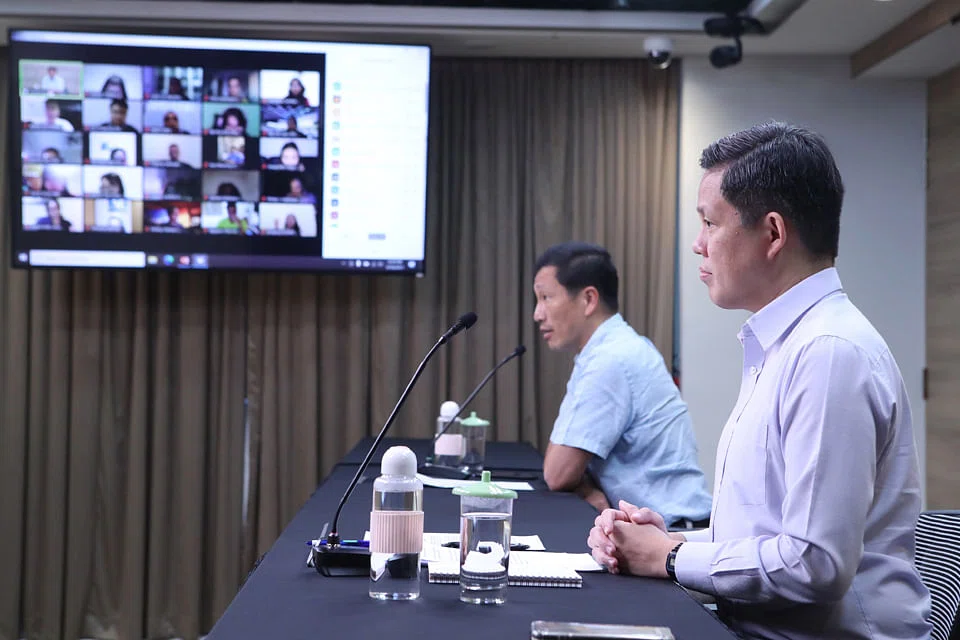
Many international studies show that at least one dose can provide good protection from the virus without compromising efficacy, new Health Minister Ong Ye Kung said at a Covid-19 multi-ministry task force press conference on Sunday evening.
"Our scientists have been studying this. We have an expert committee, and the evidence locally and overseas is... it's reasonable for (the second dose) to be further apart (from the first). Instead of 21 or 28 days, it can possibly extend to six to eight weeks without materially impacting the efficacy of the vaccine," said Mr Ong.
Such a strategy will be helpful, given "the current situation where we have more cases" and the fact that the vaccination rate is limited by the pace at which vaccine supplies arrive in Singapore, Mr Ong added.
He noted that the first phase of Singapore's vaccination exercise was focused on those who needed it most, including vulnerable members of society and those on the frontlines, and gave the assurance that those who already have appointments for their second dose will not be affected.
The UK and parts of Europe have deployed a similar strategy of delaying the second vaccine dose to protect as many people as possible while vaccine supplies catch up with demand, said Hsu Li Yang, an infectious disease expert at the National University of Singapore's (NUS) Saw Swee Hock School of Public Health.
Prof Hsu noted that the first doses of the mRNA vaccines have been found to confer about 80 per cent protection against symptomatic Covid-19 infection in the first week.
Among current research that might support the practice is a study conducted by investigators from the University of Birmingham in the UK on the Pfizer-BioNTech vaccine.
The study, which has not been peer-reviewed, found that those who received the second dose 12 weeks later had higher antibody responses than those vaccinated on the usual three-week schedule.
"We do not know if this actually results in greater protection against Covid-19, but it shows that there is probably no loss of efficacy if the second dose were to be delayed up to 12 weeks," said Prof Hsu.
He added that the results are consistent with what is known about other vaccines, particularly those given in childhood. While there have not been similar studies done with the Moderna vaccine, the results are unlikely to differ significantly.
"Given the situation in Singapore and the higher transmissibility of current Covid-19 variants - in particular the B.1.617.2 variant - it is prudent to vaccinate as many people as quickly as possible," he said.
Teo Yik Ying, dean of NUS's Saw Swee Hock School of Public Health, said an article published in May in the British Medical Journal highlighted the public health benefit of delaying the second vaccine dose, especially if the delay helps to get more of the population at least partially vaccinated.
But evidence for this is very recent, and public health policies must evolve to account for new evidence that emerge, said Prof Teo.
To date, a quarter of the population in Singapore is already fully vaccinated, while a third has been given at least one dose. The vaccines are currently available to those aged 45 and above, and the government will invite subsequent age bands to receive their shots from the later part of May. The aim is to complete the vaccination programme by the end of the year, if supplies arrive as scheduled.
New Education Minister Chan Chun Sing, who was also at the press conference, said that although the main constraint facing Singapore is the supply of the vaccines, the country's vaccination capacity is always higher than the availability of the vaccines.
He added that the number of people to be vaccinated could increase soon, when approval is given for the Pfizer vaccine to be administered to those aged 12 and above.
"In the overall review of the vaccination plan for the (rest) of our population, we will take into account the prioritisation for this group of people with the rest of the other age groups that may not have been vaccinated yet," said Mr Chan.
Amid the sharp increase in community cases of late and with 18 unlinked cases announced on Sunday, all primary, secondary, junior college and Millennia Institute students, including students from Special Education schools, will shift to full home-based learning from Wednesday till the end of the term on May 28.
Pre-schools and student care centres will remain open to support parents who need to work.
Responding to a question from BT at the press conference, Mr Ong said the organisers of the upcoming Shangri-La Dialogue in June and the World Economic Forum's special annual meeting in August will continue to monitor the situation in Singapore closely and come to their own recommendations and decisions whether to proceed with their events.
At the previous press conference last Friday, task force co-chair Lawrence Wong had said the organisers are receiving the latest information on Singapore's prevailing health updates, cases and measures and will take the broader global health situation into consideration too.
Mr Ong said on Sunday that there has not been any further development since then, and "the answers have substantively not changed".