

Singapore factory sentiment expands more slowly in September as cost pressures rise
 Add BT as a preferred source
DeeperDive is a beta AI feature. Refer to full articles for the facts.
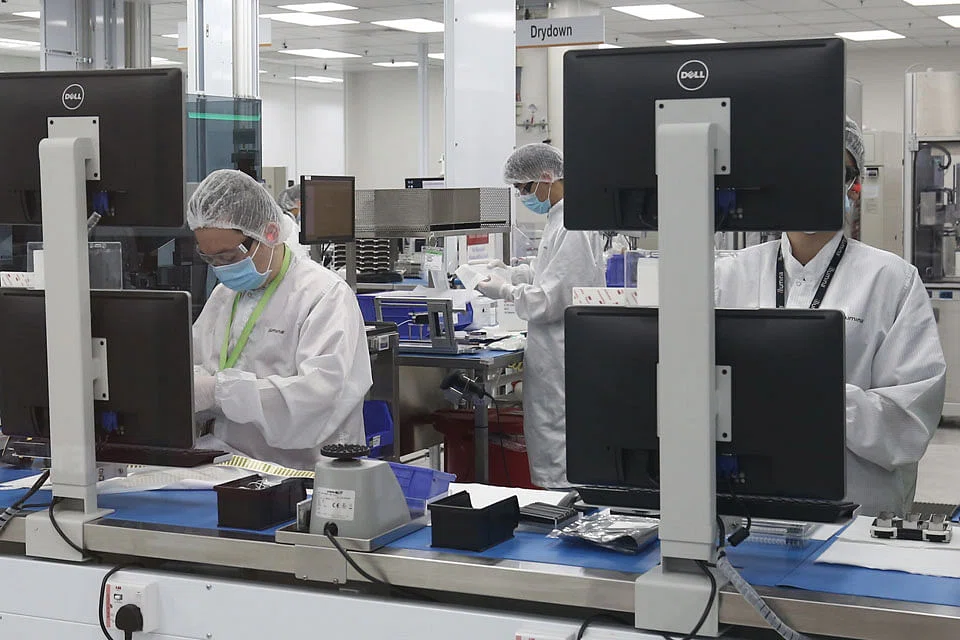
SINGAPORE's overall manufacturing sentiment inched lower for the second straight month in September, as growth cooled in the non-electronics segment, according to a monthly gauge released on Monday by the Singapore Institute of Purchasing and Materials Management (SIPMM).
The slower expansion tracked broader regional caution, and raised concerns of a weakening export environment for manufacturers amid price pressures from costlier commodities.
While the latest SIPMM Purchasing Managers' Index (PMI) showed expansion in the manufacturing sector for the 15th straight month, OCBC chief economist Selena Ling has suggested that "momentum could have peaked and an imminent slowdown is on the cards".
The headline PMI reading dipped to 50.8 points in September, from 50.9 in August, on slower expansion in new orders, new exports, factory output, inventory and employment.
Granted, the electronics industry grew at a faster clip, with the electronics PMI picking up to 51.2 points, from 51.0 in the month prior. Still, the segment's inventory, employment and finished goods indices increased more slowly, while the electronics supplier deliveries index shrank after eight months in positive territory.
PMI readings above 50 points indicate an expansion, while those below 50 points represent a contraction.
Navigate Asia in
a new global order
Get the insights delivered to your inbox.
Meanwhile, Sophia Poh, SIPMM's vice-president for industry engagement and development, also said: "Supply chain disruptions are still plaguing local manufacturers as they struggle to cope with reduced margins from the higher cost pressures."
That is as the overall and electronics input price indices both rose by 0.3 point - to 51.7 points overall and 52.5 for the electronics segment.
Said Ms Ling: "As inventory levels edge lower for both the domestic manufacturing and electronics sectors, the ability to sustain production in the run-up to the Christmas season may be at stake... The ability to pass on some of the higher costs to end-consumers would also be key."
UOB economist Barnabas Gan attributed the recent overall manufacturing PMI decline to "a slightly softer external environment", adding that it was in line with other regional data that showed slowing export growth.
Indeed, industry research firm IHS Markit's Asean manufacturing PMI stood at the neutral 50.0 point mark in September, against 44.5 in August.
IHS Markit noted the reading "signalled no change in manufacturing conditions on the month", and IHS Markit economist Lewis Cooper added that "the sector remains on an uneven footing".
Mr Cooper cited inflationary pressures from a steep increase in costs, as well as the whammy of regional Covid-19 outbreaks on producers: "Until this subsides, it's unlikely we will see a meaningful return to growth for the manufacturing sector."
Manufacturing PMIs remained contractionary in several major South-east Asian economies, with Vietnam's PMI reading stagnant at 40.2 points. Malaysia's factory sector shrank at a slower pace, with the PMI at 48.1 in September, against 43.4 in August. Meanwhile, Thailand's PMI stayed underwater, despite picking up to 48.9 points, from 48.3 in August.
Now, emerging Asia faces "downward pressure on regional manufacturing PMIs", as China and the United States have seen growth peak and external demand could thus weaken, Barclays analysts noted in a report.
"A slowing Chinese economy, the country's decarbonisation campaign and its recent power shortages will have a negative spillover effect on the rest of EM (emerging markets) Asia, with the trade and manufacturing channels likely bearing the brunt," the analysts wrote.
Outside Asean, the IHS Markit PMI was in positive territory in key electronics exporter markets, although the pace of growth varied. Taiwan's PMI slid to 54.7 points in September, from 58.5 in August, while the South Korean PMI rallied to 52.4 points, from 51.2 in the month before.
While mainland China's official manufacturing PMI fell to 49.6 points, from 50.1 in August, the private Caixin PMI - which focuses on smaller and external-oriented manufacturers - improved to 50.0, from 49.2 before.
Said the SIPMM's Ms Poh: "The overall manufacturing sector has ended the third quarter with slowing growth, albeit the electronics sector continues to record a faster growth."
Ms Ling noted: "Fears of supply chain disruptions and component shortages interrupting the manufacturing momentum within Asia appear to pose potential headwinds ahead for regional manufacturing centres, including Singapore, particularly given recent news headlines about China's ongoing power shortage and earlier Covid-related restrictions."
Still, Mr Gan reiterated that Singapore's factory sector remains "one of the key economic support pillars", and kept to his estimate of 8.0 per cent manufacturing growth in 2021.
Decoding Asia newsletter: your guide to navigating Asia in a new global order. Sign up here to get Decoding Asia newsletter. Delivered to your inbox. Free.
Copyright SPH Media. All rights reserved.
TRENDING NOW

China pips the US if Asean is forced to choose, but analysts warn against reading it like a sports result

Beijing’s calculated silence on the Iran war

Shelving S$5 billion office redevelopment plan proved ‘wise’ as geopolitical risks mount: OCBC chairman

Vietnam formalises new state leadership, redefining ‘four pillars’ power balance

