

Singapore firms can tap EU expertise in urban sustainability
Closer economic ties could result in more examples like that of Keppel Seghers Belgium

Janice Heng
Brussels
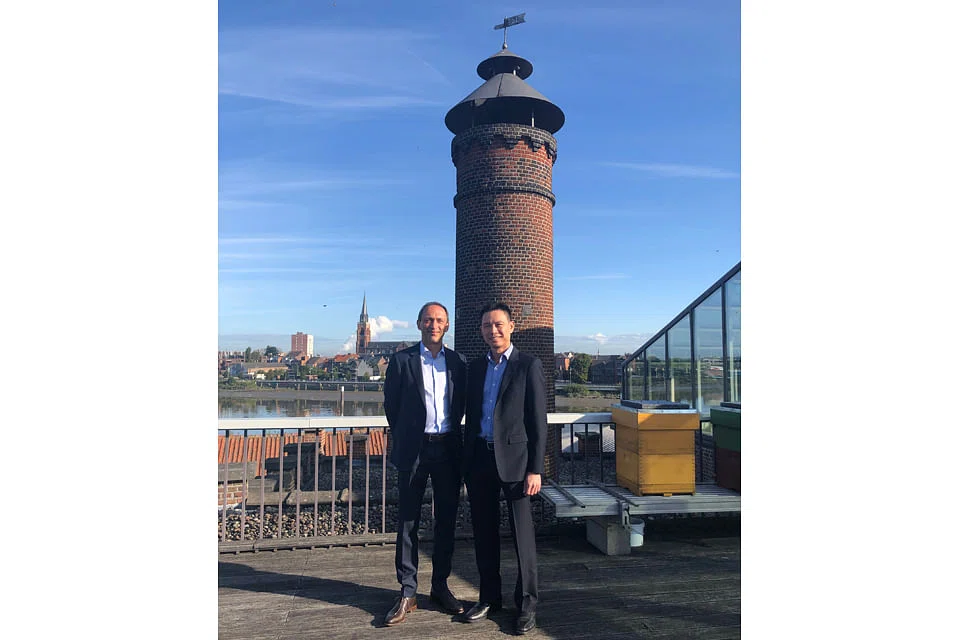
KEPPEL Corporation unit Keppel Seghers houses its engineering centre in a cosy former brewery in Belgium, while its Singapore team oversees operations and project management aspects of the company's waste-to-energy, water reuse, desalination, and wastewater treatment projects.
Moves such as the European Union-Singapore Free Trade Agreement (EUSFTA) could facilitate other Singapore firms who are looking at opportunities in Europe, said Keppel Seghers Belgium executive director Jackson Goh.
With European firms being generally more advanced in areas such as environmental sustainability, Singapore firms can tap their decades of experience and technology "so you don't need to go through that learning curve", he added.
In 2002, Keppel acquired Belgian environmental technologies firm Seghers Better Technology, housed in an historic red-brick building in the idyllic town of Klein Willebroek, about an hour from Brussels, with cobbled streets and a picturesque canal. Renamed Keppel Seghers, the firm retains those premises as its engineering centre.
Such attractiveness notwithstanding, the acquisition was of course based on hard business logic: Seghers' expertise in waste-to-energy plants, which burn municipal waste to produce steam, which then generates electricity. Its proprietary technology can be customised to suit clients' needs and market conditions.
From the Belgian firm's point of view, the move made sense due to Keppel's extensive international network and strong reputation, said general manager Ivan Christiaens.
Though Seghers already had an overseas presence, being part of Keppel allows it to offer more complete solutions, including operation and maintenance, in contrast to its original business of providing technology alone, added Mr Christiaens. "Because you can deliver all these things, you also have less competition."
Keppel Seghers has waste-to-energy projects in countries such as Belgium, the United Kingdom, Singapore, Qatar, and China, including the world's largest waste-to-energy facility in Shenzhen. It recently secured a contract for Australia's first waste-to-energy plant.
In terms of the EUSFTA's direct impact, Keppel Seghers in Singapore does procure equipment and technology from Europe, noted Mr Goh. More broadly, given the collaboration between Europe and Singapore, "anything that permits the free movement of goods and services is going to be helpful for our business", he said.
The alignment of standards is also important, with EU environmental standards being among the world's strictest, he added. Keppel Seghers' flue gas cleaning systems have stringent emission control limits.
Minister-in-charge of Trade Relations S Iswaran is currently in Brussels to meet EU Trade Commissioner Cecilia Malmström and EU enterprises, as the EUSFTA enters its final ratification stages.
Closer economic ties could result in more examples like Keppel Seghers. With the rise of urban sustainability, not least in Asia, Europe's long-established expertise in this field is valuable for Singapore firms, said Mr Goh. "I think there're always Singapore companies looking at Europe."
Keppel Seghers' ISVAG waste-to-energy plant in Belgium, for instance, has been running for nearly 40 years, after a revamp in the 1990s. The inter-municipal company ISVAG handles household waste for Antwerp and surrounding areas. There are plans for Keppel Seghers to rebuild the plant for greater efficiency, and build a district heating network to supply homes with heating from it.
TRENDING NOW
World’s largest offshore wind platform by Seatrium consortium on track to be completed by 2028

Is stamp collecting enjoying an analogue revival or are its best days over?
GovTech retrenches another 38 staff in second round of layoffs

MBS adjusted property Ebitda falls 20.6% in Q3 with fewer high-roller visits, weaker hold

