

Singapore freezes new ticket sales for VTL entry before Jan 21
Singapore
NEW ticket sales for Vaccinated Travel Lane (VTL) flights and buses entering Singapore from Thursday (Dec 23) to Jan 20 next year will be frozen, with quotas and sales to be temporarily reduced after that.
While this will mainly affect last-minute travellers, longer-term uncertainty could disrupt firms' manpower plans, said industry players.
Announcing these moves to limit VTL arrivals on Wednesday, the Ministry of Health (MOH) said they aim to reduce the country's exposure to imported Omicron cases.
More Omicron cases are being picked up here because of the Covid-19 variant's rapid spread, with 65 confirmed cases in travellers here to date, said MOH.
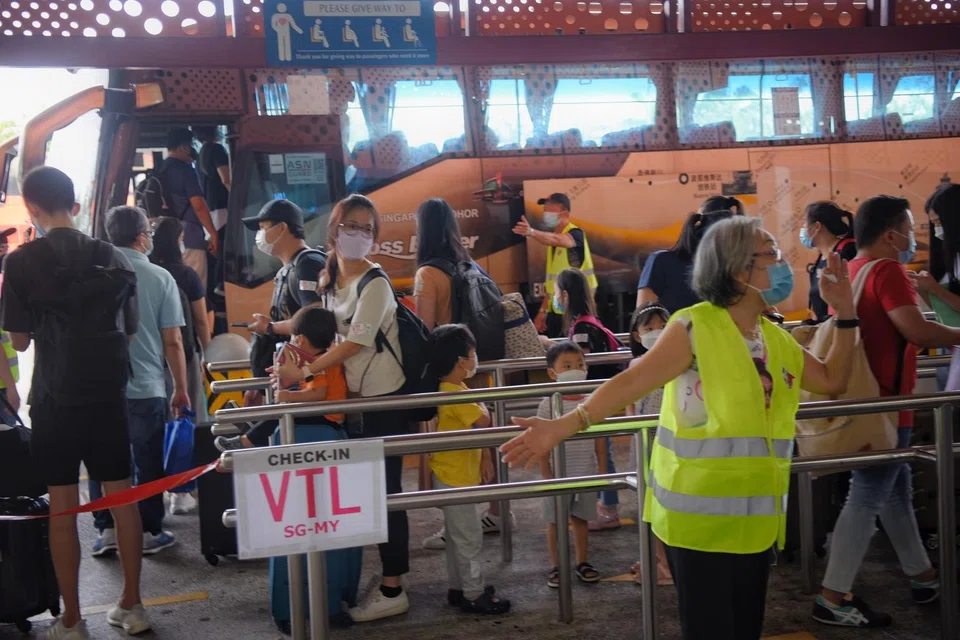
For the VTL (Land) with Malaysia, capacity from Jan 21 onwards will be halved, by the equivalent of 24 bus rides one way per day, said the Ministry of Trade and Industry.
For VTL flights into Singapore, total ticket sales will be capped at half of the allocated quota from Jan 21, said the Civil Aviation Authority of Singapore (CAAS).
But travellers who already hold a ticket for a VTL flight or bus and meet all the other requirements can continue to travel under the VTL. Said MOH: "We will continue to monitor developments closely and update this policy as the situation changes."
In the wake of the announcement, Malaysia also announced a freezing of the sale of plane and bus tickets to Singapore under its sole vaccinated travel lane from Thursday through Jan 20.
The freeze on new VTL ticket sales, for both buses and flights, applies to travel into Singapore from 11.59 pm on Dec 22 to 11.59 pm on Jan 20. It does not affect tickets for entering Singapore after that.
In response to a query by The Business Times on the percentage of VTL tickets that remain unsold for the affected period, Singapore Airlines said it does not comment on commercially sensitive matters.
In the labour-strapped construction, marine shipyard and process sectors, dormitory-bound work pass holders have already been barred from entering via VTLs since 11.59 pm on Dec 4.
But other sectors now worry that VTL changes will make it harder to get their foreign hires or candidates into Singapore.
Calling the freeze a "cautionary signal", tech industry association SGTech voiced fears that business expansion plans will be disrupted.
"Given the existing shortages in tech roles, tech companies have been planning to bring in much-needed skilled talent. The increasing number of VTLs were definitely a promising sign for tech companies and many had either begun planning or had started to bring in talent," its spokesperson told The Business Times.
Industries which rely on foreigners will feel a manpower crunch, said Valetia Tian, a recruitment manager at workforce solutions provider MCI Career Services. She cited India and Malaysia as source countries with the most workers entering via VTLs.
VTL flights are an important route, as many new workers enter via VTLs instead of the usual Work Pass Holder Lane, she noted. The latter generally requires a stay-home notice to be served.
Tian expects the 1-month freeze to cause "a sharp decrease" in the inflow of new workers, adding: "As the situation remains volatile, companies will also be hesitant in forward planning as it goes beyond hiring of workers."
In contrast, travel agencies may be less affected, as the move is more likely to affect travellers who make last-minute bookings.
Jeremiah Wong, Chan Brothers Travel's senior marketing communications manager, said the halt in new VTL bookings has "limited impact" as most of the travel agency's confirmed tours during the year-end holiday travel season have departed or are scheduled to depart.
Sales of Chinese New Year and March holiday packages are not affected for now, as their return flights fall outside the affected period, he added.
On Wednesday, MOH also announced stricter enforcement for VTL travellers, who must undergo an on-arrival test and test themselves daily using self-administered antigen rapid tests (ARTs).
This is with the exception of days 3 and 7, on which they are to undergo a supervised test at a Combined Test Centre or Quick Test Centre before doing anything else.
Travellers must take their ARTs and submit their self-administered ART results as necessary in a timely manner, said MOH. Those who do not will be issued a stay order or stay-home notice, and will also face enforcement actions under the Infectious Diseases Act.
"In view of the rise in Omicron cases globally, travellers should exercise personal responsibility, minimise their social interactions, and refrain from high-risk mask-off activities, as well as avoid large gatherings and crowded places for 7 days from arrival, even if they have a negative daily ART result," MOH added. High-risk activities include dining at food and beverage establishments, exercising in gyms and attending fitness classes.
Travellers who are unwell, including those showing early or mild symptoms, should be socially responsible and seek medical attention immediately, said MOH.
Calling it "a matter of time" before Omicron spreads in the community, MOH said border measures would buy time to study the variant and strengthen defences, including increasing healthcare capacity and booster rates.
CAAS is also stepping up safeguards for aviation workers. All airport workers who interact with arriving passengers, including those working in public areas such as taxi stands, must wear enhanced personal protective equipment.
All frontline airport workers will be placed on 7-day polymerase chain reaction (PCR) rostered routine testing, instead of the current 7-day ART testing cycle, at the minimum. Those identified to be "higher risk" frontline airport workers will require an employer-supervised ART on the third day of their 7-day PCR testing cycle.
Singapore air crew will come under an enhanced 7-day PCR rostered routine testing regime, with an employer-supervised ART on the third day of the cycle.






