Singapore hotel revenues down 20.9% year on year to S$979.6m in 2021 despite Dec bump

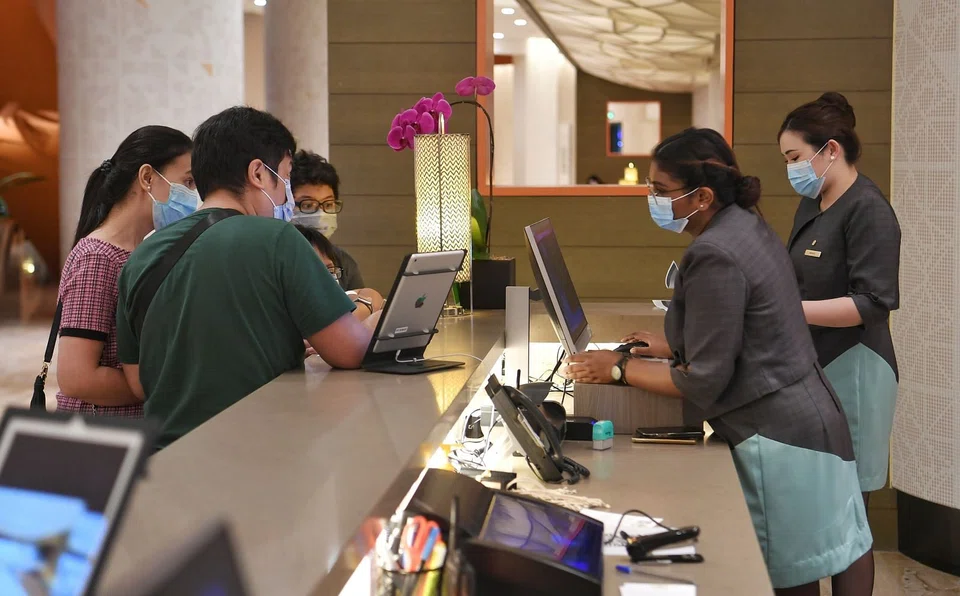
HOTEL industry room revenues fell by 20.9 per cent year on year in 2021, easing from the 70.5 per cent drop in the year before, according to the latest figures from the Singapore Tourism Board (STB).
Full-year industry revenue came in at S$979.6 million, even as festive spending pushed overall revenue per available room (RevPAR) to a year-round high in December.
Zhang Jia Hao, associate director of CBRE Hotels for Asia-Pacific, called hotel occupancies "at a considerably healthy level compared to its peers in the region".
That is as borders were mostly shut to short-term visitors for the first 3 quarters, with the quarantine-free Vaccinated Travel Lane (VTL) scheme rolled out only from Sep 2021 on, he noted.
Still, Govinda Singh, executive director at Colliers, credited VTLs with the year-on-year changes.
The full-year average RevPAR improved by 0.7 per cent year on year to S$89.02, and average room rate picked up 2.7 per cent to S$158.32. Occupancy rates averaged 56.2 per cent, against 57.4 per cent in 2020.
"The strengthening of the (average daily rate) and moderate increase in RevPAR imply that we may be seeing some light at the end of the tunnel," Singh said.
Vijay Natarajan, real estate and real estate investment trust analyst at RHB, told The Business Times that industry revenue was down on an annual basis, mainly as 2020 made for a strong base until the Covid-19 situation deteriorated worldwide.
Still, "the hospitality sector posted a decent performance, supported mainly by government contract business and push to support domestic tourism", he remarked.
Zhang tipped a stronger tourism recovery from the second half of 2022, on expectations of more VTLs and higher daily flight quotas once the spread of the contagious Omicron virus variant stabilises.
On the other hand, Wong Xian Yang, head of research at Cushman & Wakefield, warned that the recovery "will likely be gradual and potentially volatile" as visitor figures remain below pre-Covid-19 levels.
The expiry of the SingapoRediscovers Vouchers stimulus could "lead to a drop in local staycation demand, which would negatively impact hotel revenues", he added.
The latest hotel receipts came as Singapore recorded about 330,000 visitor arrivals in all of 2021, down by 88 per cent on the year before.
Mainland China was the biggest source market, at 88,230 arrivals; India overtook Indonesia for second place, at 54,380; and Indonesia retreated from pole position to third place, at 33,450.
But "Chinese visitors, a key source of tourists for Singapore, may take a while to recover as China continues to pursue a zero-Covid policy", Wong said. China has curbs on inbound and outbound travel.
Also, arrival numbers were uneven over the course of the year. More than one-quarter of travellers in 2021 showed up in December alone, as arrivals jumped to 92,780 visitors, from 41,150 in November.
Visitors from India, who made up 27,670 of the month's travellers, dominated the arrivals hall.
Hotel takings also saw a year-end surge, as December marked the strongest month for the industry since the pandemic began.
Room revenue for the month was S$127.9 million, against S$105.5 million in the month prior, as RevPAR grew to S$156.45, up from S$136.50 before. The average room rate stood at S$220.33, compared with S$175.61 in November.
Occupancy dipped to 71.0 per cent, from a peak of 77.7 per cent in November, but was still up 8.6 per cent on the year-ago period in a fourth month of year-on-year growth.
Said Singh from Colliers: "Reciprocal travel connections with Indonesia, Malaysia and India - the key source markets for Singapore - will continue to play an important role in the industry's recovery, possibly followed by China, towards the end of 2022 or in early 2023."
Hoteliers' key challenge is "the in-between period" in 2022, as government support measures taper off and international arrivals are yet to recover, added Natarajan.
The STB defines international visitors as people who spend less than a year in Singapore. It excludes returning residents and pass holders, Malaysians arriving by land, non-resident air and sea crew, and air transit passengers.