

Singapore hotels rake in highest revenue per available room since start of Covid-19 pandemic: STB data

Sharon See
SINGAPORE hotels raked in the highest revenue per available room (RevPAR) in June, the highest since the Covid-19 pandemic began. Average room rates also hit a 6-year high, data from the Singapore Tourism Board (STB) showed.
The average room rate in June was S$238.32 — the highest since September 2016. Year on year, the jump was 63.1 per cent; month on month, the growth rate was 7 per cent.
Average occupancy rates hit a 6-month high at 77 per cent, just 6 percentage points shy of the pre-pandemic rate of 83 per cent clocked in December 2019 and January 2020.
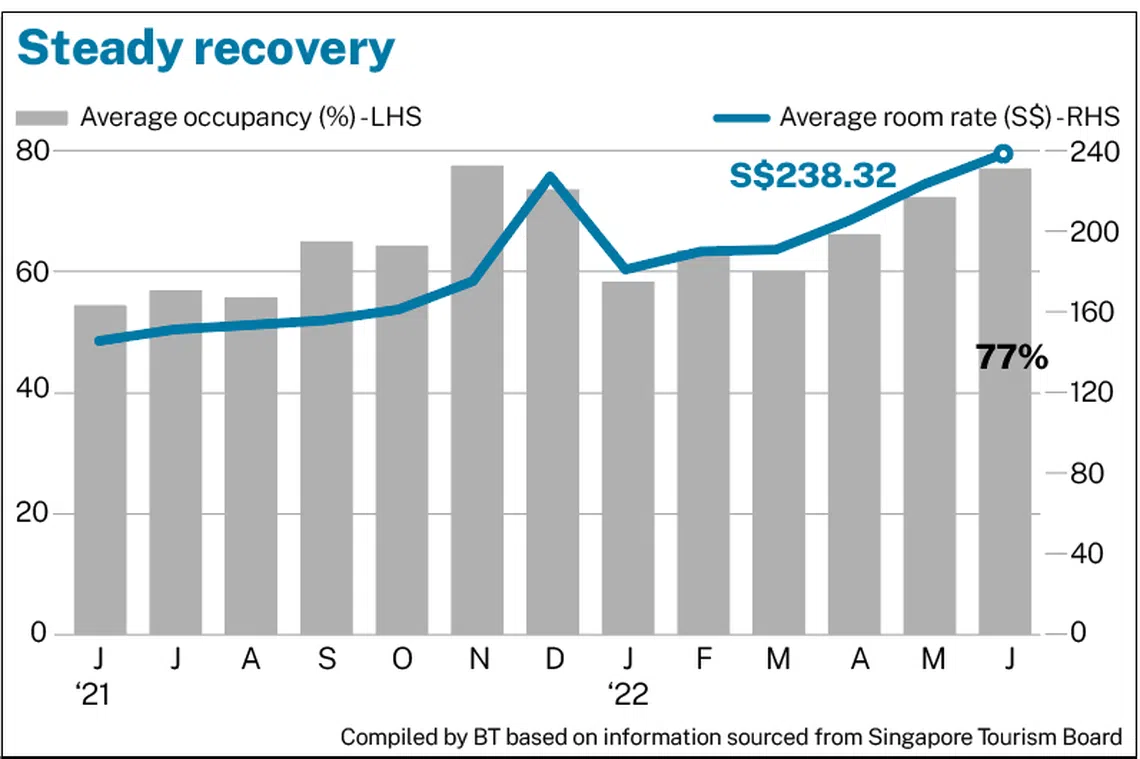
These numbers have pushed RevPAR to its highest since January 2020 — at S$183.31, a result that has surprised some market watchers.
Geraldine Wong, a property analyst from DBS, said: “Our base-case assumption assumes for RevPAR to return to pre-Covid (level) by 2024 — which looks to be conservative now, given the strong hotels data in the year to date. A more likely scenario would be by 2023.”
She told The Business Times that a similar trend of RevPAR exceeding 2019 levels was also recorded in the United States over the summer.
“The heightened RevPAR, we would think, can be associated with more room to up ADR (average daily rate) by hoteliers as leisure and corporate demand gains visibility and traction, inflation and heightened operating costs such as utilities,” she said, adding that the “dynamic nature” of hotel pricing also helped.
Govinda Singh, executive director for Asia hotel and leisure at Colliers, said hoteliers are likely using pricing to manage demand, given the current labour shortage, and to preserve service levels.
Compared to the first six months of 2021, average room rate in the first half of this year rose 40.8 per cent year on year to S$210.30. Average occupancy rate was up 17.3 per cent year on year to 67.2 per cent.
Meanwhile, RevPAR for H1 jumped nearly 90 per cent to S$141.33, compared with the same period last year.
For the first 6 months of the year, overall room revenue was S$1.07 billion, which is on par with the amount earned for the whole of 2021.
Overall room revenue for the industry hit S$292.8 million in June, more than 4 times the level recorded in the same month a year ago.
This comes as Singapore’s international visitor arrivals hit a new high of over half a million since the pandemic began in early 2020, although the figure was barely a third of the number of visitors that entered in June 2019.
Nonetheless, watchers say they are optimistic about the travel industry’s continued recovery, although they believe momentum could be slowed down in the coming months.
“We do believe that the lack of tourists from mainland China for the majority of 2022 will slow down the pace of recovery in the city state,” said Calvin Li, head of transaction advisory services for JLL Hotels & Hospitality Asia-Pacific.
“Additionally, we also believe that other source markets will still need some time to recover before reaching a more stabilised pace,” he said.
This means the sector may recover to pre-Covid-19 levels only by next year, assuming that the global economic and geopolitical situation does not worsen, he said.
Singh holds a similar view, and is expecting occupancy rates to return by the second quarter of 2023.
“Singapore will continue to benefit from open borders, tempered only by reduced airlift. However, some of this demand might slow into Q3, as schools reopen and pent-up demand driven by leisure VFR (visiting friends and relatives) plateaus,” he said.
Nonetheless, the industry’s performance could return to 80 per cent of pre-pandemic levels by year-end, he added.
Likewise, DBS’ Wong said RevPAR could moderate after peaking in June and July, but added that it is likely to climb “further north” going into end-2022.
TRENDING NOW

He built the Vingroup empire. Now South-east Asia’s richest man is handing some key roles to his sons
Despite the de-dollarisation debate, demand for dollar liquidity in Asia is growing
Can a first-time homebuyer couple earning S$18,000 a month afford a new EC unit?

Asia needs new energy security architecture

