

Singapore must not despair, but stay cohesive: Tharman
Government will redouble efforts to strengthen Singapore's social compact

Singapore
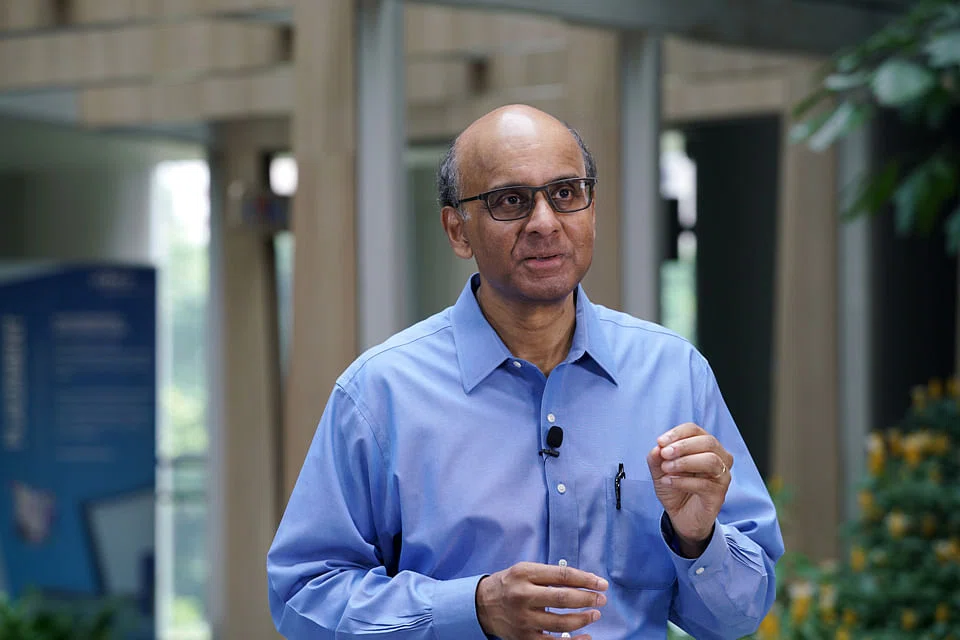
WHILE Singapore cannot escape the global economic downturn, it must absolutely defy the loss of social cohesion, polarisation and despair that are taking hold in other countries, Senior Minister Tharman Shanmugaratnam said on Wednesday.
"Never think these trends cannot take hold in Singapore. There are many societies which used to be cohesive, but are now fragmenting, both in the West and in Asia," said Mr Tharman, who is also Coordinating Minister for Social Policies. "No society remains cohesive simply because it used to be."
Instead, the economic dangers compel Singapore to fortify its society, Mr Tharman said in the fifth of a series of national broadcasts by various ministers.
He said the government will redouble efforts to strengthen Singapore's social compact.
This means giving everyone full opportunity to do well for themselves, whether through education, skills or jobs. For those who "start life at a disadvantage", he said the government will boost support for them so that social mobility can be kept alive in Singapore with inequalities lessened over time. In strengthening Singapore's culture of solidarity, he called on every individual to put in the effort to achieve their fullest potential and to also help others bounce back from setbacks so that no Singaporean is left behind.
Saving jobs is the government's first priority, and this is not just an economic issue but a social priority, Mr Tharman said.
"We will do all we can to prevent people from being out of work for long, so they can stand on their own feet and retain their sense of dignity. Good jobs are also at the heart of our whole approach to building a cohesive society and tempering inequalities," he said.
However, given the uncertainty in the global economy, unemployment is likely to "rise significantly" over the next year, if it is simply left to market forces, he pointed out.
Hence, the government is working with companies to take on Singaporeans through temporary assignments, attachments and traineeships during this down period, while waiting for permanent jobs to open up.
The National Jobs Council, which Mr Tharman chairs, is moving at full speed to secure 100,000 jobs and training places targeted by the SGUnited Jobs and Skills package. The government is heavily subsidising these opportunities, he said.
"It gives people far greater benefit when government provides support this way. No amount of unemployment allowances can compensate for the demoralisation of being out of work for long," Mr Tharman said.
He added that Singapore has faced conditions of high unemployment before, rising past 6 per cent. The first time was in the late 1960s when the British began pulling out their forces, while the second was in the mid 1980s when the country suffered a major recession.
While Singapore's economy is far more diversified and skilled today, the labour force is also much older, he said. In those times, less than 30 per cent of the labour force was 40 years or older, but the proportion has now doubled to 60 per cent.
This is why the government is making a concerted effort to help middle-aged and mature Singaporean workers and will spare no effort to help them carry on with their careers in the most productive jobs they can do, Mr Tharman said. He added that the government will give employers extra support when hiring these older Singaporeans. It will also scale up the new Mid-Career Pathways programme in the coming months.
However, he said this needs to be a national effort as employers too need to reorient their thinking and management philosophies to give such workers a fair chance to prove themselves.
At the same time, reskilling and upskilling continue to be important for the majority of Singaporeans, given that Covid-19 has accelerated digital transformation at the workplace, he said. Meanwhile, good schools are critical to social mobility too, and Mr Tharman said the government is investing a lot more into equalising opportunities when children are young.
"We must remain a society where self-effort is rewarded, and each one of us takes pride in achieving something in life. But we also need, more than we did in the earlier years, a strong spirit of selflessness and solidarity, looking out for the vulnerable, and supporting each other."
Mr Tharman said this solidarity was on display during the Covid-19 crisis, when Singaporeans came forward to support those who were most affected. Such community efforts have complemented the government's social support schemes, which are part of a broader re-orientation in Singapore's social policies that began well before Covid-19 and will outlast it, he said.
He added that the government is working systematically to provide greater support for lower and middle-income Singaporeans, and these policies will be strengthened in the coming years.
These social strategies are what will strengthen Singapore's social compact, Mr Tharman said, and these go much deeper than government policies.
"Ultimately, the greatest confidence we get in our future as Singaporeans comes from our social compact," he said.
Mr Tharman's speech came on a day Singapore reported 247 new Covid-19 cases, bringing the tally to 41,216. Five cases were in the community, of which two are Singaporeans or permanent residents, and three are work pass holders.
Singapore is set to enter phase two of its reopening on Friday, and Deputy Prime Minister and Finance Minister Heng Swee Keat will deliver the sixth and final ministerial national broadcast on Saturday.
TRENDING NOW
World’s largest offshore wind platform by Seatrium consortium on track to be completed by 2028

Is stamp collecting enjoying an analogue revival or are its best days over?

GovTech retrenches another 38 staff in second round of layoffs
MBS adjusted property Ebitda falls 20.6% in Q3 with fewer high-roller visits, weaker hold

