

Singapore PMI stays in expansion in May, though slowing from Apr on Covid-19 curbs
 Add BT as a preferred source
DeeperDive is a beta AI feature. Refer to full articles for the facts.
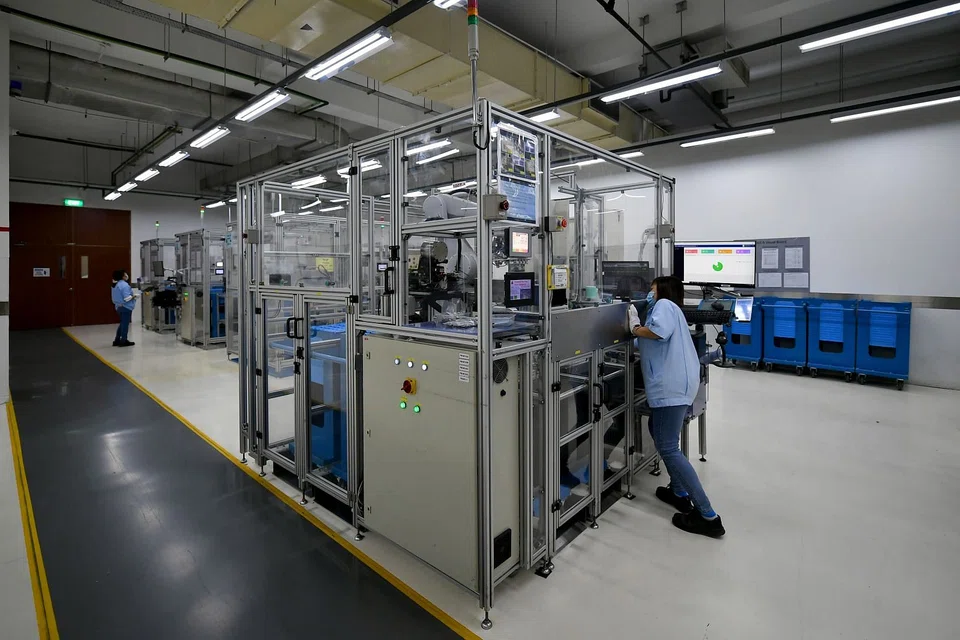
MANUFACTURING sentiment in Singapore stayed strong in May, albeit slowing slightly from April's recent high, which economists attributed to the tightening of Covid-19 restrictions.
In the latest Purchasing Managers' Index (PMI) release on Wednesday, May's PMI was 50.7, marking the 11th straight month in expansion - that is, a reading above 50. This was down from 50.9 in April, which had been the highest reading since December 2018.
The PMI for the key electronics sector was 50.4, down from 50.7 in April, but still in expansion for the 10th straight month.
The Singapore Institute of Purchasing and Materials Management (SIPMM), which compiles the index, attributed May's lower PMI reading to slower expansion rates in new orders, new exports, factory output, and employment.
Lower readings were seen for those indexes in the electronics sector too, where inventory also expanded at a slower rate.
In the overall PMI, the supplier deliveries index returned to a marginal expansion. Inventory, input prices, and order backlog all saw faster rates of expansion, with the latter having spent 11 straight months in expansion.
Navigate Asia in
a new global order
Get the insights delivered to your inbox.
The overall employment index has recorded three months of continuous expansion, "which bodes well for the manufacturing sectors", said SIPMM - though at 50.2, it was down marginally from April's 50.3 reading.
SIPMM vice-president for industry engagement and development Sophia Poh said that stricter Covid-19 measures introduced in May - under Phase 2 (Heightened Alert) - have affected the manufacturing sector, but added that the extent of this impact will depend on the duration of the tightened measures. This phase is currently expected to end after June 13.
Anecdotal evidence suggests that manufacturers are facing delivery postponements instead of order cancellations, added Ms Poh. "This could explain the faster supplier deliveries with increasing order backlog."
Announced on May 14 and in place since May 16, Phase 2 (Heightened Alert) "[HA]is likely the key driver behind the growth slowdown" as it "could have affected manufacturers' optimism in the last month" , said UOB economist Barnabas Gan.
[/HA]Nonetheless, the full-year trajectory for manufacturing "remains sound", said Mr Gan, who expects the sector to grow 5.5 per cent this year.
Barring a worsening of the Covid-19 situation here, the manufacturing sector is expected to be one of the key pillars of growth, as export-oriented industries ride the winds of global trade growth, he added.
May's reading could also have been affected by the Covid-19 resurgence and corresponding tightened measures in other Asian countries, which may have hampered flows of goods and manpower, said OCBC head of treasury research and strategy Selena Ling.
Still, she sees the current situation as "a temporary setback rather than a deal-breaker". Although the strong performance in the second half of 2020 means that base effects will turn less favourable later this year - "and manufacturing growth could peter out and possibly flat-line" - she still expects full-year manufacturing growth to come in at 6 per cent.
In the electronics sector, supplier deliveries, stocks of finished goods, input prices, and order backlog all saw faster expansion rates in May, with the latter in expansion for the 11th straight month. The electronics employment index remained in expansion for the seventh straight month, though easing marginally from April.
Singapore's May figure forms part of a broad regional picture of sustained growth. In Asean, Indonesia led the way with a record high PMI of 55.3 in May, while Vietnam and Malaysia saw continued though slower expansion.
But the Philippines' PMI slipped into marginal contraction at 49.9, while Thailand's fell to a three-month low of 47.8.
In the wider region, the Caixin China general manufacturing PMI edged up to 52. Japan, South Korea, and Taiwan all saw lower but still-expansionary readings.
Decoding Asia newsletter: your guide to navigating Asia in a new global order. Sign up here to get Decoding Asia newsletter. Delivered to your inbox. Free.
Copyright SPH Media. All rights reserved.
TRENDING NOW

Autobahn Rent A Car directors declared bankrupt over S$50 million each owed to DBS

Amazon’s MGM Studios gains creative control over ‘James Bond’ franchise

UOB’s Wee Ee Cheong says S$4.9 billion Citi deal ‘paying off’ as Asean push accelerates
In taxing wealth, how far can Singapore push property owners?

