

Singapore tests 200,000 'higher-risk' individuals every two weeks for Covid-19: Gan Kim Yong
 Add BT as a preferred source
DeeperDive is a beta AI feature. Refer to full articles for the facts.
Singapore
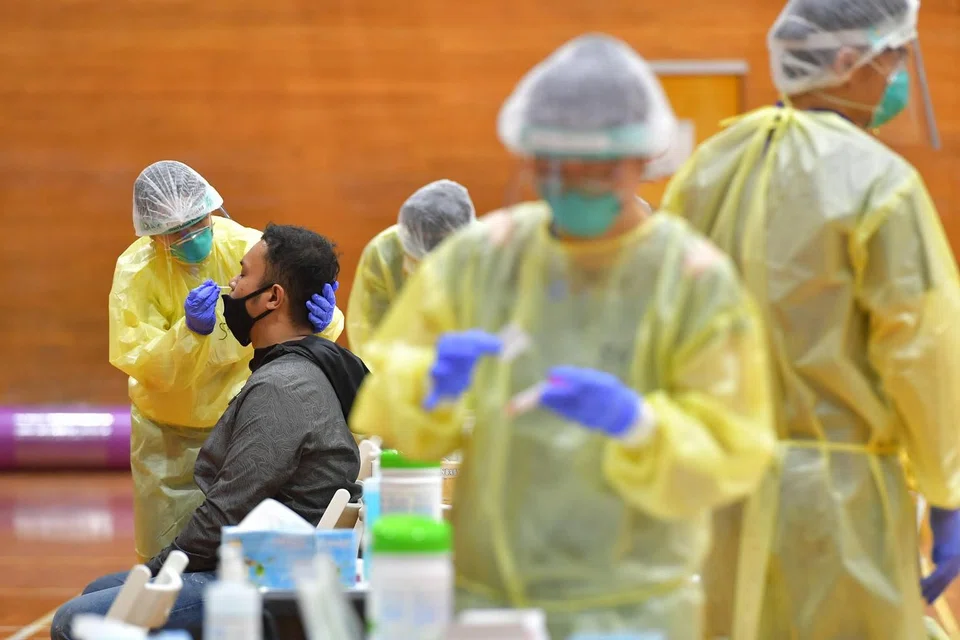
OVER 200,000 individuals who are deemed to have higher risk of exposure to Covid-19 are tested every two weeks for the novel coronavirus as part of Singapore's surveillance testing, Health Minister Gan Kim Yong said on Friday. This includes migrant workers who live in dormitories, workers who returned to work in the construction, marine and process sectors and workers supporting Singapore's frontline Covid-19 operations, Mr Gan said in a written reply to parliamentary questions on Covid-19 testing filed by Aljunied GRC MPs Gerald Giam and Leon Perera.
In the last two-week cycle, about 200 such individuals tested positive for Covid-19, he said, with the majority of these cases "likely to be past infections".
At the same time, about 76 per cent of patients aged 13 and older diagnosed with acute respiratory infection at polyclinics and Public Health Preparedness Clinics were tested between July 1 and Aug 16, the minister said. "Of these, a small percentage - 0.03 per cent - tested positive, indicating that the community prevalence of Covid-19 is low," Mr Gan added.
As Singapore reopens its economy, the Ministry of Health (MOH) will be expanding testing to more community groups. For a start, this includes taxi and private hire car drivers, food delivery personnel, key vendors servicing worker dormitories and stallholders at selected hawker centres, markets and coffee shops, he said. "While there has been no local evidence that these community groups are of higher risks of getting infected, MOH will be offering tests to them as part of our expanded testing and surveillance efforts given the nature of their working environment, such as the high frequency of interactions with members of public," he noted. "These one-time testing operations will help to provide a better picture of population prevalence."
According to Mr Gan, the majority of linked cases are detected through active case finding around confirmed cases.
Navigate Asia in
a new global order
Get the insights delivered to your inbox.
Meanwhile, MOH also conducts "special operations" to test selected groups of individuals where there is a higher risk of transmission of Covid-19, he said.
In answer to questions from West Coast GRC MP Ang Wei Neng and Bukit Batok MP Murali Pillai on the ministry's vaccine plans, Mr Gan said: "Our vaccination approach aims to protect individuals who are more vulnerable or at higher risk from the disease, as well as those who may be more likely exposed to infection, while progressively expanding the coverage of vaccination to our population." He added that the vaccination strategy and schedule would depend on several factors.
Mr Gan noted that Singapore is actively engaged in international discussions to accelerate development and promote fair and equitable access to Covid-19 vaccines, beyond discussion with multiple pharmaceutical companies developing the vaccines. In particular, Singapore has been working closely with the World Health Organisation, Gavi, the Vaccine Alliance, the Coalition for Epidemic Preparedness Innovations (CEPI) and like-minded countries to establish a multilateral collaboration called the Covid-19 Vaccine Global Access (Covax) Facility. This will enable countries to pool risk and resources to gain access to a portfolio of vaccines from different vaccine developers, he said.
At the same time, the government is supporting local efforts to develop a Covid-19 vaccine, he added. This includes Duke-NUS Medical School's collaboration with US biotechnology firm Arcturus Therapeutics to develop an mRNA vaccine.
Decoding Asia newsletter: your guide to navigating Asia in a new global order. Sign up here to get Decoding Asia newsletter. Delivered to your inbox. Free.
Copyright SPH Media. All rights reserved.
TRENDING NOW

Shelving S$5 billion office redevelopment plan proved ‘wise’ as geopolitical risks mount: OCBC chairman

Eurokars Group introduces rental car franchises Enterprise Rent-A-Car, National Car Rental, and Alamo to Singapore
20 photos that show how dramatically Singapore has changed in two decades
Singapore’s key exports up 15.3% in March from electronics surge, exceeding forecasts

