

Singapore to ease Covid-19 curbs from June 14 in two steps

Singapore
SINGAPORE will exit Phase 2 (Heightened Alert) as planned after this Sunday, but in a two-step approach, with some activities such as dining-in only allowed from June 21 instead, and work-from-home staying the default.
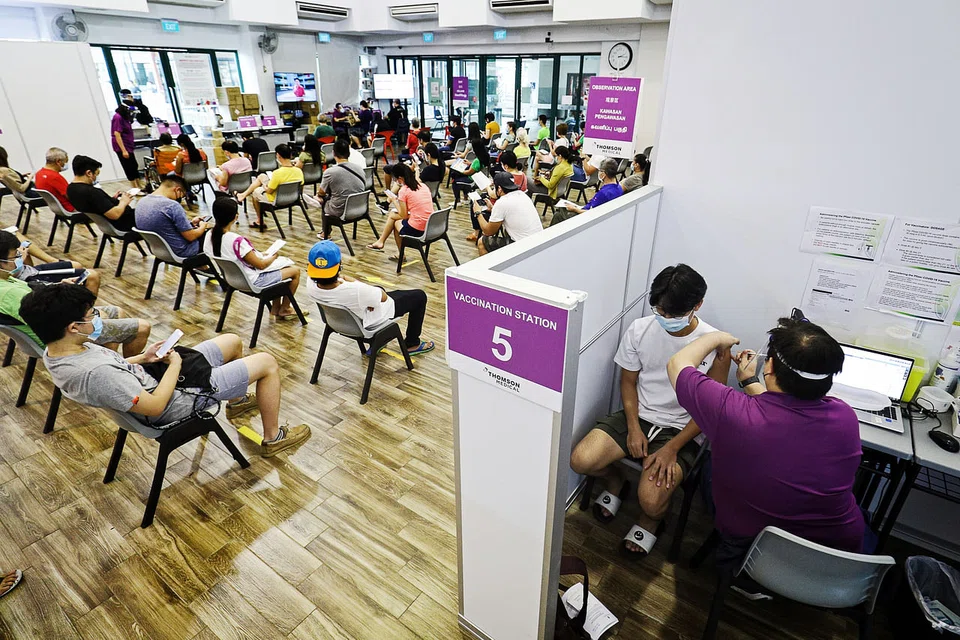
Meanwhile, vaccination - a key enabler of further re-opening - will be extended to citizens aged 12 to 39, who can reserve and book appointments from June 11.
From June 14, in the first step of moving to Phase 3 (Heightened Alert), social gatherings of up to five will be allowed and households may have up to five visitors a day.
Attractions, cruises, museums, and public libraries may operate at 50 per cent of capacity, while various types of events may have up to 250 attendees with pre-event testing.
Personal care and appearance services which require masks to be removed, such as facials and saunas, will also be allowed to resume.
But activities assessed as higher-risk may only resume from June 21, assuming the situation stays under control, the multi-ministry taskforce on Covid-19 said at a press conference on Thursday.
These include dining in, wedding receptions, and indoor mask-off activities in gyms and fitness studios. Jobs Support Scheme aid will be extended for affected sectors till June 20.
The delay is so that one full incubation cycle of 14 days can pass from June 6, when low daily cases began, giving assurance that most of "the embers of the virus... have been put out", said Health Minister Ong Ye Kung.
The two-step move does not include changes for workplaces, with work-from-home staying the default for now.
With greater capabilities today - in contact tracing, ring-fencing, testing, and localised lockdowns - "we really hope we have put 'circuit breaker' as a response behind us", said Mr Ong.
In future outbreaks, these targeted methods can be used instead of a blanket approach such as last year's "circuit breaker", he added.
"With increased activity levels, as we reopen and resume more activities, we must be prepared to see more cases," warned Finance Minister Lawrence Wong.
As hidden cases remain, Singapore must "learn to live with the virus, and then try our best to minimise transmission and minimise the risk of large clusters breaking out".
Phase 3 (Heightened Alert) differs from the previous Phase 3 situation as controls remain, including at the borders, said Mr Wong. "We need all of these controls in place until our vaccination rates are higher."
He also noted that entry curbs for migrant workers or foreign domestic workers remain, and the government may only reconsider this after the local situation has been stable for a while.
In a press release, the Ministry of Health said: "Further relaxations such as for group and event sizes, capacity limits, distancing requirements, mask-wearing and travel will be introduced when a sufficient proportion of the population has been fully vaccinated, especially for those who are vaccinated."
Responding to a question about travel bubbles, Trade and Industry Minister Gan Kim Yong said: "Once we have a very high vaccination rate, then it opens up a lot more possibilities and offers us greater flexibility, even in international travelling."
Half the population is expected to be fully vaccinated by August, rising to 75 per cent or higher by October.
As of June 9, Singapore has administered more than 4.4 million doses of the vaccine. About 2.5 million people have had a first dose, of whom 1.9 million have also received the second.
From June 11, apart from citizens aged 12 to 39, vaccination will also be made available to persons who have previously recovered from Covid-19.
They will be eligible to receive a single dose to boost their immunity. Priority will be given to those who were infected over six months ago, as the immune response tends to fade after six months.
With testing as another major prong of Singapore's approach, there will be mandatory "fast and easy testing" for all staff in settings with unmasked patrons, including dine-in food and beverage (F&B) outlets, personal care services requiring mask removal, and gyms.
The government will subsidise the first three months of this mandatory testing regime, with details to come.
From June 16, antigen rapid test kits will also be available at retail pharmacies for the public to self-test.
For the longer term, Singapore is developing its strategy for living with Covid-19 on a permanent basis, said Mr Wong.
With vaccination meaning mild or asymptomatic cases, and the prospect of better medical treatments, the focus may no longer be daily case numbers, he added.
TRENDING NOW
Stocks to watch: CapitaLand Ascott Trust, Keppel Infrastructure Trust, iFast, ESR Reit, First Sponsor
Indonesia says gas export cuts to Singapore remain within contract terms
If Europe goes to war, the fallout will be felt in East Asia
Government to bring forward raising of retirement age, give employers more financial support to create flexi-load jobs

