Singapore works to bring back foreign workers, but won't scrap manpower-lean goal
Manpower Minister Tan See Leng urges firms to transform and to pare manpower reliance

SINGAPORE is likely to see more foreign workers in the next few years, as the authorities tackle a labour crunch in the construction, marine shipyard and process (CMP) sectors amid Covid-19 border closures.
But the recruitment and retention of these work permit holders are not expected to detract from the longer-term goal of a more manpower-lean workforce in these sectors.
That's even as Minister for Manpower Tan See Leng on Friday unveiled temporary measures, such as a waiver of some employment conditions, to support employers.
With the number of work permit holders in the CMP sectors falling to 311,000 as at end-2020 - down from 370,100 the year before - Dr Tan said that "we would be looking to replace a portion" of the net outflow at least.
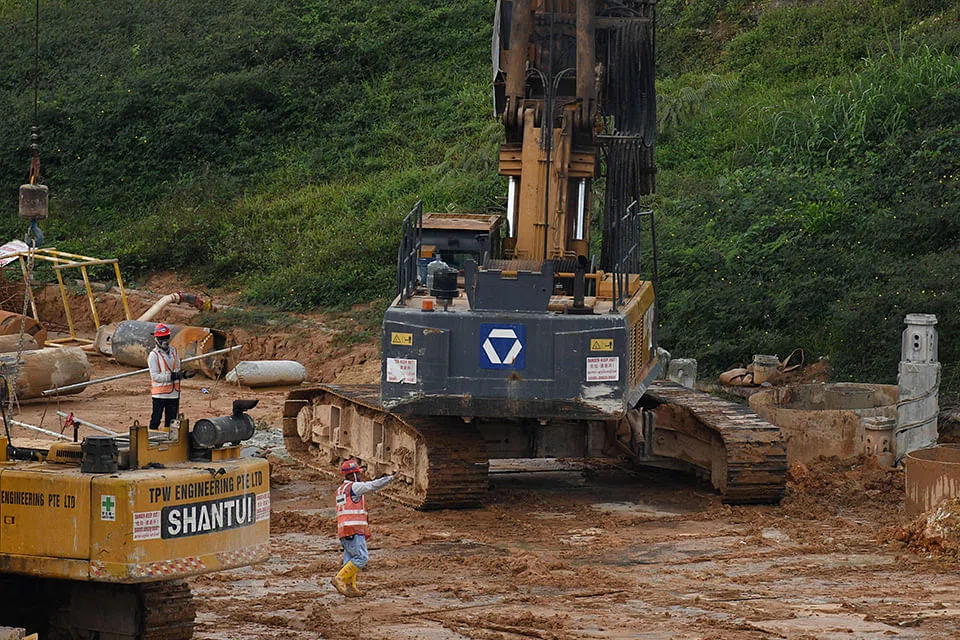
He said that he "cannot possibly commit to a particular number" for the work permit workforce, but cited projects such as Build-to-Order flats, the Deep Tunnel Sewerage System and Mass Rapid Transit lines, where "we will still need quite a significant number of migrant workers to come in and help to build many of these long-term infrastructure developments".
He warned that "many of these measures that we are doing are not meant to be long-term".
Instead, he urged businesses to transform and to pare manpower reliance, "through tapping technology and redesigning the jobs to attract more locals".
Given the heightened need for manpower, even the return of some departed foreign workers "would not derail the automation plan", Terence Ho, associate professor in practice at the Lee Kuan Yew School of Public Policy, told The Business Times.
He said: "It's clear that we have a shortfall now, and even with the best automation and productivity plans, we would not be able to replace the workers in the near term."
Labour economist Walter Theseira, an associate professor of economics at the Singapore University of Social Science, also noted that companies in sectors such as construction had already committed to contracts signed before the pandemic.
Since they would reasonably expect a pre-pandemic supply of labour, "the transition path for these industries can only take shape when new contracts or business arrangements are signed with the expectation of using more manpower-lean processes", Prof Theseira told BT.
Mr Ho, who used to be director of planning and policy at the Ministry of Manpower, said that "I'm not entirely sure we can avoid a short-term bump" in the number of work permit holders to meet the high demand for workers.
After all, while the government has worked to reduce manpower reliance in the CMP sectors over the years, such efforts "do take some time", Dr Tan said. "At the same time, the CMP sectors continue to face significant manpower shortages as a result of tighter border restrictions."
The result, as introduced on Friday, is "a package of measures to help these sectors retain their existing work permit holders, as well as facilitate new ones to enter Singapore".
For example, CMP workers whose work permits expire between July and December 2021 can renew their permits for up to two years, even if they do not meet the renewal criteria such as the caps on employment period or employment age.
Companies in the construction and process sectors have also been excused from a minimum work experience requirement for hiring work permit holders from certain countries, from Oct 1, 2021 to March 31, 2022.
Experienced construction workers whose work permits have been terminated have a 30-day window to find new jobs - rather than being immediately repatriated - with the help of the Singapore Contractors Association Ltd trade group.
Despite "the backlog, market supply and demand forces, and health and mobility constraints", Mr Ho said policymakers' intent is still to bring down the number of work permit holders, in line with more automation and workforce localisation.
Prof Theseira added: "It's only manpower reductions and cost increases that provide the push to sign new contracts that reduce dependence on manpower."
As such, he called for commitment to a "credible" transition path, with lower foreign worker quotas, greater support for technology, and skills upgrading for locals.
Looking to the long term, Dr Tan told reporters: "There is always growth after a crisis, after a significant pullback. What we want to do is also be able to help the entire industry to right-size and optimise the workforce that is required to capture, harness and harvest the growth."
READ MORE