Singapore’s new talent attraction initiatives could include special visas, relocation grants: observers


Sharon See &
Tessa Oh

SPECIAL visas or work passes for top foreign talent, and government support for multinationals looking to bring them in, are some possible forms which Singapore’s upcoming talent-attraction initiatives could take, industry watchers said.
For instance, Singapore could roll out visas specific to a particular sector, demographic or even lifestyle – such as the hotly-discussed “digital nomad visa”, watchers told The Business Times.
Prime Minister Lee Hsien Loong said in his National Day Rally speech on Sunday (Aug 21) that the government will soon announce new initiatives to attract top talent as part of efforts to build a world-class talent pool.
Singapore already has several work pass categories or visas targeting top talent, such as the Personalised Employment Pass (PEP) for high-earning foreign professionals, the EntrePass for serial entrepreneurs and the Tech.Pass for established tech leaders. But PM Lee stressed that more needs to be done, especially in sectors with “good potential”.
Singapore Business Federation chief Lam Yi Young said attracting top talent is an area in which its members have been giving “consistent feedback”, adding: “Foreign talent can help us bridge critical skills gaps in new and emerging areas, like digital technology, advanced manufacturing and cutting-edge research.”
Industry watchers told BT that visas for specific demographics or sectors could be in the works, given that a growing number of countries have begun offering these.
For instance, Estonia and Iceland have “digital nomad” visas catered to those who rely on technology to work remotely while they lead a “nomadic lifestyle” outside their home countries. Having a specific visa for such individuals allows them to work legally when they are travelling, which they cannot do on a tourist visa.
“Governments are actively relooking the way they attract talent, and new archetypes of visa policies are emerging to attract talent and capital,” said Lee Junxian, co-founder and chief executive of relocation specialist Moovaz.
Singapore could also introduce visas for specific demographics, similar to the High Potential Individual visa that the United Kingdom recently rolled out for recent graduates of top 50 universities outside the country – which PM Lee cited in his speech.
This would be if the government wishes to attract “young, fresh or ‘unproven’ talent”, said Gedeon Lim, a Singaporean economist from the University of Hong Kong. But he added: “If they are looking mainly for established, top 1 percentile innovators, bankers, thought leaders in their respective fields, we already have a scheme in place, so it seems difficult to think of what else the government might be able to do, short of lowering the threshold and increasing the quota for these existing visa schemes.”
Singapore National Employers Federation executive director Sim Gim Guan, however, noted the limitations of current schemes. The PEP is not tied to a specific employer and allows holders to take jobs in any sector, but is more “transitional” as it cannot be renewed. Meanwhile, the EntrePass and Tech.Pass “may be too specific in purpose to cover all types of talent that we may need in Singapore”.
“We may need a scheme which would attract masters in their respective fields to be in Singapore to contribute to the growth of an industry and development of the local workforce,” said Sim. Manufacturing industries such as electronics and precision engineering could benefit from such a scheme as the sector is undergoing transformation, he added.
Currently, Singapore’s only sector-specific visa is the Tech.Pass, introduced in 2020 for up to 500 proven founders, leaders and experts from top tech companies.
Other industries with an urgent need for talent attraction initiatives include financial services, business-to-business services and healthcare, said Martijn Schouten, people and organisation leader at PwC South-east Asia Consulting.
“There are also skill sets which are in deficit that cut across industries, for instance ESG (environmental, social and governance), cyber, data and analytics and broader tech and AI (artificial intelligence) skills,” he added.
In that sense, it may be useful for the government to take a skills-based approach in collaboration with industry associations, instead of relying only on salary and qualification benchmarking, said Wong Wai Meng, chair of tech association SGTech.
However, Asst Prof Lim questioned the feasibility of a sector-specific visa for top talent: “In a knowledge economy, most skills would be transferable, something quite different from when we look at work permits where there is a clear justification for sectoral quotas – sectors in which Singaporeans do not want to work in or for which they lack the skills.”
Goh Jia Yong, people advisory services partner at Ernst & Young, said broad-based talent attraction programmes can be complemented by sector-based schemes to cater for each industry’s specialised needs, particularly green economy skills for the resources and utilities, built environment, mobility and food manufacturing sectors.
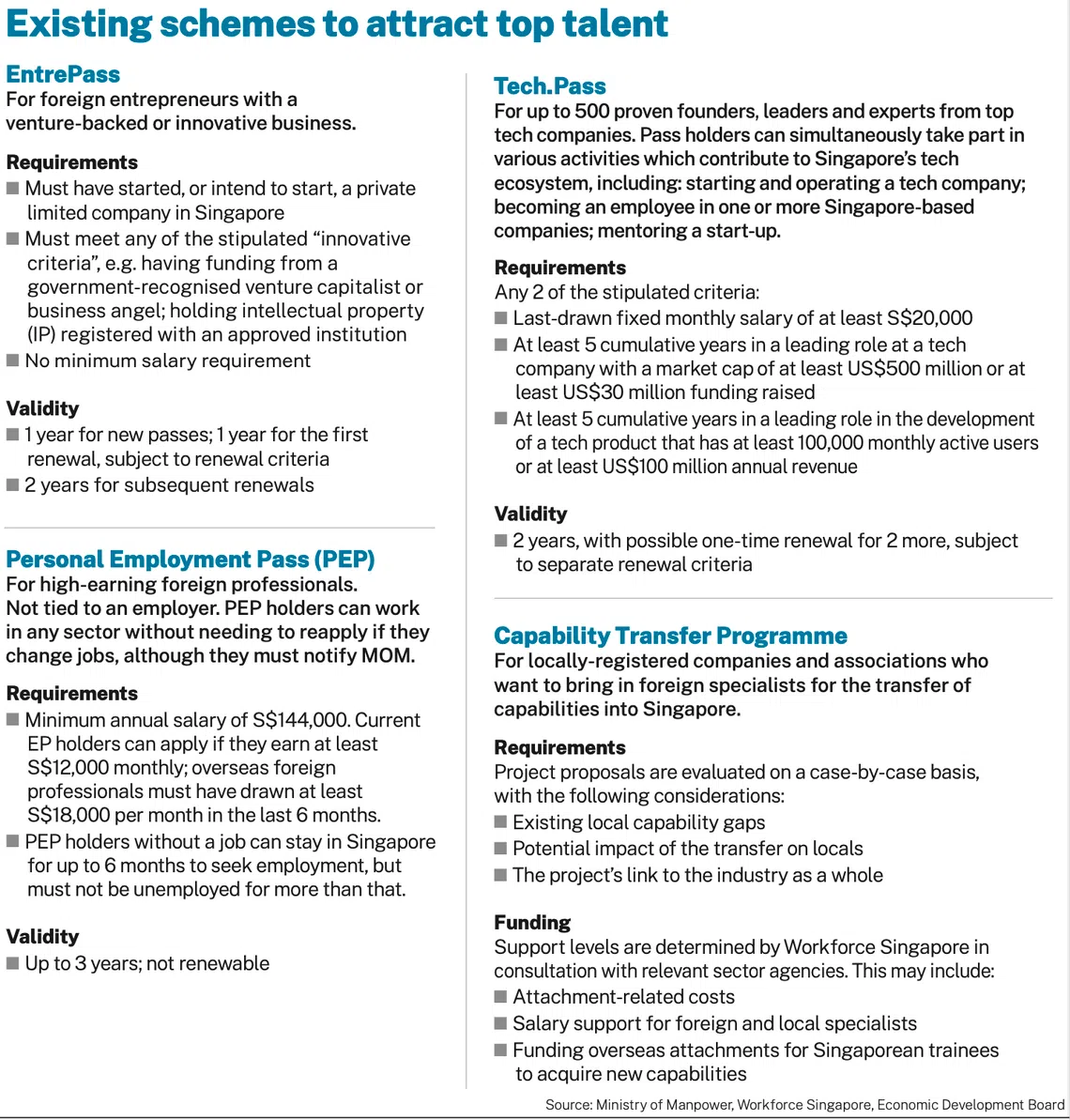
Beyond visas, the government could consider grants and subsidies to encourage companies to attract and relocate skilled workers, or incentivise multinationals to base their Singaporean headcount in the Republic, said Moovaz’s Lee.
Singapore can also address other concerns that top talent may have. Victor Mills, chief executive of the Singapore International Chamber of Commerce, said: “The majority of executive relocation decisions in today’s world put a lot of weight on whether or not the partner or spouse will be able to work too.”
He noted that Dependent Pass holders used to be able to work with a Letter of Consent, but this was phased out in May last year. To make the relocation decision easy for top talent, he suggested the automatic approval of part-time work for all Employment Pass holders’ partners and spouses: “This will allow them to integrate and will give businesses and organisations access to more talent and skills.”
Rahul Chawla, head of human capital solutions at Aon South-east Asia, said diversity, equity and inclusion policies – such as maternity, paternity and family care benefits – are another “key broad-based value proposition” to attract and retain talent.
“The government could also explore access to social security and investment avenues to attract mobile top talent globally – and this would require considering several variables across stakeholder groups and would be a fine balancing act,” he added.